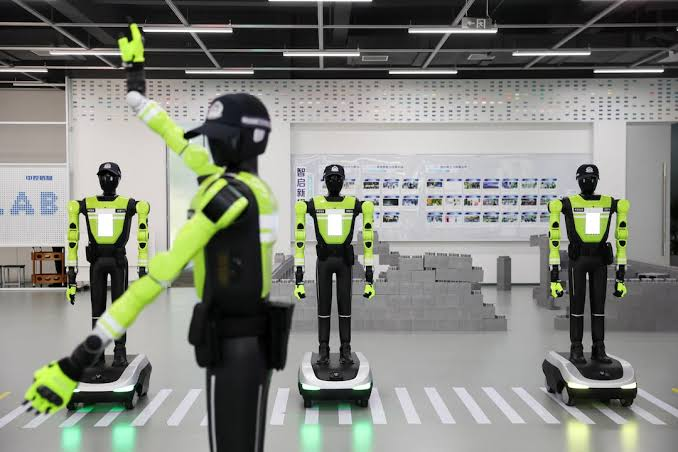
Hangzhou (GNP): A fleet of humanoid robots has begun patrolling intersections in Hangzhou, marking one of the clearest signs yet of China’s push to move automation from demonstration settings into everyday public roles.
Standing 1.88 meters tall and weighing 98 kilograms, the T2 robot, developed by SUPCON Information, has been active on city streets since May, using cameras, radar, and onboard computing to detect helmetless e-bike riders, vehicles crossing stop lines, and pedestrians ignoring traffic signals.
Fifteen T2 units have operated in Hangzhou since their deployment began, issuing more than 170,000 warnings to date. According to SUPCON, monthly violations involving helmetless riding and stop-line crossings have dropped by more than 40 percent since the robots entered service, although these figures have not been independently verified, as Hangzhou’s traffic police did not respond to requests for comment.
Even without outside confirmation, the reported results have drawn attention from authorities elsewhere in the country, with nearly 50 robots now operating across roughly eight cities in three provinces, and deployments expected to approach 200 units by the end of the year.
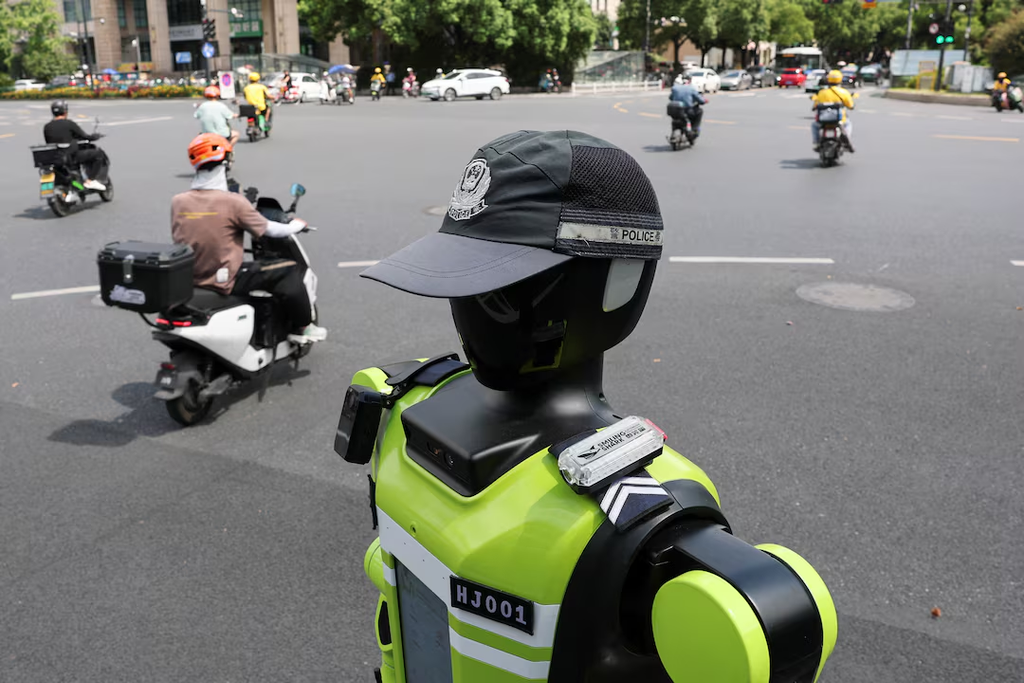
The T2’s capabilities extend beyond simple detection. Its sensor system allows it to identify multiple violation types at once, including unhelmeted riders, e-bikes carrying unauthorized passengers, vehicles stopping over marked lines, and pedestrians crossing against signals.
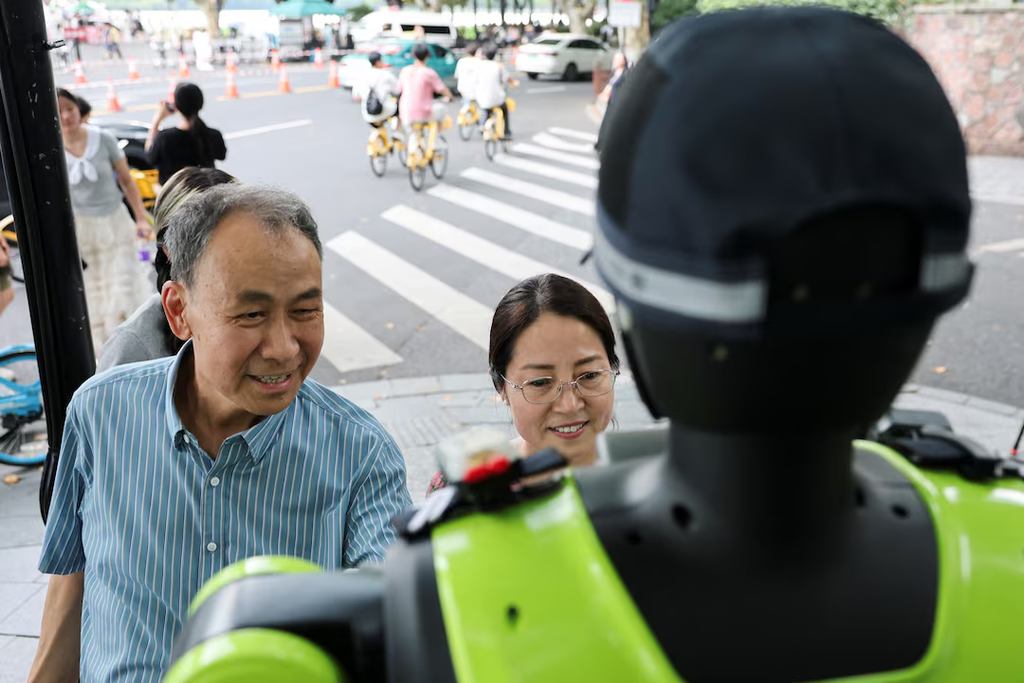
The robot’s seven-jointed arms replicate standard traffic police hand gestures in sync with signal timing, while its height makes it easy for commuters to spot from a distance. Beyond enforcement, the robot can answer questions about directions, parking, and traffic rules, and includes an emergency function that connects users directly to local police.
Cao Hui, who leads SUPCON’s intelligent unmanned systems innovation center, said the robots reflect a broader shift in enforcement philosophy, aiming to intervene before violations become habitual rather than punishing them after the fact. The robots operate autonomously between 7 a.m. and 6 p.m., moving between preset positions without remote control, while a central platform allows human traffic police teams to monitor and dispatch them as needed.
Cao noted that unlike human officers, the robots do not tire and can operate steadily over long periods. SUPCON says the units have been tested for thousands of hours across tourist areas, school zones, business districts, and rush-hour traffic, maintaining violation-recognition accuracy above 95 percent, though extreme weather conditions can still affect camera and radar performance.
The rollout in Hangzhou builds on earlier trials, including a single robot tested in the city’s Binjiang district in December before a full squad of 15 units was deployed around the West Lake scenic area during the May Day holiday, where they assisted human officers with crowd guidance and tourist navigation. Similar squads were introduced simultaneously in Kashgar and Ordos, reflecting a coordinated national effort behind the technology’s expansion.
Beyond domestic use, Chinese manufacturers are eyeing export opportunities, particularly in regions where traffic officers work under difficult conditions. Chery-backed robotics firm AiMOGA has pointed to high temperatures in the Middle East and extended rainy seasons in Southeast Asia as potential markets.
However, AiMOGA executive Zhang Guibing said international sales face significant hurdles, since police robots must be adapted to local law enforcement IT systems, obtain proper certifications, and comply with regional data protection rules, an especially sensitive issue given that the machines are equipped with cameras and other sensors.
Those privacy concerns are not unique to China. Similar debates over automated policing have intensified in Europe and the United Kingdom, where civil liberties groups have raised concerns that routine biometric monitoring risks normalizing mass surveillance in public spaces.
Also Read: 29 States Take Meta to Trial Over Child Safety
Trade barriers present a further obstacle, as the United States Federal Communications Commission has banned future imports of foreign-made humanoid and quadruped robots on national security grounds, a rule broad enough to potentially affect a wide range of robotic devices. For Chinese manufacturers, this closes off a major market just as domestic deployments are beginning to generate the operational data needed to support export efforts elsewhere.
State projections estimate the broader embodied intelligence market could surpass one trillion yuan by 2035, underscoring the scale of the bet being placed on this technology. For now, China’s traffic robots remain a domestic phenomenon, steadily expanding their presence on city streets as authorities test how far machine-based governance can extend into daily urban life.