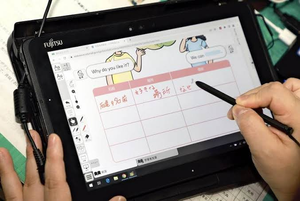
NEW YORK (GNP): Artificial intelligence is no longer on the horizon; it has become a fixture of everyday life, and its influence on childhood worldwide is already being felt in both positive and troubling ways.
Fresh evidence is revealing just how quickly and widely children are taking up AI tools, while also highlighting the serious risks and inequalities that are developing alongside this trend.
Drawing on new data gathered across 10 countries, UNICEF estimates that at least 20 million children have already used AI in some form, and many of them are picking it up at a pace more than three times that of adults. Over 2 million children, roughly one in ten, said they turn to AI when they have worries or need advice, and an estimated 13 million reported using it as a study or homework aid.
Yet as children’s engagement with AI grows rapidly, the rules and safeguards meant to govern its use, including those designed to protect young users, are falling behind. Children tend to be more deeply exposed to AI systems, including the way they are built, the business interests driving them, and how their personal data gets used. At the same time, they have far less ability to question or opt out of these systems. They are the first to bear the consequences of poor governance, and they will carry those consequences the longest. Despite this, children are rarely made a priority in AI policy discussions.
While AI clearly offers potential benefits for learning, creativity, and play, the research on how it affects cognitive growth, emotional reliance, and vulnerability to harm is still in its early stages. In practical terms, an entire generation is being raised inside a large-scale experiment with no guaranteed outcomes.
Children themselves are aware of the dangers. In the surveyed countries, roughly a third of children said they were worried about AI being used to deceive or manipulate people, or to spread false information. A quarter expressed fears about their images or videos being altered into sexually explicit deepfake content. Far too many AI products are reaching children with little to no protection built in — safety appearing to be an afterthought rather than a design priority.
Also Read: Mbappé, Messi, Ronaldo Rewrite FIFA World Cup Record Books
With the first Global Dialogue on AI Governance approaching, UNICEF is urging governments, businesses, and international partners to put children’s rights, particularly the right to safety and protection, at the center of AI governance efforts. Specific calls to action include:
- Funding research into how AI affects children’s development and well-being, with particular attention to risks.
- Strengthening laws, regulatory frameworks, and corporate responsibility measures to prevent AI-enabled sexual exploitation and abuse of children.
- Designing AI systems with the highest possible standards of safety and transparency, so children can be protected while also accessing the benefits.
- Promoting AI literacy and providing practical support for children, parents, and caregivers to navigate the digital world confidently.
- Investing in digital infrastructure and reliable connectivity for all children and families, both at home and at school, to bridge the growing AI gap between and within countries.
The decisions being made about AI today will define children’s safety, privacy, well-being, and access to opportunity for generations to come. This moment calls for action.

Sohail Majeed is a Special Correspondent at The Diplomatic Insight. He has twelve plus years of experience in journalism & reporting. He covers International Affairs, Diplomacy, UN, Sports, Climate Change, Economy, Technology, and Health.