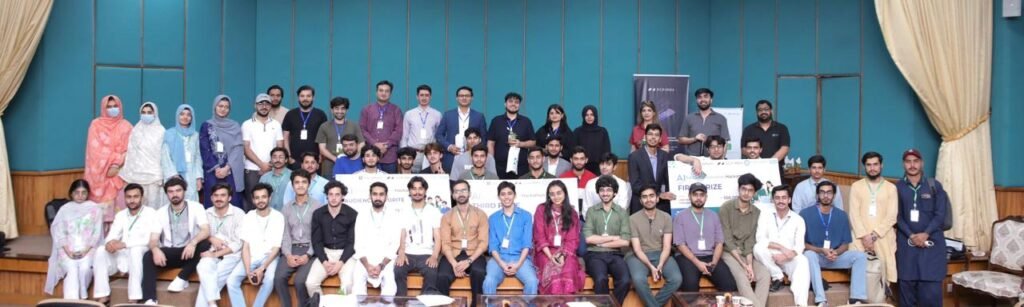
Islamabad (GNP): Code for Pakistan, working alongside Grey Software, Scrimba, and the National University of Computer and Emerging Sciences (FAST-NUCES Islamabad), held the AI for Civic Innovation Hackathon 2026 at the FAST-NUCES campus in Islamabad, drawing developers, students, and civic-minded problem-solvers from across the country to build AI-driven solutions for real-world public challenges.
The event drew over 160 registrations nationally, reflecting growing enthusiasm for applying artificial intelligence to public-sector and community problems. After a competitive shortlisting process, 30 teams made it to the final, where they designed and built AI-powered tools targeting improvements in public services, citizen engagement, accessibility, transparency, and community welfare.
Beyond the competition itself, participants had the chance to work alongside industry experts, mentors, and civic innovation practitioners — an experience that brought into focus how much practical ground AI can cover when pointed at everyday governance and community challenges.
A total prize pool of PKR 250,000 was distributed across the winning teams. The top team took home PKR 100,000, second place received PKR 75,000, third place earned PKR 50,000, and an Audience Favourite award of PKR 25,000 rounded out the prizes. All members of the winning teams also received a one-year subscription to Scrimba’s AI Learning Platform to support their ongoing development in AI and software engineering.
First place went to Sach Batao, built by Muhammad Anas Tahir, Muhammad Obaidullah, Ali Ateeb, and Ali Zulfiqar. The tool is an AI-powered fact-checking platform that lets users forward suspicious text messages or voice notes via WhatsApp and get an instant Urdu-language verdict on whether the content is a scam, misinformation, or fraud.
Second place was claimed by Haris Ahmad Khan’s Haq Itilla, KP Information Commons Companion, an AI-based guide that helps citizens find and navigate public information and Right to Information resources more easily.
Third place went to Awaz Data, developed by Junaid Ahmad and Muhammad Uzair, a project focused on building the data infrastructure needed for AI systems to understand Pakistan’s languages by allowing citizens to contribute text, audio, and documents that can make AI more inclusive for millions of native speakers.
The Audience Favourite Award went to RedLockX, created by Abdullah, Haseeb Ihsan, Muhammad Uzair, and Shaheer Ahmad, a cybersecurity tool that uses AI to detect and block prompt injection and jailbreak attacks, making AI applications more robust and secure.
Code for Pakistan Founder and Executive Director Sheba Najmi said the hackathon was a demonstration of what Pakistan’s young innovators are capable of when they turn their technical skills toward civic problems, and described the creativity and commitment on display as genuinely inspiring. She said the organization believes technology should serve citizens and build stronger communities, and expressed pride in the partnerships that helped translate promising ideas into real impact.
Sheba Najmi, Founder and Executive Director of Code for Pakistan, said the hackathon demonstrates the potential of Pakistan’s young innovators to use emerging technologies for public good. She added that technology should empower citizens and strengthen communities, and expressed pride in working with partners to turn innovative ideas into meaningful impact.
Also Read: NASA Celebrates Delivery of Roman Space Telescope to KSC
Dr. Waseem Shahzad, Campus Director at FAST-NUCES Islamabad, highlighted the importance of industry-academia collaboration in preparing future technology leaders. He described the hackathon as an excellent platform for young talent to develop solutions to real-world challenges and praised the partnership with Code for Pakistan, Grey Software, and Scrimba.
Arsala Khan, representing Scrimba and Grey Software, emphasised the value of experiential learning, noting that hackathons give students exposure to real-world problem-solving that academic settings alone cannot replicate.
The Audience Favourite Award went to RedLockX, an AI-powered cybersecurity solution focused on detecting and preventing prompt injection and jailbreak attacks. The project was developed by Abdullah, Haseeb Ihsan, Muhammad Uzair, and Shaheer Ahmad.

Sohail Majeed is a Special Correspondent at The Diplomatic Insight. He has twelve plus years of experience in journalism & reporting. He covers International Affairs, Diplomacy, UN, Sports, Climate Change, Economy, Technology, and Health.