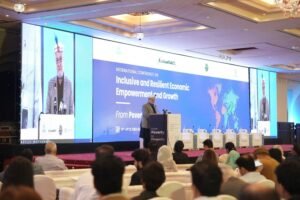
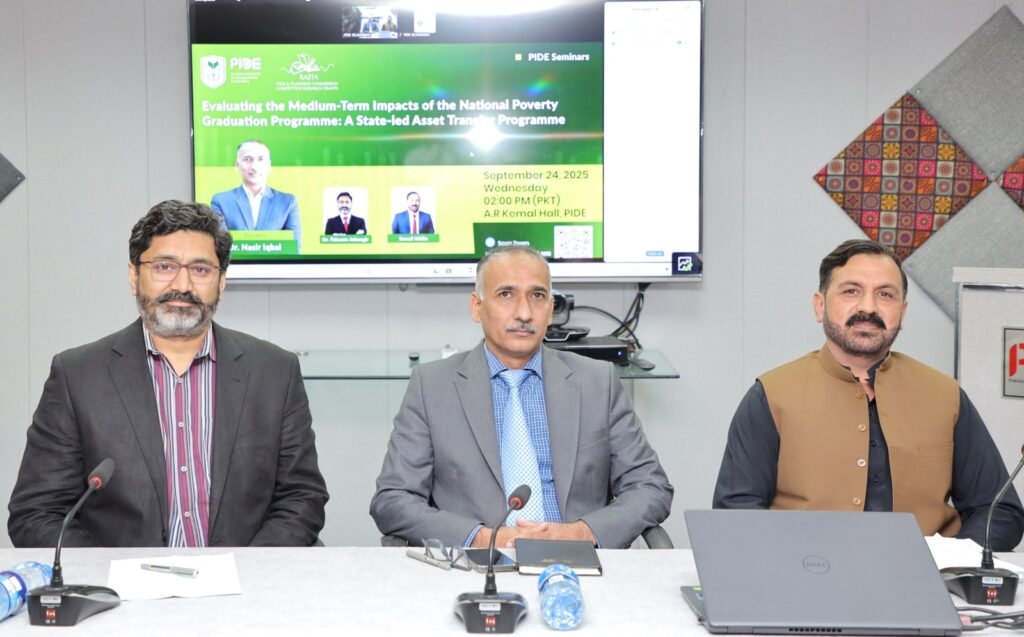
Islamabad : Pakistan Institute of Development Economics (PIDE), under its flagship RASTA (Research for Social Transformation and Advancement) project, organized a seminar on “Graduation Programme: A State-led Asset Transfer Programme.” The event was moderated by Dr. Faheem Jehangir, Dean (Policy) at PIDE and Project Director of RASTA, with the keynote presentation delivered by Dr. Nasir Iqbal, Registrar and Associate Professor at PIDE, and commentary by Saeed Uddin, Project Director of the National Poverty Graduation Programme (NPGP).
The seminar focused on evaluating the medium-term impacts of the NPGP, Pakistan’s largest state-led asset transfer programme designed to lift ultra-poor households out of poverty through assets, skills, and institutional integration. Presenting the results of a rigorous four-year study using Regression Discontinuity Design (RDD), Dr. Nasir Iqbal highlighted that the programme has had significant positive impacts on beneficiaries’ economic well-being. Results showed increased income, consumption, and welfare scores, with over 50% of beneficiary households officially crossing the poverty score threshold (23) and “graduating” from poverty, while nearly 85% showed improvements in welfare indicators.
Beyond economic outcomes, Dr. Iqbal underscored the programme’s role in systemic integration, enabling beneficiaries to obtain CNICs, access formal healthcare, and develop a stronger sense of citizenship and connection to the state. However, he cautioned that the programme’s long-term sustainability faces critical challenges. Vulnerability to climate shocks, as seen during the 2022 floods, left many households falling back into poverty due to the absence of protective mechanisms such as asset insurance or emergency shelters. He also pointed to potential negative trade-offs, including instances where children were withdrawn from school to support family micro-enterprises, undermining long-term human capital development. Furthermore, scalability remains a challenge, as the intensive programme model reaches only a small fraction of Pakistan’s poor. Outcomes also varied geographically, performing better in Punjab where infrastructure and market access are stronger compared to weaker results in Sindh.
To address these challenges, Dr. Iqbal proposed reimagining the model for scalability and resilience. Recommendations included the creation of Village Economic Zones by repurposing public spaces (such as schools after hours) into community markets, diversifying asset transfers beyond livestock to include enterprises like street vending, packaging, and logistics, and shifting the state’s role from direct asset provision to creating an ecosystem that facilitates access to finance, markets, and private sector linkages.
He further stated that the report was shared with the Islamic Development Bank, World Bank, and GIZ, where it received significant appreciation and recognition.
Discussant Mr. Saeed Uddin emphasized the practical value of PIDE’s evaluation, noting that the positive findings were instrumental in securing new funding from the Islamic Development Bank for expansion into 25 additional districts. He outlined future programme adaptations, such as offering smaller livestock options for quicker income generation, incorporating digital skills training, and establishing 16 Business Development Centers (BDCs) to provide beneficiaries with continuous business support. He also raised critical questions for future programme design, including the need to assess gender-differentiated impacts, determine the optimal cost for asset transfers, and identify strategies for improving results in lower-performing regions.
Moderator Dr. Faheem Jehangir placed the programme in context, contrasting the NPGP with other initiatives such as the Benazir Income Support Programme (BISP), noting that while BISP provides unconditional cash for consumption smoothing, NPGP is focused on sustainable economic empowerment. He also highlighted targeting challenges, including instances of household splitting to appear poorer and qualify for benefits, a common issue in large-scale social protection systems. Stressing the bigger picture, Dr. Jehangir reiterated that the ultimate solution to poverty lies in creating widespread, systemic economic opportunities—moving from small-scale “proof-of-concept” interventions to scalable models of inclusive growth.

Sohail Majeed is a Special Correspondent at The Diplomatic Insight. He has twelve plus years of experience in journalism & reporting. He covers International Affairs, Diplomacy, UN, Sports, Climate Change, Economy, Technology, and Health.