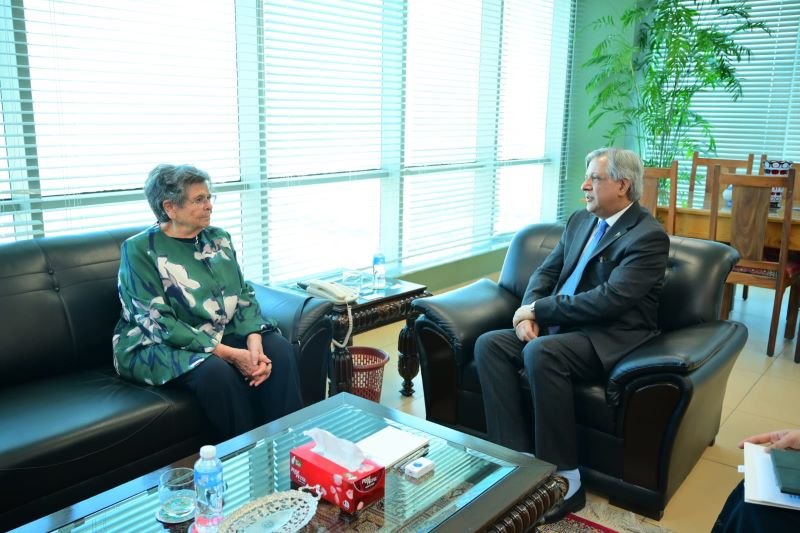
Islamabad (GNP): Federal Minister for Law and Justice and Human Rights Senator Azam Nazeer Tarar met Ruth Dreifuss, a former President of Switzerland and founding member of the Global Commission on Drug Policy. They discussed Pakistan’s drug-related legislation, international drug control policies, the protection of human rights and reform of the criminal justice system.
Speaking about Pakistan’s legal and geographical situation, Mr Tarar said the country faces particular difficulties in fighting narcotics because it borders Afghanistan and because of drug trafficking in the wider region. Effective legislation, he said, depends not just on legal provisions but also on how they are applied in practice, on court rulings and on realities on the ground.
He said Pakistan has also introduced legislative reforms on the death penalty for drug-related offences. Any review of drug laws and the international policy framework, he added, must weigh scientific evidence, public health, human rights, and the nature and seriousness of each offence.
Ms Dreifuss welcomed the continuing dialogue on drug policy among Pakistan’s Parliament, government institutions and other stakeholders, and stressed the value of awareness and training programmes. She traced the history of the international drug control system, observing that policies shaped in the Global North, especially Europe and North America, have affected other regions too. She called for a reassessment of the effects and results of these policies and for the system’s shortcomings to be addressed.
The meeting also covered the legal and historical background of the 1988 United Nations Convention against Illicit Traffic in Narcotic Drugs and Psychotropic Substances and Pakistan’s Control of Narcotic Substances Act, 1997. Participants stressed that the social, economic and legal conditions of individual countries should be considered when drug policies are reviewed.
Also read: alifornia Braces for Flooding as King Tides Hit Coast
Both sides agreed on the need to distinguish between the roles and circumstances of people involved in drug offences. Senior figures in organised trafficking networks, they said, should not be treated in the same way as vulnerable people, particularly women who may be exploited or used to carry drugs. Each case should be assessed individually, taking into account the accused’s role, any coercion, economic vulnerability and criminal intent.

Sohail Majeed is a Special Correspondent at The Diplomatic Insight. He has twelve plus years of experience in journalism & reporting. He covers International Affairs, Diplomacy, UN, Sports, Climate Change, Economy, Technology, and Health.