Prime Minister Tarique Rahman’s UN address restated a familiar position. Its force comes from how many governments, across how many regions, now say the same thing.
A principle spoken by one country is an opinion. Spoken by many, across regions and political systems, it becomes the outline of a consensus. That is the best way to read the Palestine passage in Prime Minister Tarique Rahman’s maiden address to the UN General Assembly on September 24. Most of the speech concerned Bangladesh’s own recovery, and the Palestine passage was short and contained nothing new. Its significance lies in how closely it echoes what a growing number of states are saying.
What the prime minister said
Palestine came early in the speech. He said Bangladesh remained unwavering in its support for the Palestinian people’s legitimate demands, including self-determination and an independent State of Palestine. He placed that commitment beside disarmament and arms control, and appealed for dialogue, diplomacy and cooperation as the way to settle disputes in a world of conflict and displacement.
He also spoke as a man with a family history at that rostrum. He said he felt nostalgic standing where his father, President Ziaur Rahman, and his mother, the late Prime Minister Khaleda Zia, had addressed the world. And he arrived after the 2024 uprising, an interim administration and the February 2026 election that returned the BNP to government. A leader who has just regained a democratic mandate has particular standing to speak for others still seeking self-rule.
His framing mattered too. He did not present Palestine as a sectarian grievance but as a test of whether the international order’s principles, self-determination above all, apply to everyone. That is why the position travels so easily to other capitals.
The Global South’s shared language
For much of the world’s population, Palestine is not a distant dispute but a familiar story. South Africa has made the cause part of its post-apartheid identity. Across Africa, governments born of anti-colonial struggles read the Palestinian demand for self-rule as unfinished business from their own decolonisation. In Latin America, countries with their own memories of dispossession, foreign intervention and dictatorship have long backed Palestinian statehood. In Asia, Malaysia and Indonesia, among the largest voices in the Muslim world, hold positions close to Dhaka’s.
What binds these governments is not a treaty or a bloc. It is shared experience: the memory of being ruled, divided or ignored by others. That is why this is the deepest resonance of all. It rests on history, not on alliance, and it will not dissolve when diplomatic fashions change.
The Muslim-majority world
The Organisation of Islamic Cooperation, of which Bangladesh is a member, has made Palestinian statehood a long-standing priority, and the prime minister’s schedule in New York showed how naturally Dhaka sits in that company. He met the leaders of seven countries during his four working days in New York, including Türkiye, Iran and Pakistan. His talks with President Erdogan covered trade and investment, and his meetings with Middle Eastern leaders covered the protection of Bangladeshi workers, energy security and investment.
The published accounts do not say Palestine was a formal agenda item, and it would be wrong to claim so. But the pattern is plain. The states Bangladesh works with most closely in this world are the same states that share its view.
The West moves closer
For years, governments in the Global South were told that support for Palestinian statehood was a gesture without prospects. That has changed. In September 2025, several Western governments, including the United Kingdom, France, Canada and Australia, announced recognition of a Palestinian state. A position once treated as a regional outlier now sits closer to the mainstream. When Tarique Rahman restates it, he speaks less against the current of Western diplomacy and more alongside part of it.
The neutral middle
Alignment is not limited to the blocs one would expect. Analysts noted that his government wants to maintain relations across competing geopolitical blocs while keeping Bangladesh’s established positions on Palestine and climate justice. That balance has an audience among countries that belong to no camp. Thailand, Bhutan and Croatia were among the governments on his bilateral schedule, and none is defined by a bloc on this question. When a populous democracy with no stake in the conflict argues for self-determination and diplomacy, it makes the case sound like common sense and not partisanship.
Bangladesh as the comparative case
Bangladesh is a useful example precisely because its story contains the ingredients seen across the wider alignment.
First, a founding struggle. A nation born from a liberation war and a fight over language and self-rule tends to recognise those struggles in others. Bangladesh recognised the State of Palestine soon after the 1988 declaration of independence, and it has long declined to establish relations with Israel, a stance reflected even in the wording of its passports.
Second, continuity. Governments of every stripe have kept this line, including the interim administration that preceded the current one. Palestine is part of a national position that outlasts any single election.
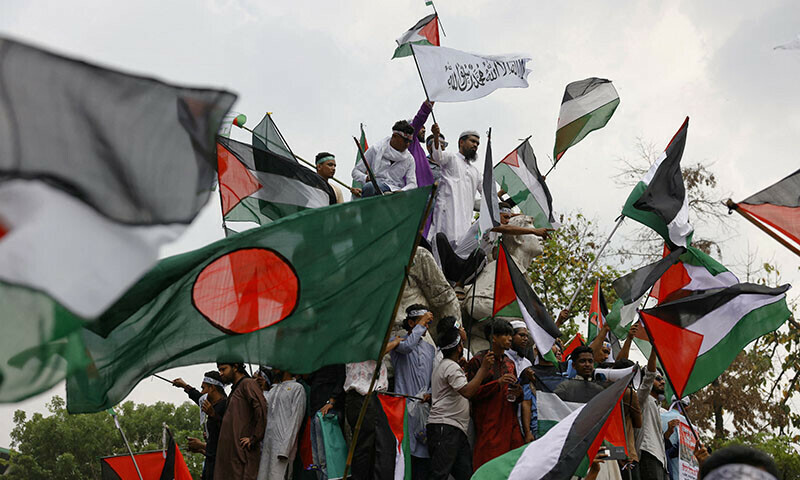
Third, public feeling. Mass rallies over Gaza, boycott campaigns and relief fundraising show a public that backs the policy, and that gives the government’s words credibility abroad.
Fourth, lived experience of displacement. The prime minister told the Assembly that Bangladesh hosts more than 1.2 million forcibly displaced Rohingya. He warned that failure to deliver justice for them could become a humanitarian crisis in the near future. A country that bears the daily cost of another people’s dispossession speaks about stateless people as a witness, not an observer.
Replace Dhaka with Pretoria, Kuala Lumpur or Jakarta, and much of the same story could be told: a history of struggle, a public that cares, and an experience of injustice that makes the principle feel concrete. Bangladesh is not the exception. It is a clear instance of the rule.
Why the resonance matters
Alignment does three things a solitary position cannot. It turns repetition into pressure: one government’s statement is easy to dismiss, while dozens repeating the same principle in different accents raise the diplomatic cost of ignoring it. It builds practical coalitions, because shared positions are the raw material for joint votes, humanitarian initiatives and proposals that many states can sponsor. And it reassures those on the receiving end. A siege will not lift because of a speech, but a chorus of governments from Dhaka to Pretoria to Paris tells Palestinians the world still remembers them.
Also Read: Sisi Pledges to Defend Saudi Arabia Amid Escalating Regional Conflict
The limits, honestly stated
Admirers should not overstate the point. Shared principle is not shared action. States that agree on statehood can differ sharply on tactics, and some who applaud in New York will hesitate when concrete costs arise. Commentators should resist inventing consensus where the record is silent. The sober conclusion is that Bangladesh’s position is not isolated, and that its overlap with many other governments is an asset waiting to be used.
From echo to action
The test for Tarique Rahman’s government is what it does with that overlap. It can work with OIC partners, Global South allies and sympathetic Western governments on humanitarian access and accountability under international law. It can use Bangladesh’s long peacekeeping record to press for the protection of civilians. And it can insist, as a country that has seen the cost of conflict up close, that any settlement secure the dignity and safety of everyone in the region.
His closing words offer a fitting frame. He ended with the phrase “Bangladesh before all — Bangladesh for all.” Applied beyond Bangladesh’s borders, the idea is simple: a country that wants its own people treated fairly will stand with others who want the same.
In New York, Tarique Rahman added Bangladesh’s voice to a chorus already in motion. The measure of his leadership will be whether he helps that chorus move from words to deeds.
The views presented in this article are the author’s own and do not necessarily reflect the views of Global News Pakistan

Political and International Affairs Analyst; Research Fellow, Bangladesh Neeti Gobeshona Kendra (Policy Research Center, NGK)