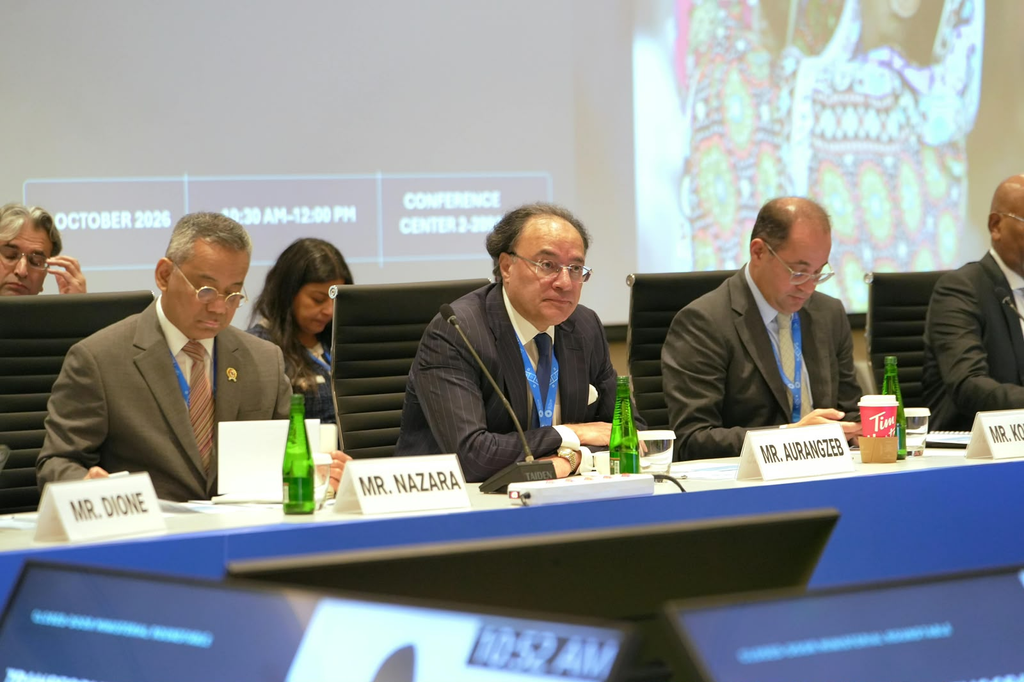
Bangkok (GNP): Pakistan has called for reform of the international financial system so that it better represents and serves developing economies, Finance Minister Muhammad Aurangzeb said on Tuesday.
He made the call as First Vice-Chair of the Group of 24 (G-24) at a meeting of finance ministers and central bank governors in Bangkok, Thailand. The meeting was held on the sidelines of the World Bank Group and International Monetary Fund (IMF) Annual Meetings 2026.
Pakistan is expected to assume the G-24 chairmanship when the Annual Meetings conclude in October, succeeding Nigeria. The group’s governance rules provide for the chair country’s one-year term to begin at the end of the Annual Meeting of Ministers. The G-24 is a coalition of developing countries that coordinates positions on international monetary, financial and development issues, particularly in dealings with the IMF and the World Bank.
Speaking in that capacity, Aurangzeb pointed to the pressures facing developing countries. He listed trade and investment disruptions, climate shocks, restrictive financial conditions and widening financing gaps.
He said the global financial architecture must evolve to meet these challenges. In his view, countries undertaking difficult economic reforms need timely support when they face external shocks beyond their control.
To that end, he outlined three priorities for the G-24. The first is restoring development as the central objective of the international financial system. The second is making the Bretton Woods institutions, the World Bank and the IMF, more representative and responsive. The third is building a development-oriented global financial architecture.
Also Read: Aurangzeb Discusses Technical Cooperation with ESCAP Executive Secretary
The finance minister said Pakistan would use its chairmanship to strengthen the group’s collective influence and advance the interests of developing economies. He stressed cooperation among member countries and institutional partners, and he appreciated Nigeria’s leadership of the group, noting the importance of continuity.
Pakistan’s own circumstances add weight to this agenda. IMF research notes that climate-vulnerable G-24 members, Pakistan among them, face mounting losses from floods, droughts, heatwaves and rising sea levels. The World Bank also identifies Pakistan as highly exposed to recurrent floods, intensifying heatwaves and accelerated glacial melt.
Such countries need greater access to affordable finance for disaster recovery, resilient infrastructure and long-term adaptation. Pakistan’s chairmanship will give it an opportunity to coordinate member positions on these reforms and press for measures that address the financing needs of vulnerable economies.
Aurangzeb said, “The international financial architecture must evolve to address these challenges.”

Managing Editor at Global News Pakistan (GNP), with a Bachelor's degree in International Relations from Riphah International University, graduated with a Gold Medal. Reach out at sabahtareengnp@gmail.com