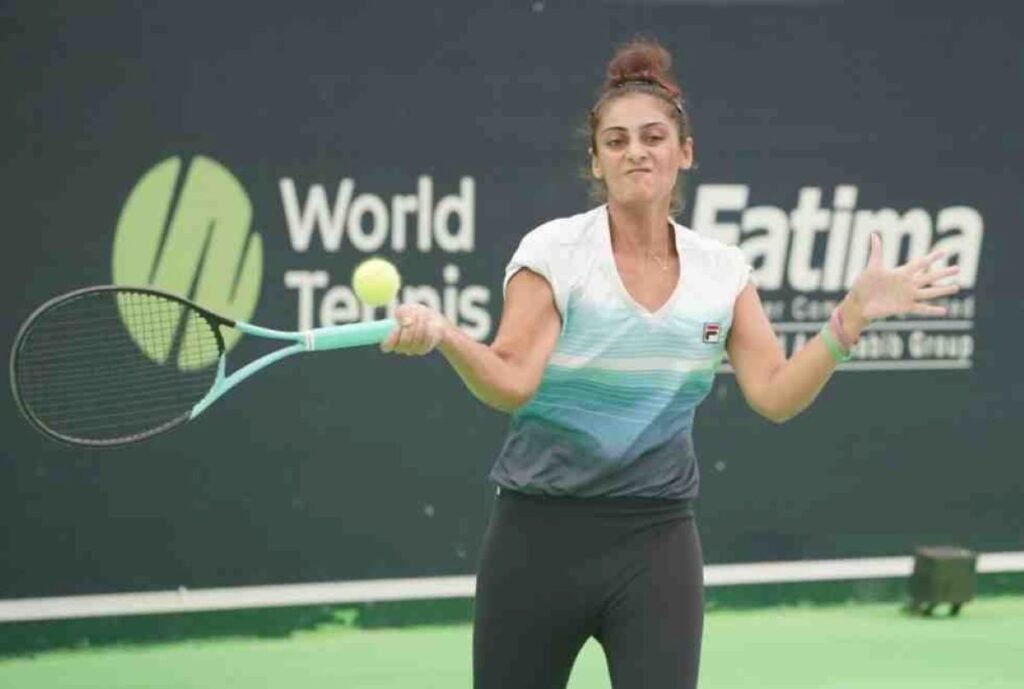
Islamabad (GNP): Pakistan’s women’s tennis campaign at the ITF W15 Islamabad has suffered another disappointing setback, with all five Pakistani women entered in the singles draw eliminated in the opening round, exposing yet again the widening gap between local players and international competition. The tournament, being staged on home soil, was expected to provide Pakistani players with an important opportunity to compete against international opposition and gain valuable ranking points and experience.
Instead, all five local players have now been eliminated from the singles event, with only Mahin Qureshi managing to push her opponent into a fiercely contested three-set battle.
The opening day had already produced a worrying result for Pakistan when Ksenia Laskutova defeated Pakistan’s Ushna Suhail 6-2, 6-0 in the first round of singles. The doubles competition also began on a difficult note, with Jeong Moon of South Korea and Kamonwan Yodpetch of Thailand defeating Pakistan’s Meheq Khokhar and Anna Simkina 6-1, 6-0.
The second day brought further disappointment as the remaining Pakistani players failed to progress in singles.
Nepal’s Abhilasha Bista defeated Pakistan’s Romisa Malik 6-0, 6-1, while Germany’s Anastasiya Kuparev beat Pakistan’s Hajra Sohail 6-4, 6-1. Denmark’s Elena Jamshidi defeated Pakistan’s Meheq Khokhar 6-0, 6-0, producing another completely one-sided result for a Pakistani player. The most competitive performance came from Mahin Qureshi, who fought hard against South Africa’s Wozuko Mdlulwa. Qureshi won the opening set 6-4 but was unable to close out the match, eventually losing 4-6, 7-6(1), 7-5 in a closely fought three-set encounter.
Qureshi’s performance was the only real bright spot in an otherwise extremely disappointing singles campaign for the Pakistani contingent. While the defeat was ultimately another first-round exit, her ability to take the match deep into a deciding set showed considerably more competitiveness than the other local performances. Her satisfactory performance is a result of Mahin’s continuous tennis training in Spain for more than 3 years.
With all five Pakistani players now out of the singles draw, attention turns to the doubles competition. In one of the second-day doubles matches, Mahin Qureshi and Ushna Suhail defeated South Africa’s Nissa Finnigan and Pakistan’s Romisa Malik 6-0, 6-0 in the first round. The Pakistani pair, however, now face a significantly tougher challenge as they move on to play the top-seeded women’s doubles pair in the tournament in the second round.
The overall picture remains deeply concerning. The ITF W15 level is one of the lowest entry points into professional women’s tennis, yet Pakistan’s five representatives have struggled to make an impact even on home soil. The tournament’s top seed in the women’s singles, France’s Astrid Cirotte, is ranked No. 618 in the world, illustrating that the event is not populated exclusively by elite WTA-level players. The fact that only five Pakistani women from across the entire country are participating in the singles competition is itself a worrying indicator of the depth of women’s tennis in Pakistan.
The issue therefore goes beyond individual defeats. Pakistan continues to host international tennis events, but the results increasingly raise questions about whether these tournaments are being used as genuine development opportunities or whether they are becoming occasions for participation, headlines, photographs and social-media announcements without a sufficiently strong domestic player-development system behind them.
International tournaments on Pakistani soil should ideally provide a platform for local players to test themselves against stronger opposition, gain ranking points, learn from high-level competition and gradually move up the professional rankings. Instead, the repeated pattern of first-round exits and heavily one-sided scorelines suggests a substantial gap between Pakistan’s claims about tennis development and the results being produced on court.
The timing makes the situation even more alarming. The W15 Islamabad results have arrived shortly after Pakistan’s extremely poor tennis campaign at the 2026 Asian Games in Japan, where Pakistan won only 1 of 10 matches and lost all nine of its defeats in straight sets. Now, Pakistan’s women have suffered another wave of early exits at an international tournament being held in their own country. The question that needs to be asked is straightforward: where is the next generation of Pakistani women’s tennis players?
If only five Pakistani women are entering a W15 singles draw being staged in Islamabad, and all five are eliminated in the opening round, the problem cannot simply be attributed to bad luck or difficult draws. It points towards a much deeper development issue. Pakistan needs a long-term strategy for women’s tennis that begins at junior level and continues through national ranking tournaments, ITF junior events, professional W15 tournaments and eventually higher-level international competition. Players need regular international exposure, quality coaching, physical conditioning, sports science, financial support and a structured pathway to accumulate ranking points.
Simply bringing international tournaments to Pakistan is not enough. The tournaments must be accompanied by a development programme capable of producing players who can actually compete in them. The latest W15 results should therefore serve as another wake-up call for the Pakistan Tennis Federation and everyone responsible for the development of women’s tennis in the country.
Mahin Qureshi’s three-set fight provides one positive sign, showing that Pakistani players can compete more closely when given the opportunity and preparation. But one competitive performance cannot hide the broader picture. At the current trajectory, both men’s and women’s tennis in Pakistan need either a major course correction or a long-term, properly funded development plan.
Also read: PSL 12 Locks in March 18 Start With Eight Teams Back
The recent Davis Cup collapse, the Asian Games disappointment and now the early W15 Islamabad exits are not isolated incidents. They are increasingly forming a pattern. Pakistan does not need more participation for the sake of participation. It needs players who are prepared to win. And unless the country’s tennis authorities address the enormous gap between international exposure and actual player development, international tournaments in Pakistan risk becoming little more than stages for announcements and participation, while the real business of producing internationally competitive Pakistani tennis players remains unfinished.

Sohail Majeed is a Special Correspondent at The Diplomatic Insight. He has twelve plus years of experience in journalism & reporting. He covers International Affairs, Diplomacy, UN, Sports, Climate Change, Economy, Technology, and Health.