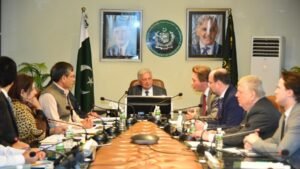
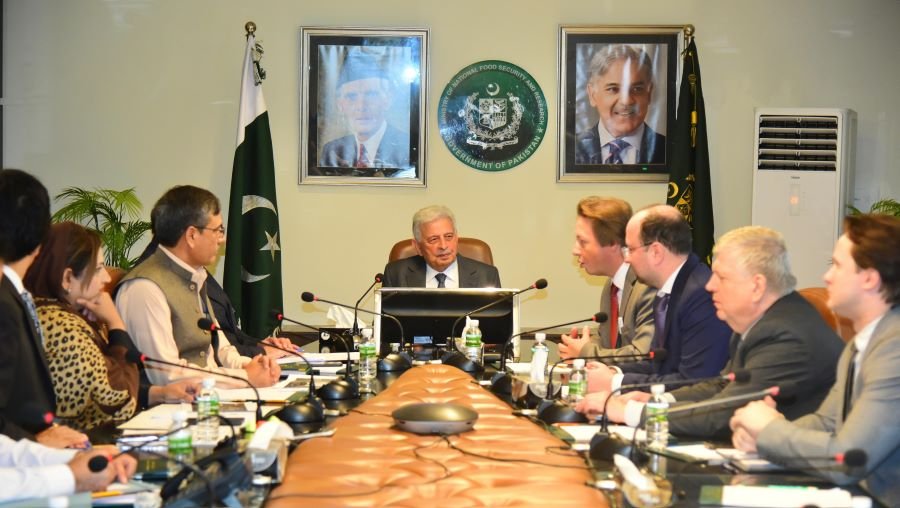
Islamabad (GNP): Federal Minister for National Food Security and Research Rana Tanveer Hussain met a delegation from Russian agricultural and agrochemical firm Schelkovo Agrohim, which was accompanied by the Russian Embassy’s Second Secretary and other officials. The talks looked at practical links between the two countries in seed development, crop protection, pesticides, micronutrients, advanced fertilisers, agricultural research, technology transfer and investment.
Rana Tanveer Hussain said Pakistan wants a partnership with Russia that goes further than buying finished products, one that brings technology transfer, local manufacturing, joint research, breeding programmes and training for Pakistani experts. He said the country needs modern farming technologies and seed varieties that raise yields while coping better with drought, disease, pests and climate stress. Because climate change is a growing threat to farm output, he added, climate-resilient technologies, drought-tolerant seeds and disease-resistant varieties are a priority.
The Russian side described Schelkovo Agrohim’s range of pesticides and newer pesticide formulations, micronutrients, micro-fertilisers, biological products and quality seeds. It also outlined its research and production strengths in seeds and hybrids of wheat, maize, sugar beet, rapeseed/canola and sorghum, and said its maize seed is non-GMO.
Participants named pest and disease control in cotton, rice, sugarcane and vegetables as promising areas. They also discussed micronutrients and alternative plant nutrition products that might make nutrient use more efficient and possibly lessen reliance on conventional fertilisers, especially phosphorus fertilisers and DAP.
Pakistani officials said future collaboration in seeds should not stop at importing finished seed. They suggested working instead on access to suitable Russian germplasm, joint breeding, technology transfer, seed traceability, local seed multiplication, and a Russian seed company or partnership operating in Pakistan.
The Pakistan Agricultural Research Council (PARC) and National Agricultural Research Centre (NARC) were proposed as the main bodies to evaluate Russian technologies scientifically. The minister insisted that any new product or technology be tested under Pakistan’s climate, farming practices and soils before wider introduction.
The two sides considered starting field trials of Russian seeds and pesticides in Pakistan. With the wheat sowing season near, they proposed that suitable Russian wheat material be supplied early for trials measuring yield potential, local adaptability, pest and disease resistance, and performance across Pakistan’s varied conditions. Hybrid wheat and other advanced seed technologies were also raised.
On pesticides, the meeting heard that the Russian delegation had already spoken with the Department of Plant Protection (DPP) and been briefed on Pakistan’s registration process, testing and study requirements and other regulations. The availability, and possible creation, of internationally accredited testing laboratories in Pakistan was also discussed.
The minister promised that the government would help match the company with potential Pakistani partners. Models discussed included local distribution, joint ventures, public-private partnerships, local seed production, research and development, and setting up a Russian farm-input or seed company in Pakistan.
Pakistan wants to broaden its sources of agricultural technology, seed and inputs, he said, and Russian products that prove effective locally and competitive on price could find substantial opportunities in its large farm market. The government, he added, would welcome Russian investment, local manufacturing, research collaboration, technology transfer and long-term business ties. Both sides also considered a Memorandum of Understanding (MoU) or Letter of Intent (LoI) to formalise future cooperation.
Also read: UN Secretary General Honoured with Nishan-e-Imtiaz
The meeting agreed to push forward technical and regulatory engagement, support local testing of suitable Russian products and seed varieties, identify prospective business partners, and explore workable research and investment projects.

Sohail Majeed is a Special Correspondent at The Diplomatic Insight. He has twelve plus years of experience in journalism & reporting. He covers International Affairs, Diplomacy, UN, Sports, Climate Change, Economy, Technology, and Health.