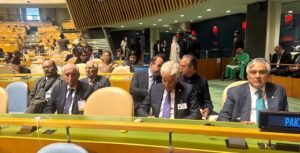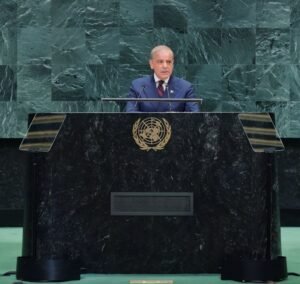
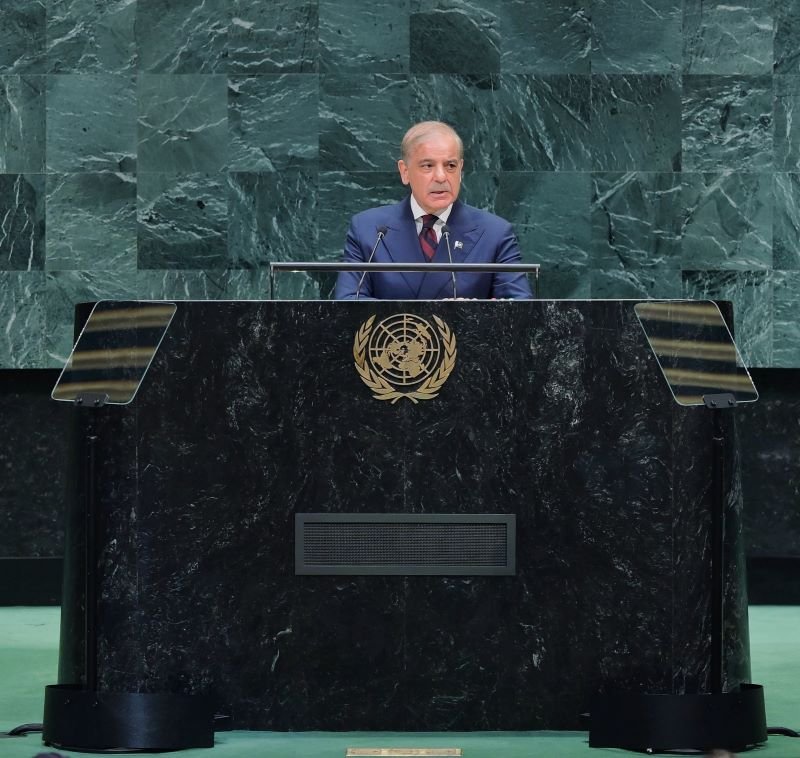
New York (GNP): Prime Minister Shehbaz Sharif told the United Nations that Pakistan had deliberately opted for dialogue rather than confrontation, arguing that settling the region’s major disputes — from the Middle East to Kashmir and Palestine — was essential to rebuilding global trust and stability.
Speaking at the General Debate of the UN General Assembly’s 81st session, themed “Restoring Trust, Managing Transformation: A United Nations That Delivers for All,” the prime minister said that while war remains one option in a dangerous era, real courage often lies in averting conflict rather than initiating it. He framed Pakistan’s stance as a deliberate choice of cooperation and peace over coercion and confrontation.
This marked Sharif’s fourth appearance before the 193-member Assembly. His speech ranged widely — touching on the Middle East crisis, human rights concerns in Palestine and Indian-administered Jammu and Kashmir, India’s unilateral move to suspend the Indus Waters Treaty, terrorism originating from Afghan territory, climate change, the debt burden facing developing nations, and the broader need for de-escalation and diplomatic engagement.
He opened with customary greetings, invoking a Quranic verse on peace before citing Muhammad Ali Jinnah’s historic pledge of support for the UN Charter.
Turning to the Middle East, Sharif warned that as hostilities intensify, the calls for diplomacy must grow louder still. He credited Pakistan’s diplomatic efforts with helping bring the United States and Iran to the negotiating table in Islamabad, resulting in the Islamabad Memorandum of Understanding, and singled out Deputy Prime Minister Ishaq Dar and Field Marshal Asim Munir for their work creating room for dialogue under difficult conditions.
He described the Strait of Hormuz and Bab-al-Mandeb as vital economic arteries that should serve as connectors between nations rather than flashpoints, saying these waterways should carry prosperity rather than the risks of war.
Sharif also condemned recent Houthi attacks on Saudi Arabia, including one aimed at Makkah, calling any threat to the holy cities an absolute red line that no Muslim could justify committing. He reaffirmed Pakistan’s full solidarity with the Kingdom and addressed the Makkah Joint Defence Agreement between Pakistan, Saudi Arabia, and Turkiye, describing it as a collective defense and stability pact not targeted at any particular nation.
Referencing last year’s conflict with India, Sharif said Pakistan’s armed forces, under Field Marshal Munir, exercised the right to self-defense with precision, delivering a lasting lesson to the aggressor. He also credited President Trump’s intervention with helping avert a far larger loss of life in South Asia.
On Kashmir, the prime minister linked regional peace to a just resolution of the dispute, calling for the long-promised UN plebiscite. He detailed allegations of extrajudicial detentions, disappearances, sexual violence, and demographic engineering under Indian occupation, describing the anguish of Kashmiri families still searching for missing loved ones. He pledged Pakistan’s continued diplomatic and moral backing for Kashmiris’ right to self-determination.
Calling the Indus river system the lifeblood of the region, Sharif argued that India’s suspension of the Indus Waters Treaty lacks legal standing — a position he said has been backed by UN experts and the Court of Arbitration. He warned that any Indian attempt to block or divert Pakistan’s water share would be regarded as an act of war, stating plainly that water should never be used as a weapon between nations.
On Palestine, Sharif invoked the deaths of children including Hind Rajab and Wafaa Akila as symbols of the world’s failure to act, asking why a child born in Gaza should be denied the same future as any other child. He condemned escalating violence in the West Bank, Lebanon, and Syria, and reaffirmed Pakistan’s support for an independent Palestinian state along pre-1967 borders with East Jerusalem as its capital.
He highlighted Pakistan’s own losses in the fight against terrorism — nearly 100,000 lives and more than $150 billion in economic damage — arguing these sacrifices had made the world safer. He renewed accusations that Afghan soil is being used by groups like the TTP and BLA to destabilize Pakistan, urging Kabul to take verifiable action against such threats and to uphold the rights of Afghan women and girls.
Sharif also pointed to Pakistan’s long history of UN peacekeeping contributions and raised concerns over rising global Islamophobia, citing mosque attacks, desecration of the Quran, and hate speech. He referenced the recent demolition of a centuries-old mosque in Saharanpur as an example of Hindutva-driven hostility, insisting there is no place for religious hatred in the world.
On the economic front, he described his government’s efforts toward fiscal discipline and structural reform as having restored macroeconomic stability, with further work underway on agricultural modernization, industrial growth, mineral development, digital transformation, and equipping youth with AI and IT skills.
He praised China’s Xi Jinping for initiatives on global development, security, civilization, and governance, and called for developing nations to receive faster debt relief, more affordable financing, and greater representation in international financial institutions. He pointed to the China-Pakistan Economic Corridor and emerging partnerships with Gulf and Central Asian states as examples of new economic pathways.
Despite contributing under one percent of global emissions, Sharif said, Pakistan continues to bear disproportionate climate impacts, and he pressed wealthier nations to deliver on climate finance pledges and loss-and-damage funding without further delay.
He argued that restoring trust requires more than rhetoric — it demands real change, from turning shared rivers into tools of cooperation rather than conflict, to nations that caused the climate crisis stepping up to protect those suffering its worst effects, to replacing weapons with genuine reconciliation.
Sharif also called for reforming the UN Security Council to make it more representative and accountable, reiterating Pakistan’s position that such reforms should serve the broader membership rather than a privileged few — summarized in his phrase “Reform for All, Privilege for None.”
He closed by urging the Assembly to choose trust and peace for the sake of future generations, expressing hope that even a divided world could still find common ground.
Also read:
Earlier in his remarks, Sharif congratulated newly elected Assembly President Khalil ur Rahman, commended outgoing President Annalena Baerbock’s leadership of the 80th session, and praised UN Secretary-General António Guterres for his advocacy on behalf of the UN and the Global South.

Sohail Majeed is a Special Correspondent at The Diplomatic Insight. He has twelve plus years of experience in journalism & reporting. He covers International Affairs, Diplomacy, UN, Sports, Climate Change, Economy, Technology, and Health.