Karachi (GNP): A new three-year partnership between Sindh’s Health Department, the Lahore University of Management Sciences (LUMS), and the Aga Khan University (AKU) will embed a National AI Hub for Maternal, Newborn and Child Health within the province’s public health system. The goal is to bring artificial intelligence tools directly to frontline healthcare workers in order to boost outcomes for at-risk mothers and children.
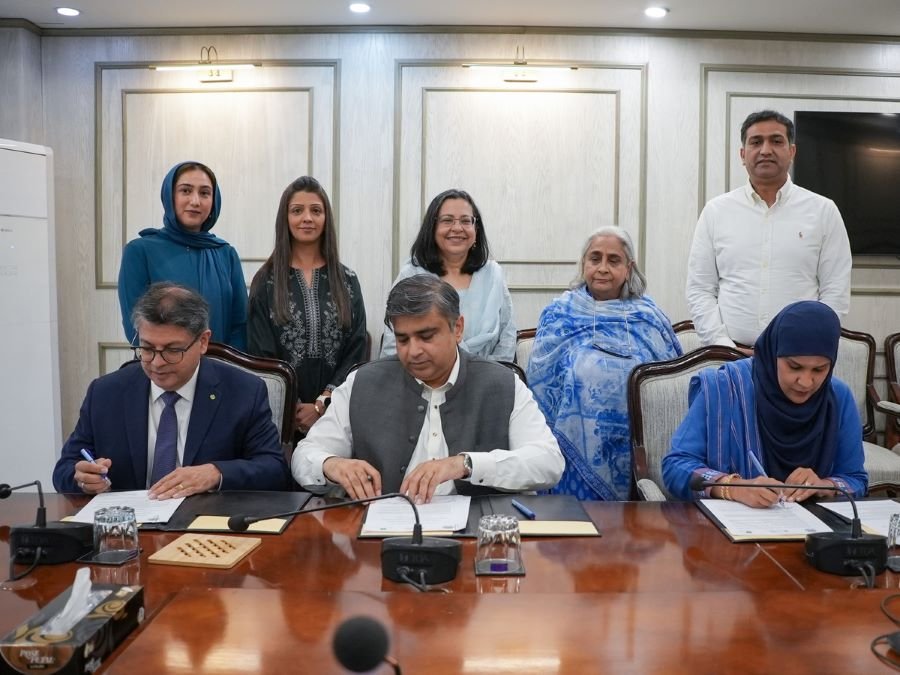
The Letter of Collaboration was formalized on Wednesday, September 2, 2026, at a signing held Signatories included Health Secretary Tahir Hussain; Dr Maryam Mustafa, an Associate Professor at LUMS who directs the Hub as Principal Investigator; and Dr Karim Damji, Dean of AKU’s Medical College.
Among those attending was Dr Anita Zaidi, who leads gender equality initiatives at the Gates Foundation — the organization behind a multi-year grant funding the Hub. Also present was Dr Zahra Hoodbhoy, an AKU Associate Professor in Paediatrics and Child Health whose research focuses on AI-driven point-of-care ultrasound.
Together, the three partners plan to deploy tools including risk-stratification models, clinical decision-support systems, and voice-enabled applications to support health workers delivering maternal and child care on the front lines.
Dr Pechuho said the initiative would focus first on primary health facilities, expressing hope that it would lead to healthier newborns, lower rates of premature birth, earlier detection of congenital conditions, and stronger paramedical services overall.
The Hub represents years of joint work among computer scientists, specialists in human-centered design, and clinical epidemiologists. Much of its clinical foundation rests on research led by Dr Fyezah Jehan, who chairs AKU’s Department of Paediatrics and Child Health and serves as the Hub’s Lead for Clinical Research.
Her extensive clinical trial networks, longitudinal maternal-newborn data, and community-based epidemiological studies supply the real-world evidence needed to validate the AI models — ensuring they’re grounded in solid clinical data and suited to the practical challenges of healthcare in under-resourced settings.
AKU Dean Karim Damji credited the university’s faculty for making the project possible, describing the collaboration as a meaningful opportunity to improve care for mothers and children and to find cost-effective, efficient ways to put AI to use in that effort.
The Hub’s technical foundation draws on Awaaz-e-Sehat, an earlier voice-enabled digital health records system developed by Dr Mustafa with support from a Grand Challenges grant. The speech-recognition and language-processing systems built for that platform — designed with low-literacy users in mind — allow frontline workers to use the new AI tools in their own languages.
Dr Mustafa noted her concern that Pakistan lags behind other countries in adopting AI for healthcare, attributing this largely to the absence of formal data infrastructure needed to scale such tools. In her view, building the technology is the relatively straightforward part; the harder challenge lies in integrating it into existing systems and securing government buy-in for adoption at scale. She emphasized that even the country’s most remote areas should have access to these tools.
Also read: China and US Deepen Medical Cooperation to Tackle Rising Cancer Burden
- Sindh’s Health and Population Welfare Department provides overall strategic direction, coordinates integration across provincial facilities, ensures alignment with national health policy, and oversees rollout within the public sector.
- LUMS acts as the technical partner, heading up model development, validating algorithms, and building speech technologies along with the necessary technical safeguards.
- AKU contributes clinical, research, and implementation expertise, overseeing clinical safety, conducting real-world evaluations, and guiding the translation of these tools into primary care settings.
The collaboration is designed to comply fully with national regulations, data privacy standards, and ethical guidelines, built on the principle that AI should support — never substitute for — clinical judgment.

Sohail Majeed is a Special Correspondent at The Diplomatic Insight. He has twelve plus years of experience in journalism & reporting. He covers International Affairs, Diplomacy, UN, Sports, Climate Change, Economy, Technology, and Health.