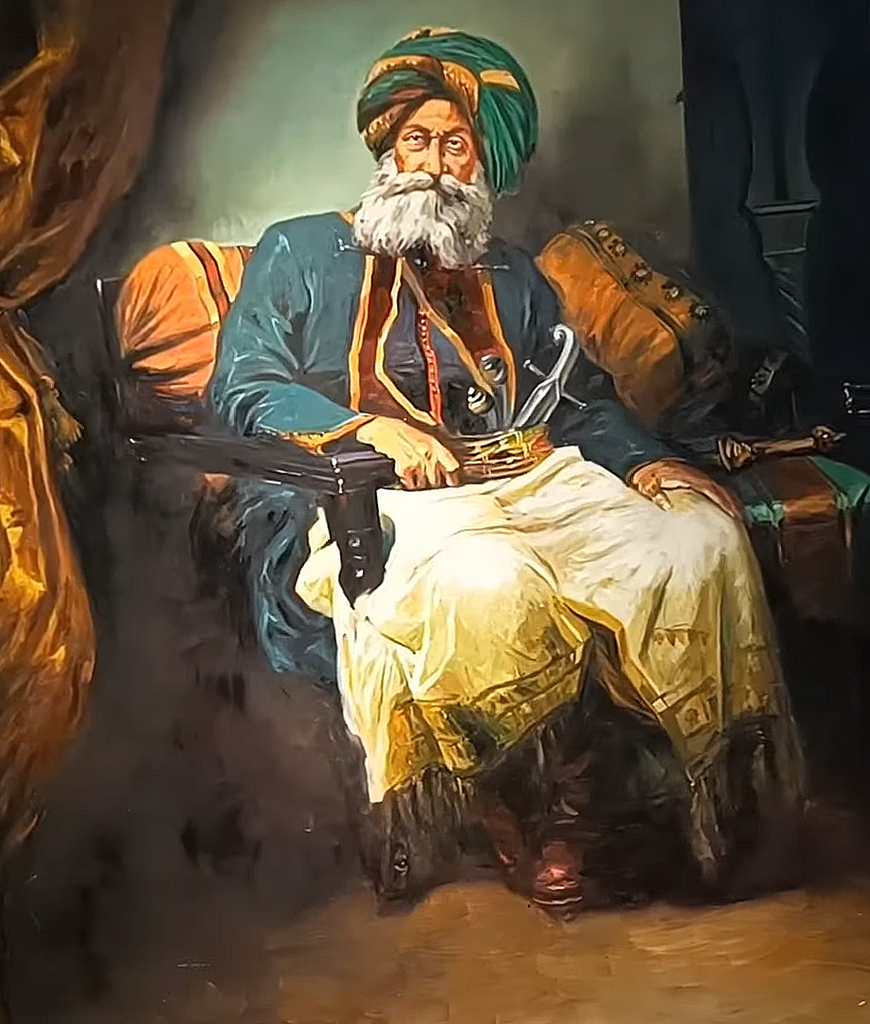
Ahmed Bey of Shusha was twenty years old when, at the recommendation of his father, Agha Kazim, he was sent to Firangistan (France) to receive an education and become a respected intellectual. There were still two years left before the end of the reign of the mighty Nadir Shah. But fate had other plans. Nadir Shah was assassinated by those closest to him, his empire fell apart, and the lands of Azerbaijan were divided into feudal khanates. Agha Kazim, too, was killed during the struggle for power, and on his deathbed he willed that all his property be given to his son, entrusting this wish to his brother, Agha Ismail.
As the years passed, news travelled slowly to the distant land known as Firangistan. The young Ahmed Bey learned of his father’s death seven years later, quite by chance, when one of his relatives happened to come to Paris. The atmosphere of exile had begun to weigh heavily upon him. At the same time, knowing little of what was truly happening in his homeland, he became consumed by a longing to return to the country he had imagined as a paradise. Ahmed Bey stayed in Paris for several more years to settle his affairs. Then he travelled by sea to Istanbul, from there to Batumi, and finally, in 1758, arrived in Shusha, the capital of the Karabakh Khanate.
What a strange predicament: Ahmed Bey could not decide whether to grieve over what he had experienced on the journey or over the bitter fate of his homeland.
His uncle, Agha Ismail, received him warmly. Not only the members of the household, but nearly all the neighbours and acquaintances came flocking to his door, eager to hear something about that distant land called Europe. After spending a week in Shusha and learning of all that had happened, Ahmed Bey began, almost at once, to miss the little house he had left behind in Paris. At the same time, he began to picture his homeland in his mind and long for it once again.
“How strange,” he thought. “The French unite and fight the English to save their country, while we have chosen to fall apart among mighty neighbours.”
Such thoughts affected Ahmed Bey so deeply that he began to weep while walking through the streets and, at times, suddenly withdrew from people.
Had the hero of our story truly existed, he might well have become the first Kefli Iskandar of our history. But let us return to our story.
One day, after the death of Panahali Khan, scribes, aghas, mullahs, sheikhs, meliks and viziers had gathered in the khan’s residence to discuss and decide upon the policy Ibrahimkhalil Khan would pursue toward his neighbours. Ahmed Bey had also been invited so that they might benefit from the experience he had gained in Firangistan.
Ibrahimkhalil Khan was the first to speak:
“Aghas, beys, my late father loved you all.”
(Everyone said at once: “May Allah have mercy on him.”)
“I am in favour of pursuing the same policy against the treacherous schemes of the neighbouring khans.”
Everyone began speaking of Panahali Khan’s bravery and his deeds. One agha said:
“The late khan had already shown his courage in the time of the Afshar.”
An akhund, eager to outdo the agha in praise, added:
“Not only the Afshar! Even Sultan Mustafa III was afraid of your father.”
A bey who was putting his scribal eloquence to questionable use tried to surpass them both:
“May Allah have mercy on him! Had your father not been there, the Afshar could never have defeated the Ottomans.”
Ahmed Bey listened to all this with sorrow and disappointment, merely sighing from time to time. At last, unable to contain himself any longer, he began to speak:
“May the khan live long, no one doubts your father’s courage. But, mighty khan! Akhunds! Scribes! Aghas! Our problem is elsewhere. The homeland is in flames. We must find a solution. Above us and below us stand old states watching us with hungry eyes. If we do not act together, we will become their prey.”
“Mirza, you seem to be a man of words, but your words are incomplete. What exactly are you trying to say?” asked the akhund sitting beside the khan.
“O Akhund, what has become of our country? The homeland is in misery, the people are poor. What is the reason? The ambitions of several khans for power,” Mirza Ahmed tried to explain passionately.
“May the khan live long! It seems they have taken away this man’s reason. Mirza Ahmed, you should be ashamed of your words. Apologise to our khan at once,” said the agha.
“Apologise! What a helpless word that is. Do you not understand? If the khanates do not unite, we will lose our independence. Look at Europe! Every day they struggle together for their freedom. Against whom? Against their own brothers and kin? No, against outsiders. In Italy there are various magnificent states. They call them republics. Everything is carried out according to the will of the people. The people live in prosperity,” Mirza Ahmed added.
“Your father was a fine man. He knew these lands and never used unnecessary words. But you went to that nest of devils, Firangistan, and became a Mirza there. You became a European Mirza!” Everyone began to laugh. “As for this ‘republic’ you speak of: if you are looking for a republic, then let our own khanates be your republic. Our people live in prosperity; we fulfil whatever they wish. Now tell me, who stands at the head of those infidel Italians?” the akhund asked.
“A head of government who changes every five years,” Mirza Ahmed replied.
“What kind of nonsense is that? Can such a man be a khan? What power does he have that his neighbours should fear him?” said the akhund. “A khan is a man whom everyone fears.”
Also Read: Antonelli Leads F1 Title Race After Stunning Turnaround
“Honourable Khan, come now, do not pay attention to the words of the European Mirza. The anger of youth has not yet left his body. We should be discussing serious matters. Allow us to begin the discussion again,” the agha addressed the khan.
“Indeed. It seems that people who go to Firangistan are trained there to weaken us and then sent back. Very well, aghas, tell me your proposals. I am listening,” said the khan.
“We must set a trap for our neighbours.”
“We should seize their lands ourselves.”
“We should even form alliances with other states for this purpose.”
Everyone put forward his own opinion.
“But… but they…” Mirza Ahmed tried to speak, but the akhund cut him off and addressed those in the room:
“The European Mirza cannot interfere with our destiny. I propose that we go to war with our neighbours.”
“Indeed!”
“Yes!”
“How magnificent the akhund’s wisdom is!” the men in the room agreed.
Mirza Ahmed, meanwhile, left the khan’s palace in disappointment and began walking home.
What did he feel? What was he thinking? None of us can know. According to our writer, perhaps even Mirza Ahmed himself did not know what he was thinking.
He simply walked. And walked.
His hands were in his pockets. Every now and then, he stopped to gaze at the magnificent beauty of Shusha. Then he lowered his head again and continued walking.
He walked and walked…

Nejat Madatoglu
Nejat Madatoğlu (Nicat Madatlı) is a historian, and an expert in International Relations. He is the author of three books and is currently pursuing a master's degree in the History of the Republic of Türkiye at Istanbul University. Additionally, he is active in the fields of culture and diplomacy in his home country, Türkiye. His articles are also published in various newspapers and magazines.