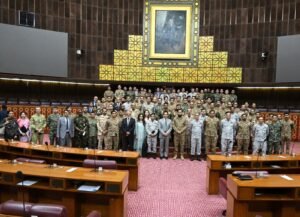
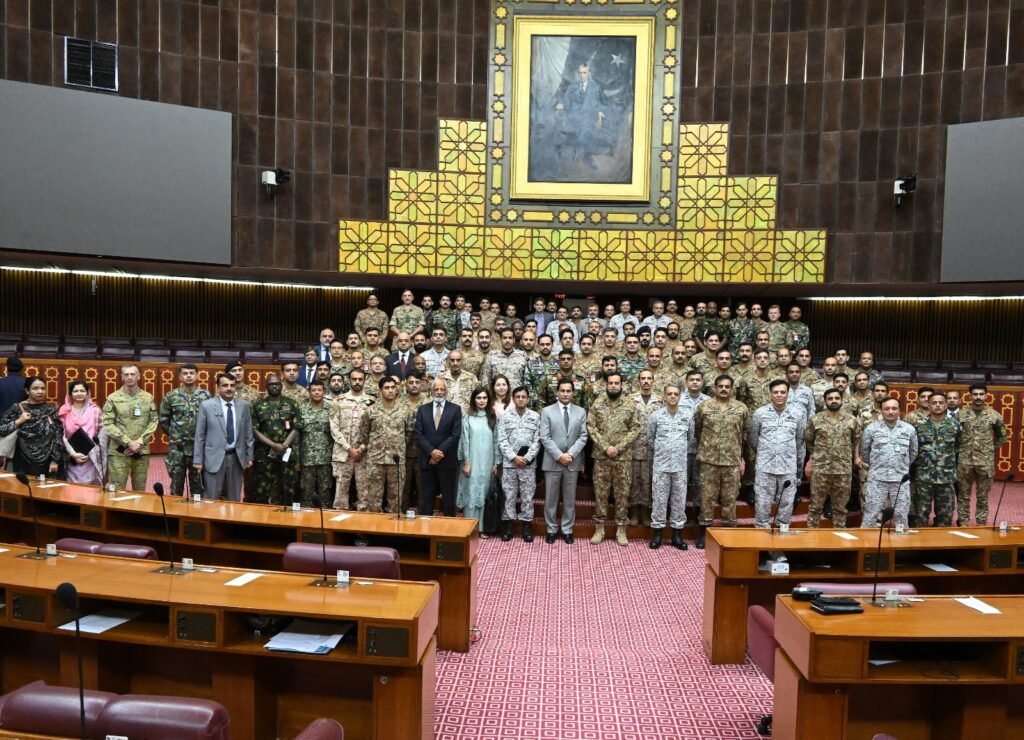
Islamabad (GNP): A 130-member delegation of the National Security and War Course (NSWC) of the National Defence University (NDU), comprising senior civil and military officers from Pakistan and friendly countries, visited Parliament House and met National Assembly Speaker Sardar Ayaz Sadiq.
The delegation was headed by General Muhammad Naeem Akhtar. During the interaction, the National Assembly Speaker briefed the participants on initiatives undertaken by Pakistan’s Parliament to modernise parliamentary operations, improve efficiency and promote environmental sustainability.
The National Security and War Course is designed to provide participants with a comprehensive understanding of national security, national power and contemporary security challenges, while preparing senior leaders for higher command and staff responsibilities in military and government institutions.
During the meeting, Speaker Ayaz Sadiq highlighted the National Assembly’s move toward a paperless parliamentary system.
Under the system, Members of Parliament have been provided with digital tablets that allow them to access parliamentary documents and proceedings electronically.
The Speaker also highlighted the digitisation of the Speaker’s Office, describing it as part of broader efforts to modernise parliamentary working methods and improve the use of institutional resources.
According to the briefing, the transition toward digital parliamentary processes has reduced reliance on printed documents and stationery.
The move has implications for both administrative efficiency and resource use, while also supporting the Parliament’s environmental objectives.
The Speaker further briefed the delegation about measures taken by the Parliament to improve energy efficiency and environmental sustainability.
Among the initiatives highlighted was an energy-efficiency audit conducted in 2013, followed by the Parliament’s transition toward solar energy in 2015. Pakistan’s National Assembly has subsequently described itself as the world’s first parliament operating entirely on solar power.
The National Assembly said its solar transition, paperless working and other environmental measures were among the initiatives recognised through the Green Parliament initiative.
Also Read: U.S-Pakistan Cotton and Textile Cooperation
The Parliament recently received the inaugural Green Mace Award at the 69th Commonwealth Parliamentary Conference in Cape Town, South Africa.
The National Assembly said the award recognised its Green Parliament initiative, solar-powered operations, paperless parliamentary practices and environmental measures.
Another issue discussed with the delegation was water conservation. Speaker Ayaz Sadiq highlighted legislation and parliamentary efforts concerning the installation of rainwater-harvesting facilities across Pakistan.
Such systems can collect rainwater for use and can contribute to groundwater replenishment and water-resource management.
The Parliament House itself has also been developing a rainwater-harvesting project as part of its environmental initiatives.
The National Assembly has identified the project as an element of its broader efforts to conserve and efficiently use water resources.
The briefing presented Parliament’s digital transformation and environmental initiatives as interconnected efforts to improve institutional efficiency while reducing the consumption of resources.
The delegation’s visit also provided an opportunity for senior civil and military officers from Pakistan and friendly countries to learn about the functioning and modernisation of the country’s legislative institution.
The National Assembly has increasingly incorporated digital tools into parliamentary proceedings, with electronic access to documents reducing the need for printed materials.
At the same time, its solar-energy transition and environmental projects have become part of its institutional sustainability programme.
The visiting delegation appreciated the Speaker’s briefing and the initiatives undertaken by Parliament in the areas of digital transformation, resource efficiency and environmental sustainability.
The interaction at Parliament House therefore brought together two dimensions of public-sector modernisation: strengthening institutional systems through technology and improving resource management through environmentally focused initiatives.