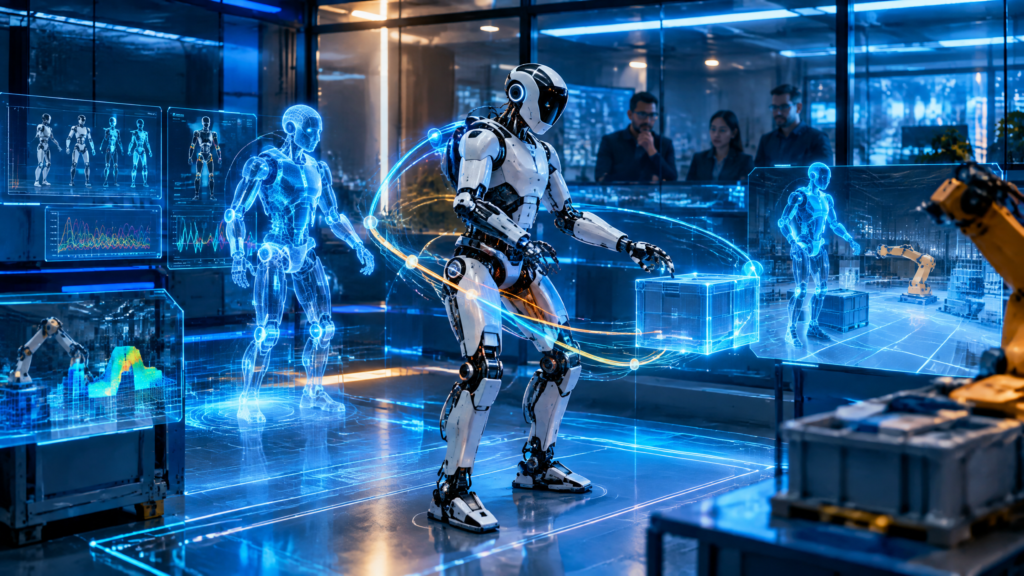
Cambridge (GNP): Virtual Robot Training is becoming an important part of robotics development as companies and researchers use computer-generated environments to teach machines how to move, react and complete tasks.
Thanks to the new technology, robots are now able to practice their movements in a digital setting before executing them in real life. Digital simulations allow robotic developers to perform same activities thousands or millions of times which means that robots get ready for their functions without the need to engage in physical experiments every time. This makes Virtual Robot Training a useful method for developing robotic systems in a controlled environment.
Despite the challenges in developing Virtual Robot Training, it is crucial to research robots suitable for home, office and unpredictable situations. Machines will have to interact with people, objects and surprise events and therefore they have to be trained very quickly.Virtual Robot Training allows researchers to expose robots to different situations before they operate in the physical world.
A British company called Vsim is developing technology which allows the robots to learn much quicker. The founders of the company work on the software solutions that enable robots to perform multiple operations in the virtual manner.
An illustration of all the above mentioned is the robotic system Freddo. This robot has been trained to walk towards a human being, identify a bottle and take it with its own hands.
The primary concept of Virtual Robot Training is creating a computerized replica of an environment and letting a robot practice a task many times. The software analyzes the various actions taken as well as the tactics that help the robot perform the task.Through Virtual Robot Training, developers can repeat these tasks without repeatedly using physical robots.
Also Read: AI is the Future of Banking: Ghazali
When the necessary solution is found, the instructions can be sent to a real robot, thus minimizing the time necessary for some kinds of training in real life.
Nvidia is busy working on its own robotic simulation technology. Its Isaac Sim platform enables users to create virtual environments to train and test robots. Also, it has developed Cosmos a world-modeling software, which helps robots understand their real-life surroundings.
Using Virtual Robot Training offers important benefits, given that testing a product physically may be both costly and time-consuming.
A computer simulation allows engineers to conduct experiments multiple times without causing any damage or needing a large physical testing area. Another upside of this technology is speed. Vsim technology is able to provide tens of simulations in a quick manner.
The potential offered by this capability is especially interesting for households. The domestic environment poses challenges for robots because of the constant movement of other people, animals, and objects around them. An active robot going about its business may then be forced to adapt its tactics.
Nevertheless, there are some disadvantages of the method of virtual robot training. Simulation cannot fully reflect the behavior of each element of the physical world. It is especially true for some materials that can deform in different ways and change shape.
That is why scientists are working on the improvement of virtual environments. The more accurate the simulations, the more useful their application. Moreover, robots can learn using other methods besides the possibility of virtual robot training.
Scientists may rely on people’s demonstrations or the use of video recording of specific actions the robots should perform. Researchers also investigate different robotic learning options. For example, MuJoCo is an open-source physics simulation program extensively utilized by researchers for studying robot behavior and performance.
With the merging of simulation, Artificial Intelligence and physical robotics, the world of robots has a lot of potential to grow. Developers can bring out their various strategies through a digital experiment before putting their strategies into action in the real world.
The future of Virtual Robot Training seems to be characterized by cool virtual environments and rapid computers. AI agents can also be involved in creating the necessary virtual environments and evaluating the results of robotic training.
What is important for robot manufacturers is that, due to faster simulation, the development time can be reduced. Instead of taking the risks of conducting many physical tests, developers can test all possible situations by using the digital environment. However, practical testing will be crucial. A robot that performs well in a virtual setting still has to prove that it can perform in the real world.
In this connection, the Virtual Robot Training represents only one part of the whole process of robot making.
With the development of robots, simulation technology is bound to remain one of the key instruments in the hands of the researchers and companies. The possibility of training machines in a virtual environment may also help developers to solve some of the problems involved in teaching robots to work in difficult conditions.
The experience of Virtual Robot Training shows how closely digital environments are related to physical robotics. By providing machines with an opportunity to practice performing various tasks before doing them in reality, simulations are paving the way for the next stage of robot development.