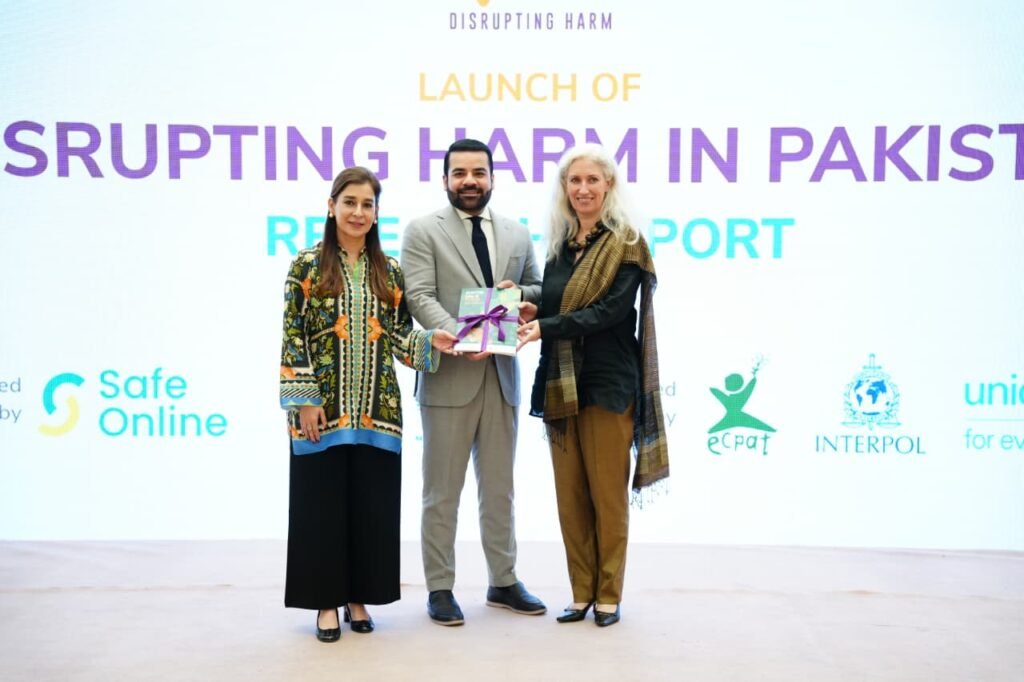
Islamabad (GNP): New research shows that roughly one in sixteen internet-using children aged 12-17 in Pakistan — an estimated 1.5 million children — experienced at least one form of technology-facilitated sexual exploitation or abuse within a single year, according to a joint study by UNICEF’s Office of Strategy and Evidence (Innocenti), ECPAT International, and INTERPOL, funded by Safe Online.
The report, titled “Disrupting Harm in Pakistan: Evidence on Technology-Facilitated Child Sexual Exploitation and Abuse,” draws on a nationally representative survey of children and their caregivers, interviews with frontline workers and justice-sector professionals, and a review of existing laws and policies. It offers insight into children’s experiences online, the circumstances that can lead to abuse, and the obstacles children face in seeking help.
The forms of harm documented in the study span a range of online risks children may encounter, including unwanted sexual contact, non-consensual sharing of images, coercion or blackmail, and the emerging use of AI tools to generate manipulated images or videos.
UNICEF Representative in Pakistan Pernille Ironside said the digital world should be a safe space for children, stressing the need to move beyond simply telling children to avoid risk and instead build systems that actively prevent abuse and hold both perpetrators and platforms accountable. She said every child deserves to explore the internet safely, with confidence that protective systems are working on their behalf.
Safe Online Executive Director Marija Manojlovic said the Pakistan findings offer critical evidence on the risks children face online and the gaps that need to be closed to protect them, noting that Safe Online’s $15 million investment across 25 countries reflects a commitment to translating this kind of evidence into concrete action. She commended the Pakistani government along with ECPAT, INTERPOL, UNICEF and local partners for their leadership on the issue.
The report underscores how often this form of abuse goes unreported in Pakistan — more than half of affected children never told anyone, and none of those surveyed reported incidents through formal channels such as helplines, social workers or police. The study points to community stigma, victim-blaming and low trust in law enforcement as key barriers keeping children and families silent, stressing that responsibility for abuse always lies with the perpetrator, not the child, and highlighting the need for confidential, accessible support systems.
ECPAT International’s Head of Programme for Justice and Child Rights, Andrea Varrella, noted that while girls and boys in Pakistan are affected at broadly similar rates, their experiences often differ — with boys frequently overlooked as victims due to stigma and social expectations around masculinity, making it harder for them to come forward. He said effective child protection must account for these differences.
According to the findings, the perpetrator was someone already known to the child in 85 percent of reported cases, challenging the common assumption that online abuse is primarily driven by strangers. Social media platforms were identified as the setting for 44 percent of reported incidents, making them the most commonly cited digital environment in the research. The report also flags emerging risks such as sexual extortion and AI-generated abuse material.
INTERPOL’s Head of Crimes Against Children Unit, Mark Beavan, said the findings point to an urgent need to strengthen protections for children facing this form of abuse, noting that by identifying both legal gaps and the lived experiences of survivors, the research offers practical recommendations for improving prevention, reporting, victim support and criminal justice response. He said the findings could help law enforcement and other stakeholders strengthen national responses in line with INTERPOL’s broader efforts against crimes targeting children, and stressed that cross-sector collaboration is essential to prevent technology from being exploited at children’s expense.
The report calls for action across the entire protective system — from stronger digital-age laws and platform accountability to safety-by-design principles and child-sensitive justice processes — alongside safe, confidential channels for children to seek help. It also stresses that prevention efforts must tackle the stigma and victim-blaming attitudes that place undue responsibility on children rather than perpetrators, noting that online safety should never be the burden of children alone.
Ayesha Raza Farooq, Chairperson of the National Commission on the Rights of the Child, said Pakistan has a solid legal foundation for protecting children online, but the priority now is ensuring these protections are put into practice — so that children and families can access justice, cases are handled with sensitivity and dignity, and institutions have the capacity to respond effectively. She said stronger implementation and accountability are essential to guaranteeing every child meaningful protection.
Also read: Zohran Mamdani Bans AI Use in Schools Through Eighth Grade
UNICEF has called for coordinated action across government, law enforcement, the justice system, social services, communities, schools, families and digital platforms to strengthen prevention, protection and response systems for children both online and offline.

Sohail Majeed is a Special Correspondent at The Diplomatic Insight. He has twelve plus years of experience in journalism & reporting. He covers International Affairs, Diplomacy, UN, Sports, Climate Change, Economy, Technology, and Health.