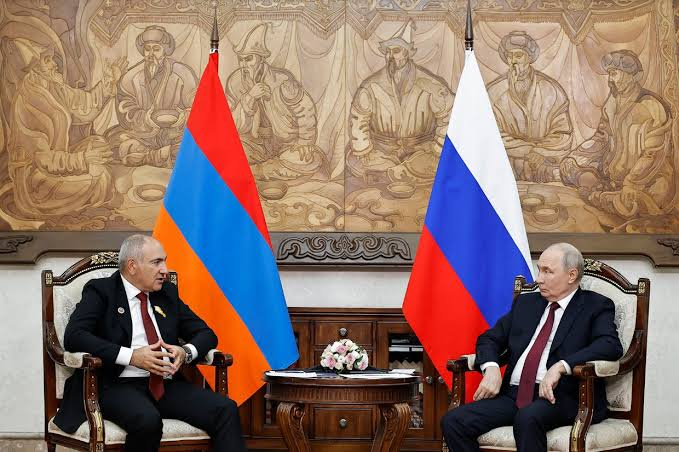
Bishkek (GNP): Russian President Vladimir Putin and Armenian Prime Minister Nikol Pashinyan held a tense bilateral meeting on the sidelines of the Shanghai Cooperation Organization (SCO) summit, marking their first face-to-face encounter since Armenia’s parliamentary elections in June.
The meeting exposed sharp disagreement over whether Yerevan can pursue European Union membership while remaining part of the Eurasian Economic Union (EAEU). Putin argued that Armenia’s move to begin the EU accession process effectively signals its exit from the EAEU, insisting that membership in both blocs simultaneously is not workable. Addressing Pashinyan directly, Putin said he found their disagreement notable but firmly maintained his opposing position on the core issue.
While Putin acknowledged EU membership as Armenia’s legitimate right, he stressed that it complicates Yerevan’s standing within the Eurasian Economic Union and said Armenia would benefit from resolving the question sooner rather than later, so Moscow can plan its relationship with Yerevan accordingly.
Pashinyan, in response, did not dispute that a decision would eventually be necessary, but said the moment for that choice has not yet arrived, pointing to the absence of any functional alternative to the EAEU’s existing economic framework. He added that a decision, potentially through a referendum, would follow only once such an alternative takes shape.
Putin renewed a proposal he has previously raised with Russia’s EAEU allies Belarus, Kazakhstan, and Kyrgyzstan, urging Armenia to settle the matter through a referendum, a route Pashinyan has resisted in the past. Putin’s response to Pashinyan’s hesitation was direct, saying that people should be given a choice and that Armenia should make one so the issue can be closed.
Ahead of the meeting, Kremlin aide Yury Ushakov had already signaled Moscow’s firm stance, saying Russia would insist that Armenia cannot seek EU membership while continuing to benefit extensively from EAEU cooperation, a five-member trade bloc that also includes Belarus, Kazakhstan, and Kyrgyzstan.
Also Read: EU and NATO Intensify Russia Pressure After 3 Alarming Escalations
Following the talks, Pashinyan described the discussion as very good in a social media post, noting that both sides agreed to continue their sincere and constructive dialogue during an upcoming visit to Moscow. He added that while bilateral relations between Armenia and Russia remain extremely important for both countries, current conditions call for rethinking how those relations are structured.
The Bishkek meeting reflects a widening strategic divergence between the two nations. Pashinyan has consistently pursued closer ties with the European Union in recent years, while Moscow continues to maintain that dual membership in the EU and EAEU is structurally incompatible. Pashinyan has said Armenia will keep operating within the EAEU until a choice between the two blocs becomes unavoidable, a divergence that extends to the Collective Security Treaty Organization as well, from which Pashinyan said in late August he would welcome Armenia’s expulsion.

Managing Editor at Global News Pakistan (GNP), with a Bachelor's degree in International Relations from Riphah International University, graduated with a Gold Medal. Reach out at sabahtareengnp@gmail.com