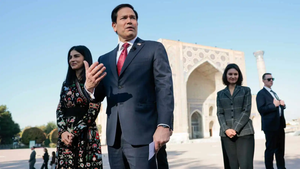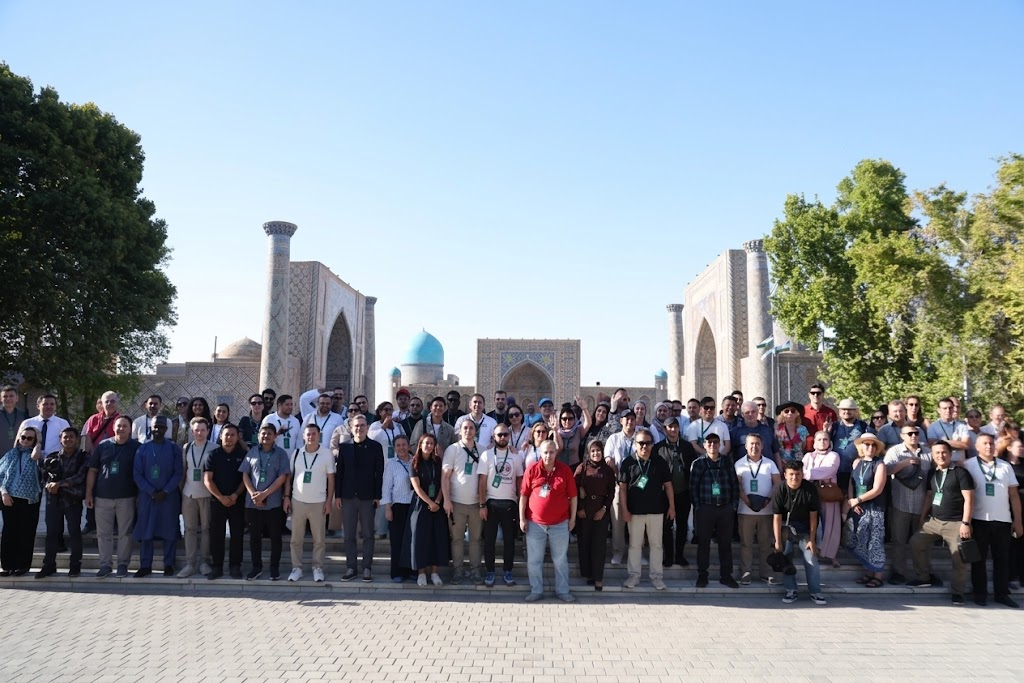
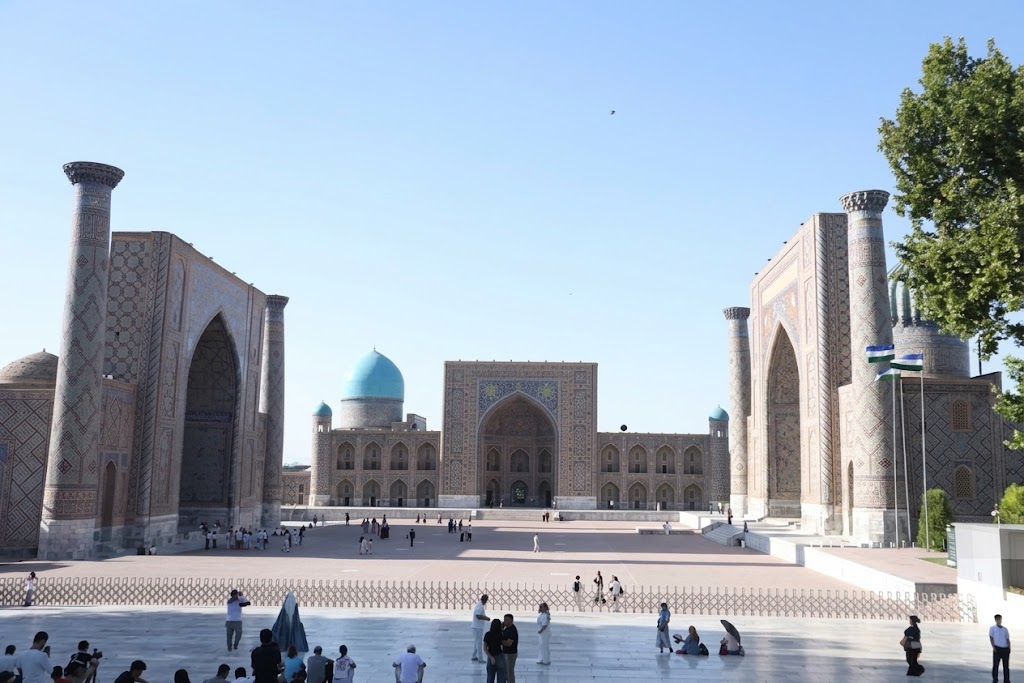
Samarkand (GNP): Participants of the international media forum visited Registan Square in Samarkand, one of Central Asia’s most famous architectural ensembles and a defining symbol of the ancient city’s cultural heritage. The tour included a visit to the Tilla-Kari Madrasah, one of three monumental structures that make up the Registan complex, alongside an overview of the square’s centuries-long history as Samarkand’s public center.
Registan’s development traces back to the Middle Ages, with a significant new chapter beginning under Mirza Ulugh Beg, a ruler, astronomer, and grandson of Amir Timur, who ordered the construction of the Ulugh Beg Madrasah between 1417 and 1420, establishing it as one of the era’s most important centers of education and science.
The square took its present form later, in the 17th century, when Samarkand ruler Yalangtush Bahadur commissioned the Sher-Dor and Tilla-Kari madrasahs opposite the original structure, forming the unified ensemble of three monumental buildings that stands today.
Tour participants paid particular attention to Tilla-Kari, constructed between 1646 and 1660 on the site of the former Mirzoi caravanserai, which had previously served travelers and merchants. Guides explained that the complex’s buildings have been affected over the centuries by time and earthquakes, with restoration carried out by craftsmen from different periods using the surviving structures and technologies of their respective eras, resulting in minor variations in geometry and proportion that reflect Registan’s layered restoration history.
A dedicated section of the tour focused on this preservation work, showcasing surviving fragments of decorative design and elements uncovered during restoration, including details tied to earthquake damage.
Participants also learned about the ensemble’s calligraphic and decorative traditions, including the creation of manuscript books and inscriptions that were combined with geometric and floral ornamentation throughout the madrasahs.
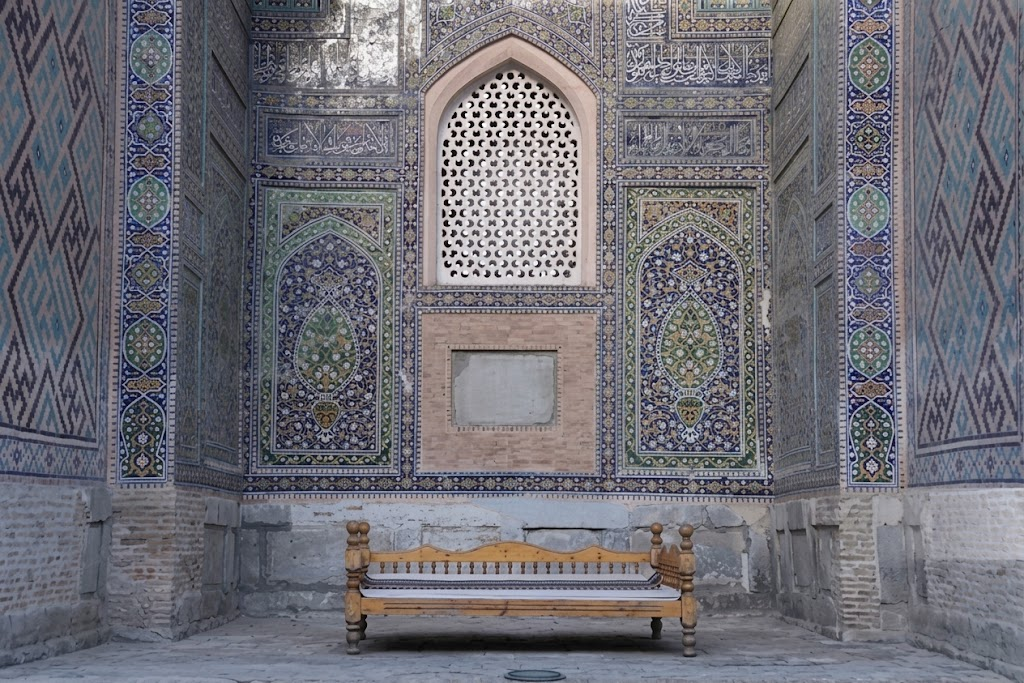
Registan’s facades are distinguished by a color palette of dark and light blue, turquoise, white, yellow, and orange, forming mosaic compositions that blend geometric and floral motifs with epigraphic text. This craftsmanship is especially prominent inside Tilla-Kari, whose name translates to “decorated with gold,” where the mosque’s walls, arches, and domed interior are richly adorned with gilded kundal paintings that contrast with the structure’s cooler exterior tones.
Also Read: Shah-i-Zinda’s Blue Domes Meet Ulugh Beg’s Stars
Beyond its architectural significance, Tilla-Kari functioned as both a madrasah and a mosque, with religious subjects taught alongside mathematics, astronomy, law, and other sciences central to Samarkand’s educational tradition. Its courtyard contains hujras, small rooms that housed students, forming a unified space that combined the madrasah’s educational and residential roles.
Registan remains one of Samarkand’s principal symbols today, and the historic center of Samarkand, including Registan Square, was inscribed on the UNESCO World Heritage List in 2001, cementing its status as a major cultural and tourism destination in Uzbekistan.

Managing Editor at Global News Pakistan (GNP), with a Bachelor's degree in International Relations from Riphah International University, graduated with a Gold Medal. Reach out at sabahtareengnp@gmail.com