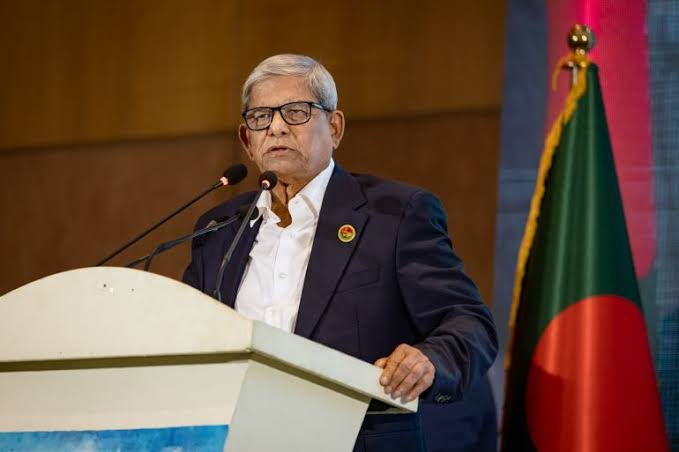
Dhaka (GNP): Mirza Fakhrul Islam Alamgir, secretary-general of the Bangladesh Nationalist Party, was elected the country’s 23rd president on Thursday, capping a political career that spans the 1971 Liberation War, decades of party politics, and repeated imprisonment under the previous government.
Fakhrul’s victory was effectively secured once the ruling BNP, led by Prime Minister Tarique Rahman, nominated him for the post, given the party and its allies hold a two-thirds majority in parliament and lawmakers are constitutionally barred from voting against their party.
The opposition alliance put forward Liberal Democratic Party Chairman Oli Ahmed as a rival candidate, though without the numbers to challenge the outcome, his nomination remained largely symbolic. Fakhrul ultimately secured the backing of 255 lawmakers, compared with 88 votes for Ahmed.
Born in 1948 in the northern district of Thakurgaon to a politically active family, Fakhrul’s early political leanings were shaped on the left. While studying economics at Dhaka University, he joined the East Pakistan Students Union and led its university unit during the 1969 uprising against Ayub Khan’s rule.
When war broke out in 1971, he joined resistance activities in his home district, later describing how he helped organise local fighters, arranged weapons training and took part in efforts to slow advancing troops before eventually crossing into India to help organise young Bangladeshis headed for training camps. Unlike many of his contemporaries, Fakhrul rarely highlighted this wartime record as a political credential in the decades that followed.
After independence, he taught economics before entering government service and later returning to teaching, eventually resigning to pursue electoral politics. He won the chairmanship of Thakurgaon municipality as an independent in 1988, joined the BNP during the movement against President Ershad, and became the party’s Thakurgaon district chief in 1992.
He entered parliament in 2001 and went on to serve as state minister for agriculture, and later for civil aviation and tourism. His rise within the party accelerated after the BNP lost power, culminating in his appointment as secretary general in 2016, a position that placed him at the centre of the organisation through some of its most difficult years.
With BNP Chairperson Khaleda Zia imprisoned and Tarique Rahman in exile in London, Fakhrul became the party’s leading public voice during a sustained government crackdown, a period marked by his consistently measured tone even as Bangladesh’s political rhetoric grew increasingly combative.
Also Read: Moscow Open to Ukraine Peace Talks, Says Sergei Ryabkov
That reputation held even as he faced roughly 100 criminal cases, including a detention at his home following unrest around a BNP rally in Dhaka in October 2023, after which he remained jailed through the lead-up to elections the party ultimately boycotted in January 2024.
Fakhrul has described himself as a liberal democrat, a stance he has said grew out of his early experience with leftist activism before concluding that lasting change required a democratic path. He has been a consistent defender of the historical significance of the 1971 war and has periodically clashed with Jamaat-e-Islami over the issue, while also stating during the 2026 campaign that the BNP’s aim was equal rights across religious communities rather than secularism itself.
His election to the presidency, a largely ceremonial post under Bangladesh’s parliamentary system that nonetheless carries constitutional weight, marks his formal exit from day-to-day party politics. He resigned as BNP secretary general following his presidential nomination, closing a career that touched nearly every major political period in Bangladesh’s history since independence.