
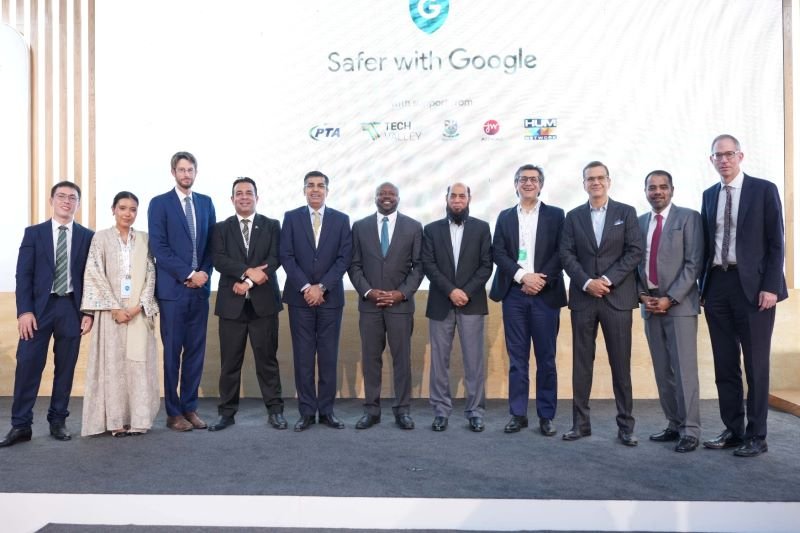
Islamabad (GNP): Google introduced Digital Pasban, a nationwide program aimed at giving Pakistani families practical tools to navigate the internet more safely. The initiative was unveiled at the “Safe Raho with Google” event and is built around supporting both parents and children as more households move online for learning, entertainment, and daily tasks.
The program targets 200,000 households with Urdu-language toolkits, instructional videos, and hands-on training sessions. It brings together a wide coalition of partners — the Pakistan Telecommunication Authority (PTA), Tech Valley, Beaconhouse School System, Jazz World, and HUM Network — with backing from the Ministry of Information Technology and Telecommunication, the Ministry of Federal Education and Professional Training, and the Ministry of Inter Provincial Coordination.
Digital Pasban combines safety tools with digital-literacy education across four areas:
- Family Link, a free app, gives parents control over screen time, app approvals, content filters, and device location tracking.
- YouTube offers age-appropriate settings and time-management tools like Take a Break and Bedtime reminders. A new feature — described as an industry first — lets parents cap or entirely eliminate the time kids spend watching Shorts, useful when children need to focus on schoolwork.
- Be Internet Awesome teaches digital citizenship to children aged 7–12 through content built around five principles: sharing carefully, avoiding scams, protecting passwords, treating others kindly, and reporting problems. These lessons are reinforced through the interactive game Interland.
- Gemini helps parents guide their children’s responsible use of AI. Google frames the assistant explicitly as a tool rather than a companion, with safeguards for minors that block harmful role-play scenarios and inappropriate content. Its Guided Learning feature also functions as an AI tutor, walking students through problems step-by-step and using visual aids rather than simply supplying answers.
The program plans to reach families through broadcast media, SMS alerts, social media campaigns run by partners, and school town halls. A key component is a series of parent and guardian safety clinics — interactive workshops where families can practice handling real online-safety scenarios together and build shared digital confidence.
Google.org is also contributing $500,000 to expand evidence-based digital citizenship and AI safety programs nationally, working with local partners to help both young people and adults build healthier online habits.
PTA Chairman Major General (Retired) Hafeez Ur Rehman said the initiative reflects a joint commitment between his organization and Google to create a safer digital environment for Pakistani children and families, and thanked Google and its partners for contributing to what he called a whole-of-society effort.
Farhan Qureshi, Google’s Cluster Director for Pakistan, the Philippines, Thailand, and Frontier Markets, said protecting children online means keeping them safe while still letting them participate in the digital world, not keeping them away from it. He said Google builds safety into its products by default and that partnerships like Digital Pasban extend that work by equipping families with digital-literacy skills, comparing the cross-sector collaboration needed to the idea that it takes a village to raise a child.
Tech Valley CEO Umar Farooq said the company has spent a decade bringing technology into Pakistani classrooms, but noted that access alone isn’t enough — parents consistently report that the pace of digital change outstrips their ability to guide their kids through it. He said Digital Pasban is meant to close that gap through safety clinics and practical, same-day-usable guidance, and described the 200,000-household target as a starting point rather than an end goal, inviting parents and teachers nationwide to get involved.
Jazz World CEO Aamir Ibrahim said that as more daily life moves online, helping families navigate it safely is increasingly important, and that Jazz World sees its role as extending beyond connectivity to include helping families make informed digital choices. He called Digital Pasban a meaningful step toward practical safety tools and guidance, and said the company is proud to partner with Google and other stakeholders on building a safer, more digitally inclusive Pakistan.
Digital Pasban extends Google’s existing work in Pakistan. Through its earlier Digital Safar program, the company has already trained more than 300,000 students and 5,000 teachers in digital citizenship, combining Be Internet Awesome materials with Gemini Academy training. That foundation was expanded further through a partnership with the Punjab government, which moved its Ministry of Education onto Google for Education and brought AI-powered learning tools and safety curricula to 1.5 million students.
Also read: Meta Faces Trial Over Child Social Media Addiction
Families and educators interested in the program can access the Digital Pasban toolkit through Google’s provided link.

Sohail Majeed is a Special Correspondent at The Diplomatic Insight. He has twelve plus years of experience in journalism & reporting. He covers International Affairs, Diplomacy, UN, Sports, Climate Change, Economy, Technology, and Health.