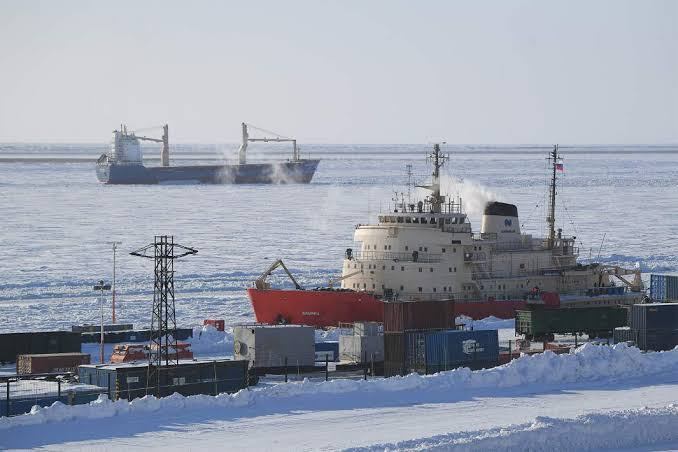
The Arctic, historically regarded as an unapproachable frozen region, has evolved into a region of significant geopolitical and economic importance. The melting ice owing to rapid climate change is creating new economic and transit opportunities. The region is home to 30 per cent of natural gas and 13 per cent of oil, as well as rare earth minerals. These natural resources are considered important for industrial consumption, technology, and the defence industry.
The melting ice has created new shipping routes, making the Northern Sea Route more accessible. The region is getting attention from non-Arctic states, having a strong interest in strategic maritime and oceanic advantages, particularly China. The Northern Sea Route can reduce China’s dependence on the Strait of Malacca, Bab al-Mandeb, and the Suez Canal, making its trade between Asia and Europe cost-effective. It can reduce maritime trade distance from China to Europe by 40%, cutting approximately 7,000 kilometres from the traditional path using the Suez Canal.
China’s Arctic Policy 2018 is divided into 3 stages. The first stage encompasses the last decade of the 20th century, when China began to show interest in the Arctic Ocean. The second stage includes the time period from 2004 to 2013. This period is referred to as the time of active implementation of China’s economic and political objectives. These objectives include a) opening an Arctic station for scientific research, b) resource extraction, c) making new shipping routes, and d) building relations with the Arctic states on Arctic governance. The Third stage began in 2013, when Xi Jinping came to power, with a political task of reviving the great Chinese nation and becoming a great maritime power.
In 2013, China’s Arctic policy became more apparent when it gained “observer state” status in the Arctic Council. In 2018, China declared itself a “Near Arctic State” in the white paper document of the People’s Republic of China (PRC). This document laid out the regulatory framework of its Arctic policy. The reason behind this policy is that it is one of the continental states closest to the Arctic Ocean based on geographical proximity.
Another reason is their belief in the Arctic region as a significant place to project national power. It seems that China wants to frame a governance system in collaboration with other Arctic states that would be more favourable to its own Arctic access and status. However, the absence of territorial sovereignty by China in the Arctic Ocean confines the extent of Chinese national power projection.
Beijing considers the Arctic region as an extension of its Belt and Road Initiative (BRI). China is linking the Arctic with the BRI and working on the “Global Arctic” Concept. Under the same BRI, China introduced another concept of maritime cooperation, referring to it as the “Polar Silk Road.” This project has been viewed as a great step to enhance Sino-Russian cooperation beyond global trade determinations.
The comprehensive partnership between China and Russia is a great strategy to diversify China’s trade and economic ties using Arctic routes. Russian President Vladimir Putin and Chinese President Xi Jinping are also vocal about “no limits” cooperation in the Arctic region.
Also Read: Forging Unity Under Law, Building a Brighter Future Through Cooperation
Therefore, the two states launched international transportation projects in the field of logistics and transportation, connecting Heilongjiang and Jilin Provinces of China with the Primorsky Krai region and Zarubino port in Russia. Moreover, in 2023, the Russian Federal Security Service and the Chinese Coast Guard signed an MoU to support Maritime Law enforcement cooperation in the region.
Although Russia is a part of the Arctic Council, the relations between Russia and the member states of the Arctic Council (Canada, Denmark, Finland, Iceland, Norway, Russia, the US, and Sweden) have become strained owing to the Russia-Ukraine war. The US interest in acquiring Greenland is also turning the region into a battleground for great power competition.
It is exemplified in the US National Strategy 2022 and the NATO document, which have identified the Sino-Russian cooperation as a potential threat to the US interests in the region.A major shift is expected if Russia and the US reach an Arctic cooperation agreement, as the US seeks mutually beneficial energy projects with Russia and access to key trade routes.
The Arctic Institute reported that Trump, in his meeting with Putin in Alaska in August 2025, suggested some economic agreements of cooperation between Russia and the US. Regardless of the possible US-Russia cooperation, both China and Russia have aligned their strategic interests in the Arctic Ocean due to its increasing importance.
In the coming years, the Beijing-Moscow alliance will have a significant advantage in order to increase cooperation in research and development. With Russian cooperation, China can seek a legitimate role in Arctic governance. The region can serve as a dual-use corridor for China, where its economic, energy, and military goals unite.
The views presented in this article are the author’s own and do not necessarily reflect the views of Global News Pakistan

Huria Bint E Ashiq
Huria Bint E Ashiq is a scholar at the Centre for International Peace and Stability (CIPS), National University of Sciences and Technology (NUST), Islamabad, with a research focus on regional and global security, great power politics, and strategic affairs. She is currently a Research Intern at the Islamabad Policy Research Institute.