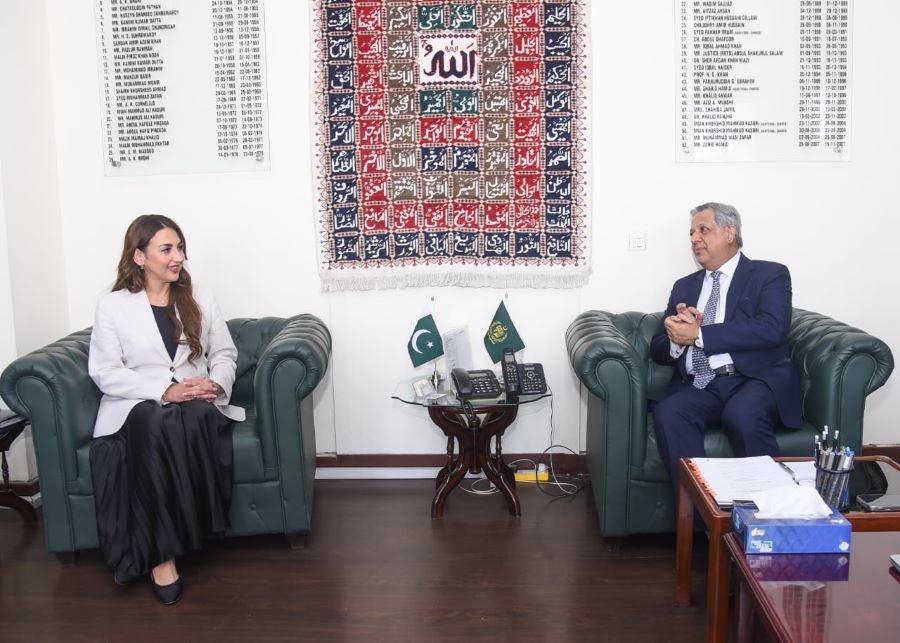
Islamabad (GNP): U.S envoy meeting focused on Pakistan-U.S. bilateral relations, role in Gulf conflict, matters of mutual interest, and the regional situation. Federal Minister for Law, Justice and Human Rights, Senator Azam Nazeer Tarar, met the Chargé d’Affaires of the U.S. Embassy, Natalie A. Baker, at the Ministry of Law, Justice and Human Rights.
During the discussion, Baker acknowledged Pakistan’s constructive role during the recent Gulf conflict, commending the country’s diplomatic efforts to promote regional peace and stability. She also recognized the contributions of Field Marshal Syed Asim Munir and Prime Minister Shehbaz Sharif in this regard.
In response, Tarar reaffirmed that Pakistan would continue playing a constructive role in supporting regional peace and dialogue.
Both officials reaffirmed their commitment to strengthening Pakistan-US cooperation, including collaboration in the legal sector and other areas of shared interest.
Analysis: Pakistan’s Mediating Role in the Gulf
Pakistan has increasingly positioned itself as a balancing force in Gulf tensions, drawing on its strong strategic relationship with Saudi Arabia alongside its close geographic and diplomatic proximity to Iran.
Through active diplomatic engagement, Islamabad has worked to prevent broader regional escalation while protecting its large overseas workforce and safeguarding its economic and energy interests in the region.
The ongoing Gulf conflict presents a complex challenge for Pakistan, requiring it to maintain functioning relationships with Washington, Tehran, Riyadh, and other Gulf capitals simultaneously, all while avoiding direct involvement in a conflict whose consequences could extend well beyond the Middle East.
Pakistan’s position is shaped by several overlapping factors: a lengthy border with Iran, deep defense and economic ties with Saudi Arabia and Gulf Cooperation Council states, a substantial expatriate population working in the Gulf, improving relations with the Trump administration, and persistent energy security concerns — making the conflict a matter of direct strategic relevance rather than a distant geopolitical event.
Recent diplomatic activity reflects this dynamic, with Pakistan working to facilitate dialogue between Tehran and Washington through high-level engagements aimed at de-escalation.
Key points of contention remain centered on Iran’s nuclear program, sanctions, access to the Strait of Hormuz, and assurances against future military action.
Analysts note that Pakistan’s advantage in this context lies in its access to multiple parties rather than any direct leverage over them — it cannot dictate terms to Iran, the US, or Gulf states, but maintains working relationships with all of them despite periodic tensions, particularly along its border with Iran.
Its long-standing defense, labor, and financial ties with Saudi Arabia and the wider Gulf, combined with continued military and diplomatic channels with Washington and a growing strategic relationship with China, position Pakistan as a useful, if imperfect, intermediary.
This role echoes Pakistan’s historical function as a diplomatic back-channel, most notably during the early 1970s US-China rapprochement — a precedent that, while not directly replicable today, underscores Pakistan’s recurring value in facilitating communication between rival parties without being fully aligned with either side.
Also read: Iran and Oman Reach Deal on Hormuz Shipping Route
In the current crisis, Pakistan is seen as capable of conveying difficult messages to both sides: cautioning Iran that further escalation risks deepening its regional isolation and hardening threat perceptions among Gulf states, while also signaling to Washington and Gulf capitals that lasting regional stability cannot be achieved through military pressure and deterrence alone.

Sohail Majeed is a Special Correspondent at The Diplomatic Insight. He has twelve plus years of experience in journalism & reporting. He covers International Affairs, Diplomacy, UN, Sports, Climate Change, Economy, Technology, and Health.