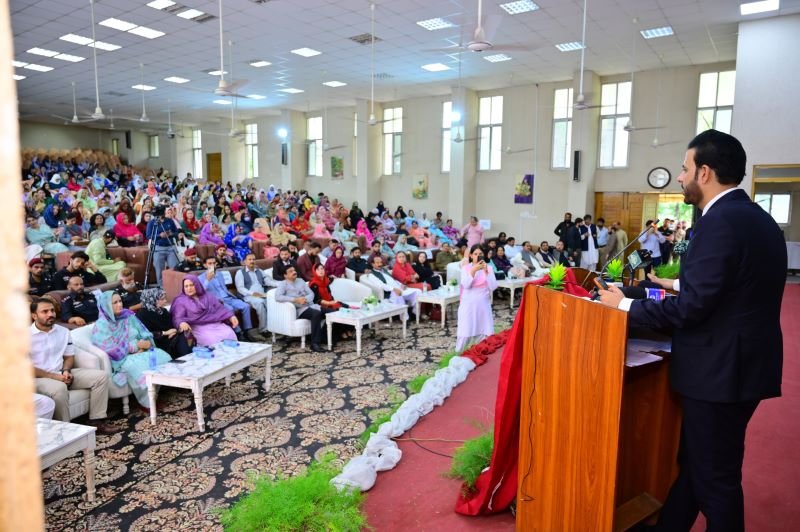
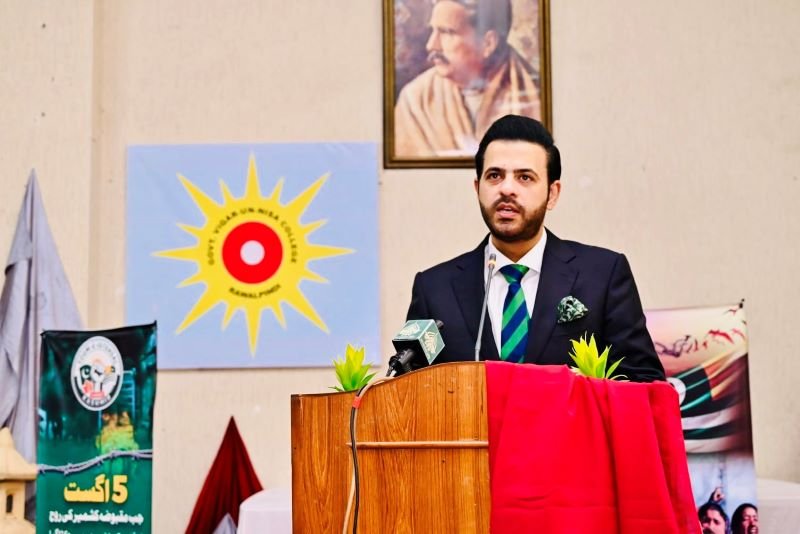
Rawalpindi (GNP): Federal Parliamentary Secretary for Information and Broadcasting Barrister Danyal Chaudhry said India’s attempt to alter the status of occupied Jammu and Kashmir on August 5, 2019, has failed and been firmly rejected by the Kashmiri people, speaking at a ceremony held at Waqar-un-Nisa College, Rawalpindi, to mark Youm-e-Istehsaal Kashmir.
The event was attended by MNAs Engineer Qamar-ul-Islam Raja and Asiya Naz Tanoli, Deputy Commissioner Rawalpindi Nadeem Nasir, MPA Shazia Rizwan, college principal Professor Zahida Parveen, along with faculty, students, and members of the public.
Remarks on Kashmir
Chaudhry said the Pakistani nation stands firmly behind the Kashmiri people and would not allow what he described as India’s expansionist ambitions to succeed. He argued that India’s 2019 actions violated UN Security Council resolutions and international law, calling them unacceptable to any law-abiding society.
He said India cannot alter the internationally recognized disputed status of Jammu and Kashmir through unilateral measures, and that efforts to change the region’s demographic and cultural composition would ultimately fail.
Despite what he described as ongoing human rights violations by occupying forces, Chaudhry said the resilience of the Kashmiri people remains unbroken, and that their decades-long struggle for self-determination cannot be suppressed.
Background on the Kashmir Dispute
The dispute traces back to the Kashmiri population’s long-standing demand for self-determination, with peaceful demonstrations historically met with force by Indian security forces, resulting in significant casualties over the years.
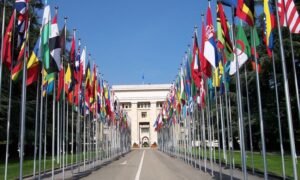
Pakistan has consistently maintained that allegations of external interference in the Kashmiri movement are unfounded, citing independent international reporting suggesting the movement is locally driven. Islamabad’s position rests on UN Security Council resolutions from 1948 and 1949, which call for a plebiscite to determine the region’s future through the will of its people.
These resolutions established that the Kashmir dispute was originally brought before the Security Council by India itself, and that the Council did not recognize Kashmir as legally part of India, instead affirming self-determination as the guiding principle for resolving the dispute — including a UN-mediated agreement between India and Pakistan for a plebiscite under agreed conditions.
Pakistan has also rejected India’s position that elections held periodically in Indian-administered Kashmir constitute an exercise of self-determination, pointing to historically low voter turnout — such as the widely cited 1989 election — as evidence undermining that claim.
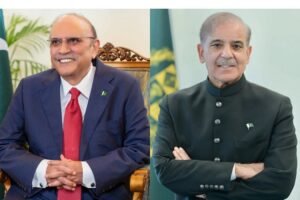
Also read: President, PM Reaffirm Solidarity with Kashmiris of IIOJK
Pakistan maintains that these UN resolutions remain binding on both countries. It also notes that the 1972 Simla Agreement, which it continues to uphold, did not change Kashmir’s status as a disputed territory — the agreement itself lists a final settlement of Jammu and Kashmir among unresolved issues, refers to a “Line of Control” rather than an international border, and preserves each side’s recognized position on the matter.

Sohail Majeed is a Special Correspondent at The Diplomatic Insight. He has twelve plus years of experience in journalism & reporting. He covers International Affairs, Diplomacy, UN, Sports, Climate Change, Economy, Technology, and Health.