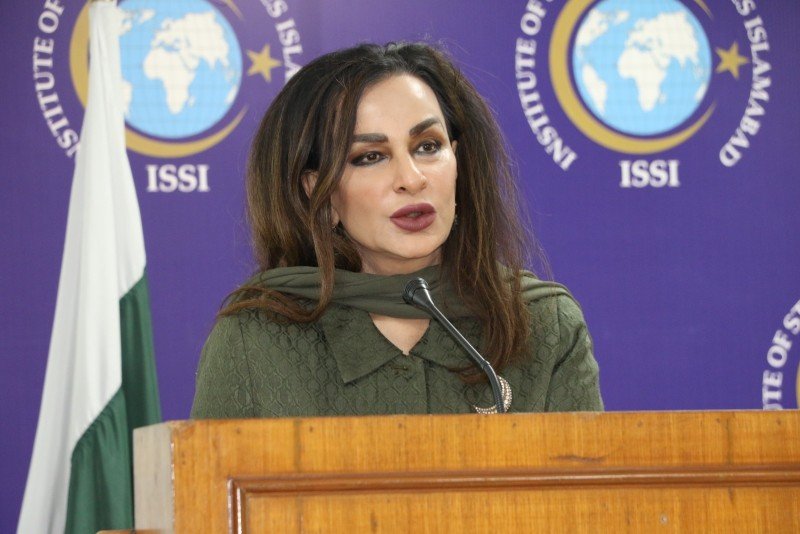
Islamabad (GNP): Senator Sherry Rehman, said that Youm-e-Istehsal Kashmir marks not merely the anniversary of India’s illegal and unilateral revocation of Article 370 on 5 August 2019, but a continuing assault on international law, human dignity and the fundamental right of the Kashmiri people to self-determination.
Delivering the Chief Guest Address at the Institute of Strategic Studies Islamabad (ISSI), Senator Rehman said the day was a solemn reminder of the grave responsibility that rests upon the international community to uphold justice for the people of Indian Illegally Occupied Jammu and Kashmir (IIOJK).
“For decades, the people of Kashmir have been denied the experience of human dignity. Behind military occupation, barbed wire, barricades, arbitrary detention and constant surveillance, generations have lived under a colonised reality. This is state-sponsored violence. Let us call a spade a spade. It is also the moral reckoning of our time,” she said.
Senator Rehman said the struggle of the Kashmiri people for self-determination is not merely their struggle alone but a shared responsibility for all those who believe in justice and international law. “Far too often, Kashmir is intentionally pushed to the diplomatic backburner, despite remaining one of the world’s oldest unresolved international disputes,” she remarked.
Describing IIOJK as “the world’s largest open-air prison,” she noted that nearly 900,000 Indian troops remain deployed against a civilian population of approximately eight million people, making it one of the highest troop-to-civilian ratios anywhere in the world.
Highlighting the immense humanitarian cost of the occupation, Senator Rehman said that according to official figures by Kashmir Media Service and independent human rights bodies: more than 500,000 Kashmiris have lost their lives since 1947, 3.5 million have been displaced, over 168,000 people have been arbitrarily detained since 1989, 110,000 homes destroyed, 22,963 women widowed, 11,259 women subjected to rape or molestation, while more than 1,200 children have been blinded by pellet guns.
Since 1989 alone, 96,449 Kashmiris have embraced martyrdom, including 930 children, and 107,982 children have been orphaned by the conflict. She further noted that following the revocation of Article 370, more than 5,000 political leaders, journalists and activists were detained in a sweeping crackdown.
“These are not merely statistics. They are shattered worlds, stolen childhoods and families torn apart. They represent a profound failure of humanity’s collective conscience,” she said.
Emphasising the legal status of the dispute, Senator Rehman said Kashmir cannot be reduced to territorial ambition or cartographic politics.
“For us, Kashmir is not real estate. It is an internationally recognised disputed territory where one of the world’s longest forcible occupations has rendered history a silent bystander to a regime of genocidal brutality. Indian impunity and the story of state terrorism in Kashmir must never be forgotten,” she said.
She reminded the audience that nearly eight decades ago, the United Nations recognised Jammu and Kashmir as a disputed territory through Security Council Resolutions 47 and 80, calling for a plebiscite that remains unimplemented after seventy-nine years.
“The revocation of Article 370 did not resolve the dispute. What India calls a constitutional resolution was, in reality, an attempted annexation by stealth.
No unilateral decree can erase Kashmir’s internationally recognised disputed status or extinguish the right of its people to determine their own future.”
She expressed concern over what she described as systematic demographic engineering following August 2019, noting that millions of domicile certificates had reportedly been issued to non-Kashmiris in an attempt to alter the demographic character of the occupied territory.
Recalling her visit to Kashmir in 2002, Senator Rehman said she encountered a land of extraordinary cultural richness overshadowed by fear and repression.
“I witnessed a people whose resilience endured despite living under the constant shadow of fear. Their voices cannot be erased, nor can their aspirations be legislated away. Kashmiris have never accepted this attempted annexation, and Pakistan has never accepted it either. Their story continues despite every effort to suppress it,” she said.
Senator Rehman reaffirmed Pakistan’s unwavering support for the people of Jammu and Kashmir, saying, “The people of Kashmir continue to ask the world one simple question: Who stands with us? Pakistan’s answer remains unequivocal. We stand with the people of Jammu and Kashmir. Their struggle is not forgotten, and neither is their right to self-determination.”
She further warned that India’s decision to place the Indus Waters Treaty in abeyance had introduced a dangerous new dimension to regional instability.
“Water is life. It sustains our people, our agriculture and our economy. Rivers cannot be turned off like a tap. Weaponising water through hydro-terrorism violates international law and threatens regional peace and security,” she said.
Also Read: UN Warns of Deepening Child Malnutrition Crisis in Afghanistan
Rejecting allegations against Pakistan, Senator Rehman said repeated attempts to portray Pakistan as an exporter of terrorism had failed to withstand objective international scrutiny, while India’s own actions continued to destabilise the region.
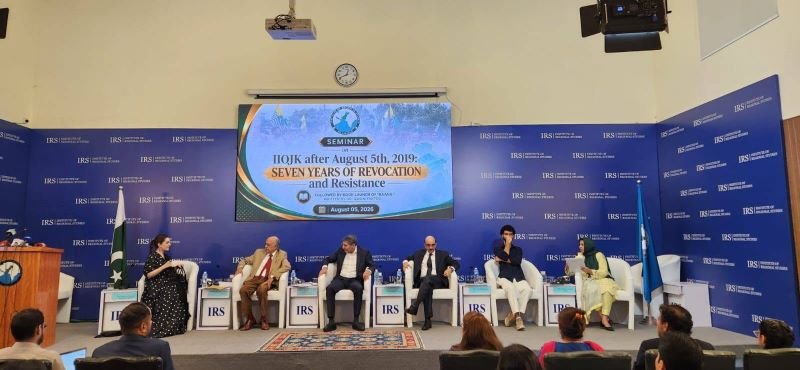
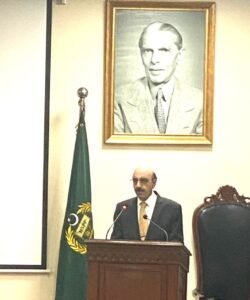
Speaking on the continuing challenges confronting the Jammu and Kashmir dispute, Ambassador Masood Khan stressed that Pakistan must move beyond token expressions of solidarity and pursue a comprehensive, year-round diplomatic, legal and intellectual campaign to keep the Kashmir issue at the forefront of the international agenda. He maintained that symbolic commemorations alone were insufficient unless complemented by sustained engagement with international institutions, academia, media, civil society and policy forums.
Ambassador Khan reiterated that India’s unilateral actions of 5 August 2019 violated the relevant United Nations Security Council resolutions and could not alter the internationally recognized disputed status of Jammu and Kashmir. He observed that the abrogation of Article 370 and related constitutional changes had further eroded the political and legal rights of the people of Indian Illegally Occupied Jammu and Kashmir, while demographic engineering, electoral restructuring and restrictive laws had fundamentally altered the region’s political landscape.
Reviewing Pakistan’s diplomatic efforts, Ambassador Khan noted that Islamabad had consistently raised the Kashmir dispute at the United Nations Security Council, the Human Rights Council and other international forums, thereby preventing the issue from disappearing from global attention. He, however, emphasized that diplomatic engagement must now be reinforced through stronger international advocacy, systematic public diplomacy and strategic communication capable of mobilizing global opinion in support of the Kashmiri people’s right to self-determination.

Sohail Majeed is a Special Correspondent at The Diplomatic Insight. He has twelve plus years of experience in journalism & reporting. He covers International Affairs, Diplomacy, UN, Sports, Climate Change, Economy, Technology, and Health.