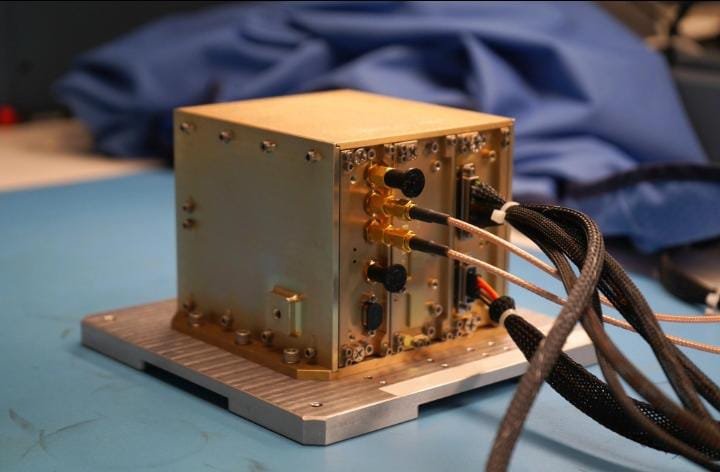
WASHINGTON (GNP): NASA NavCube3 just took another step toward making future lunar missions possible, with NASA delivering the compact navigation payload to Intuitive Machines for integration into its Altus-1 lunar relay mission. It’s a meaningful advance for the agency, which has been working to build autonomous navigation tech that lets spacecraft find their way around the Moon without leaning entirely on Earth-based tracking.
The NavCube3 itself is tiny about 3.5 pounds but its job is significant. It’s built to show how signals originating from Earth can help a spacecraft figure out exactly where it is, whether it’s orbiting the Moon or venturing on missions farther out. Once it’s bolted onto the Altus-1 spacecraft, engineers will put it through its paces to see how it holds up in the harsh environment around the Moon.
NASA is framing this as a real demonstration of what next-gen navigation could look like technology that makes lunar exploration more efficient, safer, and more dependable. The thinking here is pretty practical: the less a spacecraft needs constant back-and-forth with Earth, the more it can make its own navigation calls during deep-space operations, which matters a lot once you’re that far from home.
This whole project fits into NASA’s bigger picture building a lasting presence around the Moon as part of the Artemis program. And as more spacecraft, robotic landers, science payloads, and eventually astronauts start operating together in cislunar space, the demand for smarter, more independent navigation systems is only going to grow. NASA sees reliable autonomous positioning as one of the must-have pieces of that expanding lunar infrastructure.
The payload will actually live aboard Intuitive Machines’ Altus-1 spacecraft, a lunar relay mission designed to boost communications and navigation support for missions to come. Pair relay communications with solid positioning tech, and you’ve got the groundwork for longer, more complex operations both on and around the Moon’s surface.
There’s also a broader story here about NASA’s push toward smaller, lighter space technology. Spacecraft these days are increasingly built around compact systems that sip less power but still pack serious capability. And smaller payloads aren’t just a technical win they cut launch costs too, opening the door for more scientific instruments and commercial partners to hitch a ride on future missions.
Officials are pretty blunt about why this matters: autonomous navigation is only going to become more essential as exploration pushes past low Earth orbit. Spacecraft near the Moon deal with longer communication delays and don’t have the same navigation infrastructure satellites around Earth take for granted. So having tech that can independently figure out position and trajectory isn’t just convenient it gives missions more flexibility and takes some of the pressure off mission controllers back on Earth.
Also Read: Iran Says Hormuz Talks With Oman Ongoing, Not With US
This integration also says a lot about how far NASA’s partnership with the commercial space sector has come. Intuitive Machines has quietly become one of NASA’s go-to partners for lunar exploration, contributing to communications, transportation, and research efforts tied to Artemis. These kinds of collaborations are meant to speed up innovation while keeping costs down private industry doing some of the heavy lifting alongside NASA.
And the ambitions don’t stop at the Moon, either. NASA thinks whatever gets proven out through NavCube3 could eventually help missions headed to Mars and beyond. The farther a spacecraft travels from Earth, the more communication delays start to matter which makes autonomous navigation systems that need minimal ground support increasingly valuable.
At its core, this milestone reflects NASA’s long game, building the tools that’ll carry the next era of space exploration forward. As Artemis missions and commercial lunar projects keep ramping up, NavCube3 is one more piece of that puzzle, pushing toward a future that’s more connected, more autonomous, and more sustainable beyond Earth. Better navigation around the Moon isn’t just a nice technical achievement; it’s a real step toward NASA’s bigger vision of expanding both human and robotic exploration deeper into space.