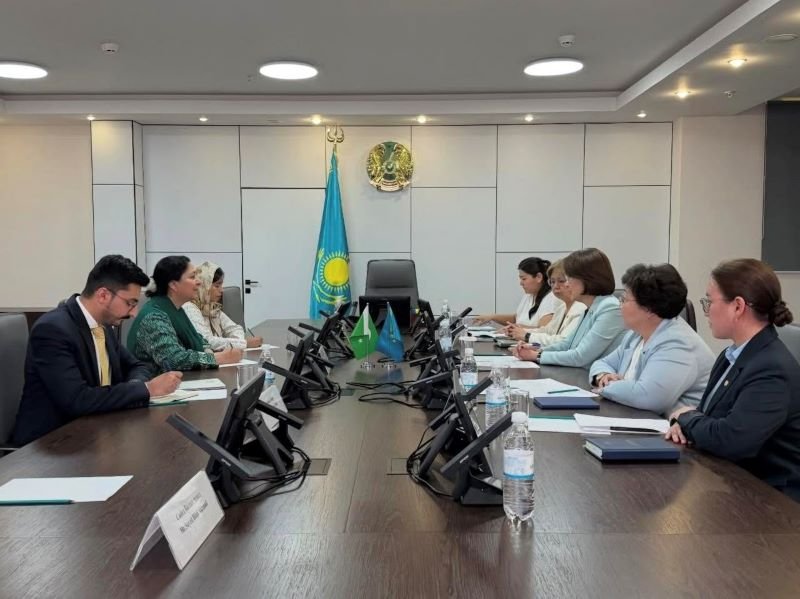
Kazakhstan (GNP): Pakistan’s Minister of State for Federal Education and Professional Training, Wajiha Qamar, met with Kazakhstan’s Minister of Health, Akmaral Alnazarova, to discuss expanding bilateral cooperation in medical education, healthcare training, research, and workforce development.
During the meeting, both officials welcomed the signing of a Memorandum of Understanding between Astana Medical University and the Pakistan Education Endowment Fund (PAK-EEF), supported by Kazakhstan’s Ministry of Health.
The agreement aims to strengthen medical education cooperation through internationally aligned training programs for doctors and nurses, joint research initiatives, academic exchanges, and broader institutional partnerships.
Qamar praised Kazakhstan’s ongoing commitment to international collaboration in higher education and healthcare, noting that under Prime Minister Shehbaz Sharif’s leadership, Pakistan remains focused on building global partnerships that improve educational quality and develop a skilled healthcare workforce prepared for future challenges.
She also expressed appreciation for the humanitarian grant extended by the Kazakh government to PAK-EEF, following a decision by Kazakh President Kassym-Jomart Tokayev, describing the gesture as a reflection of the strong friendship and growing strategic partnership between the two countries that would help expand educational opportunities for Pakistani students.
Both sides reaffirmed their commitment to deepening cooperation in medical education, research, and healthcare innovation, while encouraging stronger institutional ties between universities and medical institutions in Pakistan and Kazakhstan.
Astana, Kazakhstan’s capital, sits along the banks of the Ishim River and had a population of just over 1 million as of 2017. Known for its modern architecture and skyline, the city is also home to numerous educational, sporting, and healthcare institutions.
Also read: Pakistan built a strong foundation for digital growth, Julian
It ranks among the coldest capital cities in the world, with a continental climate featuring hot summers, where temperatures can exceed 35°C, and harsh winters that regularly drop to between -30°C and -35°C.
The city offers various transportation options, including buses and taxis for local travel, along with rail, road, and air connections for travel beyond the city.
Notable landmarks include the Museum of the First President of Kazakhstan, the Atameken ethno-memorial complex, the Palace of Peace and Reconciliation, the Nur-Astana Mosque, and the Bayterek Tower.

Sohail Majeed is a Special Correspondent at The Diplomatic Insight. He has twelve plus years of experience in journalism & reporting. He covers International Affairs, Diplomacy, UN, Sports, Climate Change, Economy, Technology, and Health.