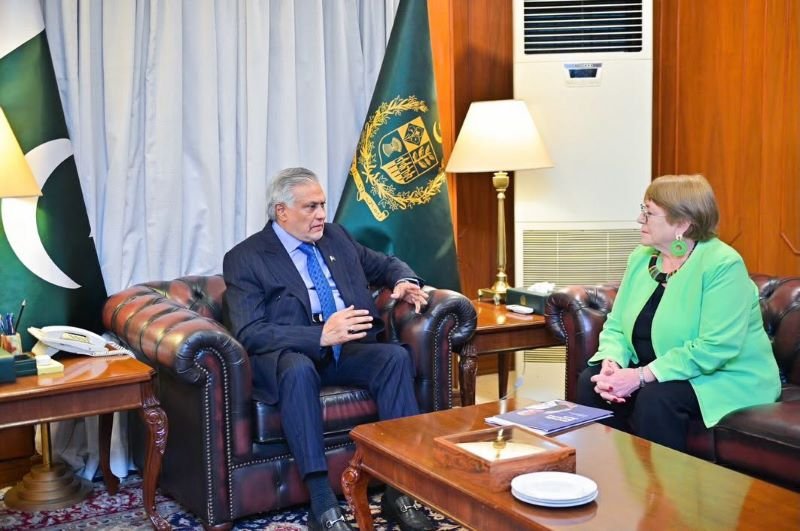
Islamabad (GNP): Michelle Bachelet Jeria, a candidate for UN Secretary-General, met with Deputy Prime Minister and Foreign Minister Senator Mohammad Ishaq Dar in Islamabad.
During the meeting, Dar reaffirmed Pakistan’s commitment to the principles of the UN Charter and to upholding international law and treaties. He emphasized the UN’s important role in advancing global development, stressing that the organization needs to remain attentive to the priorities of developing nations.
Dar also highlighted the importance of resolving international disputes peacefully through proper implementation of UN Security Council resolutions, specifically pointing to the Jammu and Kashmir dispute and the Palestine issue as matters requiring attention in this regard.
Bachelet acknowledged Pakistan’s continued efforts toward regional peace and stability and recognized the country’s long-standing contributions to the United Nations.
On the Role of the Next Secretary-General
Bachelet’s platform for the position draws on Article 97 of the UN Charter, which establishes the Secretary-General as the organization’s chief administrative officer, responsible for implementing the decisions of member states. She has argued that given the range of challenges facing the UN today, the next Secretary-General’s vision for the coming years needs to be both practical and grounded in realistic expectations.
She has said that effective leadership at this moment calls for steady judgment and a strong commitment to the Charter, with the next Secretary-General expected to work closely with member states to reaffirm the UN’s core principles, pursue institutional reform, and build a more responsive organization capable of delivering across all three pillars of the UN’s work — peace and security, development, and human rights.
Bachelet has also stressed that the next Secretary-General should engage actively with member states to ensure the UN remains a central player on issues of global significance, rather than a passive observer.
She has argued that an effective Secretary-General today needs both sound judgment and versatility, capable of serving as administrator, peacemaker, mediator, and spokesperson depending on the situation — and, crucially, able to judge which role best fits each circumstance, balancing timely action with careful consideration of long-term impact.
Also read: UN Prison Standards Draw Fresh Attention Ahead Of Mandela Day
Reflecting on the UN’s history, Bachelet has pointed to its growth from 51 founding member states to 193 today as evidence of its lasting influence, citing its achievements across decolonization, dispute resolution, environmental protection, poverty reduction, humanitarian response, and human rights. She has described the UN’s role in establishing shared global norms as one of its most significant contributions, crediting multilateralism — anchored in the UN Charter — as central to that success.
The United Nations is all of us – the 193 Member States who decide on its mandates and
the team of dedicated staff who carry out these decisions. The responsibility of ensuring
its continued relevance and effectiveness is shared by all, and the Secretary General has a
pivotal role in ensuring timely interventions, delivery on mandates, and prudent resource
management.
As chief spokesperson of the Organization, she must communicate with clarity the
breadth of the achievements of the UN, its challenges, as well as ongoing modernization
efforts to ensure that it remains fit for purpose. This is crucial in strengthening visibility,
mobilizing widespread support and resources for the UN’s work, and in countering
misinformation and disinformation which undermine public trust in the Organization.

Sohail Majeed is a Special Correspondent at The Diplomatic Insight. He has twelve plus years of experience in journalism & reporting. He covers International Affairs, Diplomacy, UN, Sports, Climate Change, Economy, Technology, and Health.