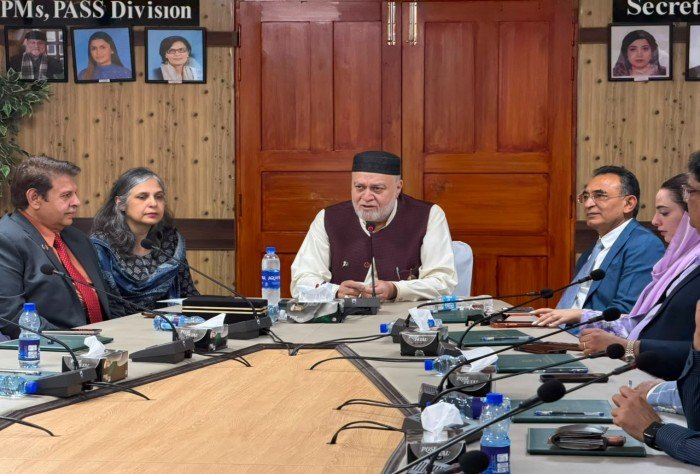
Islamabad (GNP): A delegation of the New York Chamber of Small Business Corporation, USA and members of Sahiwal Chamber of Commerce and Industry, called on the Federal Minister for Poverty Alleviation and Social Safety, Syed Imran Ahmad Shah, to discuss Pakistan’s social protection initiatives, poverty alleviation, humanitarian work, skills development, and avenues for future collaboration.
The delegation was led by Bishop Abraham Nazir Daniel and Alamdar Hussain Shah, Founder New York Chamber of Small Business Corporation, USA and comprised distinguished professionals from diverse sectors, including journalism, pharmacy, law, education, business, and social development.
The delegation also included representatives of various international chapters and wings of the Chamber from New York, the United Arab Emirates (UAE), and Qatar, reflecting its broad international outreach.
Welcoming the delegation, the Federal Minister highlighted the Government’s commitment to building an inclusive and sustainable social protection system under the vision of Prime Minister Muhammad Shehbaz Sharif.
He said the Ministry is considering changing the name “Ministry of Social Security” in line with internationally accepted terminology to better reflect its mandate.
Additional Secretary Sumaira Samad briefed the delegation on the Ministry’s mandate since its establishment in 2019, explaining that it was created to bring Pakistan’s social protection and social safety programmes under one umbrella, ensuring effective coordination with the provinces, avoiding duplication of efforts and creating greater synergy in service delivery.
She informed the delegation that the Ministry oversees four key organizations: the Benazir Income Support Programme (BISP), the Pakistan Poverty Alleviation Fund (PPAF), the Pakistan Bait-ul-Mal (PBM), and the Trust for Voluntary Organizations (TVO).
The delegation was informed that BISP’s evidence-based National Socio-Economic Registry underpins the government’s unconditional cash transfer, nutrition and social welfare programmes. The Minister shared that the government is committed to expanding the Unconditional Cash Transfer (UCT) programme beyond its existing coverage of 10.2 million beneficiary families. He noted that the allocation for the programme has been increased to Rs. 838 billion in the current financial year, reflecting the Government’s commitment to extending support to more deserving households.
The Minister emphasized that the government’s vision is not merely to provide financial assistance but to empower people with the skills to become self-reliant, stating, “We do not want to give people fish; we want to teach them how to catch fish.”
He announced that 165 Women Empowerment Centres are being modernized to align their training with market needs and that Memorandums of Understanding (MoUs) will be signed with relevant institutions to strengthen market-driven skills development. He further stressed the importance of mainstreaming women into the national economic arena through enhanced employment, entrepreneurship and livelihood opportunities.
The delegation was also briefed on PPAF’s initiatives in adaptive climate resilience and interest-free lending, Pakistan Bait-ul-Mal’s welfare programmes, including Women Empowerment Centres, orphanages, Senior Citizens’ Recreation Centres, financial assistance for deserving families and food kitchens, as well as TVO’s role in strengthening civil society organizations.
The meeting was informed that the IFAD-supported National Poverty Graduation Programme (NPGP) has been completed and has been succeeded by the Pakistan Graduation of Extremely Poor (PGEP), supported by the World Bank, which focuses on sustainable livelihoods through interest-free loans and targets the poorest and climate-vulnerable districts, with particular emphasis on 12 districts of Balochistan, five districts in Sindh and three districts of the merged areas, in line with Prime Minister Shehbaz Sharif’s vision of “Khushal Balochistan, Mazboot Pakistan.”
Highlighting the importance of education, the Minister noted that Pakistan continues to face the challenge of approximately 28 million out-of-school children.
He said the government is promoting school enrolment through its Ministry’s initiatives such as Taleemi Wazaif and Schools for Rehabilitation of Child Labour (SRCLs) etc. 12.8 million out of school children have been enrolled under the Talemi Wazaif program . he emphasized that beneficiary families are encouraged to ensure regular school attendance of their children to secure a better future.
The delegation appreciated the Government of Pakistan’s efforts in poverty alleviation, humanitarian assistance and social welfare. As a gesture of goodwill, the delegation presented the Minister with Souvenirs from different Chapters of the Chamber.
Also read: UN Women Chief Urges Gender Equality
Both sides agreed to explore collaboration in skills development, vocational training, women’s economic empowerment, entrepreneurship, social enterprise, private sector partnerships, investment promotion, market linkages and capacity building. The delegation also expressed its willingness to facilitate international business connections, knowledge exchange and investment opportunities through its global network to support Pakistan’s socio-economic development.

Sohail Majeed is a Special Correspondent at The Diplomatic Insight. He has twelve plus years of experience in journalism & reporting. He covers International Affairs, Diplomacy, UN, Sports, Climate Change, Economy, Technology, and Health.