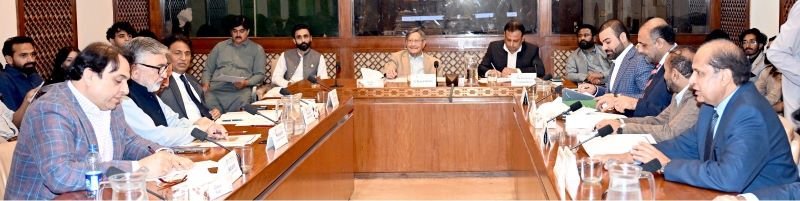
Islamabad (GNP): Senate Standing Committee on Law and Justice, chaired by Senator Farooq H. Naek, held a session covering three key agenda items: a planned briefing from the National Accountability Bureau (NAB), proposed changes to the Juvenile Justice System, and pay disparities between federal and provincial law officers.
NAB Briefing Postponed
Although the NAB Chairman was expected to brief the committee on the bureau’s operations, he did not attend the meeting. Senator Naek informed members that NAB had sent a letter regarding the matter, while NAB Deputy Chairman Sohail Nasir attended in his place and requested that the briefing be rescheduled, citing the need for additional preparation time for a more thorough presentation. He apologized to the committee, explaining that changes to the agenda meant the bureau’s material was not yet complete and that this was the reason the Chairman had not appeared.
Senator Kamran Murtaza noted that NAB had previously committed to having its Chairman personally brief the committee, and said that if he could not attend, the committee should be informed in advance so members could instead visit him directly. He emphasized that parliamentary committees represent an extension of Parliament and deserve to be treated accordingly.
In response, Senator Naek instructed NAB to finalize its preparations and submit the briefing materials by the end of July, with the item to be taken up again at the committee’s first meeting in August.
Juvenile Justice System Amendment Bill
The committee then reviewed the Juvenile Justice System (Amendment) Bill introduced by Senator Sarmad Ali, who joined the session virtually. He explained that the proposed amendments would bar the death penalty for anyone under 18 and would introduce specialized training for judges handling juvenile cases. He noted the bill currently applies only to Islamabad, with similar legislation planned for the provinces later.
The Secretary of the Ministry of Law and Justice noted that comparable provisions already exist under Islamabad’s juvenile justice law, and that provinces had implemented their own versions of the legislation with modifications following the 2018 federal law.
Senator Naek pointed out that the Criminal Procedure Code itself does not prescribe punishments, since these fall under substantive criminal law, and explained that juvenile justice legislation combines elements of both procedural and substantive law.
Senator Zamir Hussain Ghumro noted that while the federal government can amend federal laws, authority over provincial subjects rests with the provinces themselves, though amendments to criminal procedure law remain within federal purview.
The Minister of State for Law and Justice, who chairs a coordination committee focused on legal uniformity, said the remaining provinces were also in the process of implementing the Juvenile Justice Act.
Senator Naek expressed frustration that the Ministry of Law and Justice had not submitted its written position on the bill beforehand, telling the Law Secretary that engaging in debate without first providing formal comments was not appropriate.
The committee ultimately deferred further discussion of the bill, directing the Law Secretary to clarify at the next meeting whether the legislation falls under criminal law, and to provide a comparative review of juvenile justice laws across the provinces.
Disparities in Law Officers’ Compensation
The committee also examined differences in salaries, allowances, and benefits between federal and provincial law officers. Senator Murtaza clarified that the committee was reviewing the matter purely as a point of principle, and both he and the chairman announced they would abstain from voting on the issue.
The Law Secretary confirmed a clear gap exists between federal and provincial law officer benefits, noting that provincial officers receive a non-practicing allowance that federal officers do not.
Senator Ghumro questioned how law officers could engage in private legal practice while serving in official capacities, noting that the Attorney General is legally barred from private practice, and asked how similar restrictions applied within the Attorney General’s office more broadly. Senator Naek acknowledged that past Attorneys General had engaged in private practice, though this is no longer the case.
Naek argued that if federal law officers remain barred from private practice, their compensation and benefits should be adjusted accordingly, and directed the Ministry of Law and Justice to draft comprehensive rules on the matter for review at the next meeting, with the goal of bringing federal and provincial law officer benefits to parity.
The meeting was attended by Senators Kamran Murtaza, Zamir Hussain Ghumro, Abdul Qadir, along with senior officials from the ministry and related departments.

Sohail Majeed is a Special Correspondent at The Diplomatic Insight. He has twelve plus years of experience in journalism & reporting. He covers International Affairs, Diplomacy, UN, Sports, Climate Change, Economy, Technology, and Health.