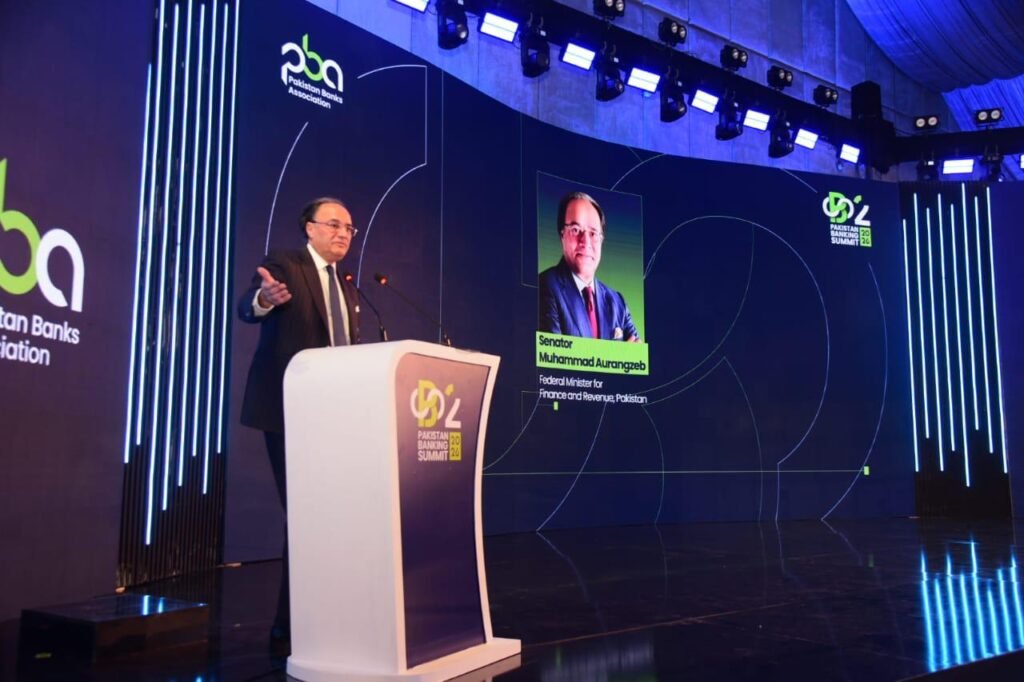
Karachi (GNP): Federal Finance and Revenue Minister Senator Muhammad Aurangzeb announced the creation of a dedicated task force aimed at improving access to financing for small and medium enterprises (SMEs). Speaking at the Pakistan Banking Summit 2026 in Karachi, he called on the banking industry as a whole to step up private sector lending, while laying out the government’s broader plans for banking reform and long-term economic growth.
The task force will operate under the leadership of the State Bank of Pakistan, with senior representatives drawn from the Pakistan Banks’ Association, the Small and Medium Enterprises Development Authority, various chambers of commerce and industry, and the Ministry of Finance. Its mandate will be to propose concrete steps for improving SME financing and expanding credit access across the banking sector.
Aurangzeb stressed the central role banks play in driving economic growth, saying that expanding credit to SMEs, exporters, and sectors such as agriculture, manufacturing, construction, housing, and information technology is essential to achieving sustainable growth. He argued that improving SME access to finance cannot rest on the shoulders of just a few institutions and must instead become a shared, sector-wide priority. He also noted that the necessary budgetary allocations for these sectors had already been incorporated into the FY27 budget.
Turning to the broader economic picture, the minister pointed to a strong close to the last fiscal year, citing a primary surplus, the lowest fiscal deficit seen in recent years, improved debt metrics, steady current account performance, record-high remittances, growing foreign exchange reserves, and renewed access to international capital markets — including Pakistan’s first-ever Panda Bond issuance.
Aurangzeb said the government remains focused on converting this macroeconomic stability into sustained, export-driven growth through structural reform and consistent policymaking. He noted that the FY27 federal budget included major tax and financing measures designed to boost competitiveness, encourage investment, support exporters, farmers and manufacturers, and ease the burden on salaried workers. He reaffirmed the government’s plan to introduce a Medium-Term Tax Strategy aimed at giving businesses greater predictability and confidence in the tax system.
He also discussed efforts to modernize tax administration through a more technology-driven approach designed to reduce manual intervention, improve transparency, and build greater trust between taxpayers and tax authorities.
The minister reaffirmed the government’s intention to expand risk-sharing arrangements and partial credit guarantee programs, particularly for SMEs and small-scale farmers, while continuing to support export-focused sectors through targeted financing. He also stressed the importance of diversifying how the government borrows — relying more on non-bank financing sources and deepening domestic debt markets — in order to ease pressure on the banking sector and free up more room for private lending.
Aurangzeb went on to outline the government’s wider agenda for financial sector reform, touching on privatization, climate finance, digital assets, and financial innovation. He pointed to the newly passed Virtual Asset Act 2026 as having established a modern regulatory structure for digital assets, and said the government is exploring new financing tools, including the possibility of tokenizing sovereign debt. He also emphasized that strengthening cyber resilience should be treated as a collective national responsibility in support of Pakistan’s growing digital financial sector.
Wrapping up his remarks, the finance minister reaffirmed the government’s commitment to working closely with banks and other stakeholders to build a modern, inclusive, and resilient financial system capable of supporting investment, innovation, and long-term economic growth.

Sohail Majeed is a Special Correspondent at The Diplomatic Insight. He has twelve plus years of experience in journalism & reporting. He covers International Affairs, Diplomacy, UN, Sports, Climate Change, Economy, Technology, and Health.