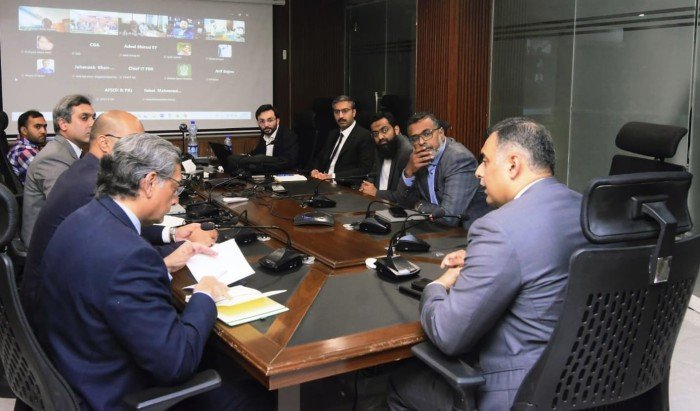
Islamabad (GNP): A high-level review meeting chaired by Minister of State for Railways and Finance Bilal Azhar Kayani at the Finance Division took stock of the first year of the Government’s Cashless Pakistan initiative, revealing substantial gains across the country’s digital payments landscape.
Key figures presented at the meeting painted an encouraging picture: annual digital transactions have climbed from 6.9 billion to 11.3 billion, the number of active digital payment merchants has grown fourfold from 0.5 million to over two million — largely driven by the Government’s Raast QR Code rollout — and digital banking users have surpassed 135 million.
Launched in June 2025 under the Prime Minister’s direct oversight, the Cashless Pakistan initiative rests on three foundational pillars: making financial services more convenient for the public, improving transparency, and bringing more of the economy into the formal documented sector through digital payments. Three sub-committees function under the main Cashless Pakistan Committee to carry out the Prime Minister’s directives: Digital Payments – Innovation and Adoption, led by the Governor of the State Bank; Digital Public Infrastructure, led by the Minister of IT&T; and Digitizing Government Payments, led by the Finance Secretary.
Kayani highlighted progress on the financial inclusion front, with the inclusion rate rising to 69 percent, while targeted measures have continued to narrow the gender gap in access to financial services. He also reviewed advances in public sector digitisation, with 25 high-impact federal and provincial entities identified for full integration with Raast by December 2026. On government-to-people payments, approximately 75 percent of centrally administered and self-accounting entities are now accepting digital payments.
The Minister stressed the need to maintain the pace of progress and deepen Pakistan’s digital transformation. He reaffirmed the Government’s commitment to working hand in hand with regulators, financial institutions, fintech firms, and the broader private sector to widen digital payment adoption, advance financial inclusion, and support a more transparent and documented economy.
On the matter of accountability, Kayani underscored the importance of verifying reported progress, closing reporting gaps, and removing data duplication from the system. The Government has engaged a third-party assessor, which has already begun independent evaluations to ensure transparency and responsible use of public resources.
The meeting brought together senior representatives from the State Bank of Pakistan, Federal Board of Revenue, Controller General of Accounts, Ministry of IT&T, and NADRA, among others. Attendees included Ammar Naqvi, Special Secretary MoITT; Sohail Javaad, Executive Director, DFS Group, SBP; Ahsan Saeed, CEO Raast Payments Pakistan; Muhammad Imaduddin, Director SBP; Rehman Qamar, CPO NADRA; Zafar Masud, Chairman Pakistan Banking Association; Atif Aslam Bajwa, President and CEO Bank Alfalah; Jahanzaib Khan, President and CEO Easypaisa Digital Bank; Aamir Ibrahim, CEO Jazz; Waqas ul Hasan, CEO Karandaaz Pakistan; Sharjeel Murtaza, Chief Digital Officer Karandaaz Pakistan; Taimoor Ali, Group Head Digital Financial Services Karandaaz Pakistan; Dr. Shazia from the Prime Minister’s Office; and Abbas Ali and Adeel Shirazi along with their team from EY.

Sohail Majeed is a Special Correspondent at The Diplomatic Insight. He has twelve plus years of experience in journalism & reporting. He covers International Affairs, Diplomacy, UN, Sports, Climate Change, Economy, Technology, and Health.