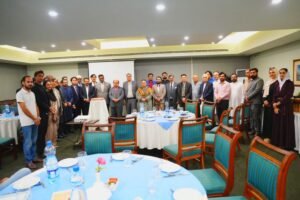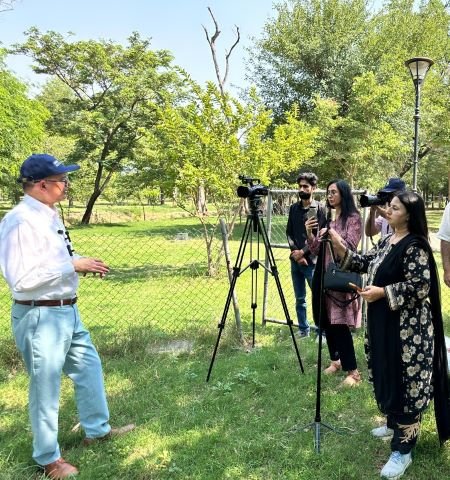
Islamabad (GNP): The International Water Management Institute hosted a media exposure visit to its Rainwater Harvesting initiative at Kachnar Park in Islamabad’s I-8 sector to demonstrate how nature-based solutions can improve urban water management and strengthen climate resilience.
Journalists from print, electronic, and digital media visited the project site to observe the innovative groundwater recharge system developed by the International Water Management Institute in collaboration with WaterAid and the Pakistan Council of Research in Water Resources.
The initiative has become an important example of sustainable water management by reducing urban flooding while restoring underground water resources. The Rainwater Harvesting project highlights how scientific planning and environmental conservation can work together to solve growing water challenges in Pakistan.
Rainwater Harvesting Provides Sustainable Water Solutions
During the visit, Strategic Program Director Water Food and Ecosystems at the International Water Management Institute, Dr. Mohsin Hafeez, briefed media representatives about the objectives, design, and long term benefits of the project. He explained that the Rainwater Harvesting system captures rainwater runoff and directs it into underground aquifers through a specially engineered recharge well.
This process helps reduce flood risks during heavy rainfall while increasing groundwater reserves that have been declining because of rapid urban development and excessive groundwater extraction. He said that the project demonstrates how modern engineering combined with nature based solutions can improve water security in urban areas.
Dr. Hafeez shared that the recharge well achieved remarkable results during previous monsoon seasons. During the 2022 monsoon, the Kachnar Park recharge well returned approximately one point nine million gallons of rainwater to underground storage, increased the local groundwater table by around four metres, and significantly reduced flood peaks in Nala Lai.
Encouraged by these successful outcomes, the Capital Development Authority installed fifty similar recharge wells across Islamabad, which collectively diverted nearly ten million gallons of rainwater into underground aquifers during the same monsoon season. These achievements have strengthened confidence in expanding Rainwater Harvesting systems throughout the capital.
Rainwater Harvesting Strengthens Climate Resilience
Highlighting the latest progress, Dr. Hafeez stated that the Kachnar Park recharge well delivered even greater results during the 2025 monsoon season. He explained that Islamabad received six hundred and eleven millimetres of rainfall in July, almost double its average monthly rainfall, yet the recharge well successfully diverted around nineteen million gallons of stormwater underground.
This significantly reduced pressure on the city’s drainage network while restoring groundwater levels and bringing previously dry boreholes in the surrounding I Eight sector back into operation. He added that the project demonstrates the importance of investing in climate resilient infrastructure capable of addressing both floods and water shortages at the same time.
The project is equipped with advanced scientific instruments including a piezometer, CTD diver, weather station, and rain gauge that continuously monitor groundwater levels, recharge performance, rainfall, and local weather conditions.
According to Dr. Hafeez, the data collected from these instruments has provided strong scientific evidence supporting the effectiveness of Rainwater Harvesting. The evidence has also guided policymakers and technical experts in expanding similar projects throughout Islamabad and integrating sustainable water management into future urban planning strategies.
Also read: WHO Calls for Awareness and Regular Monitoring of High Blood Pressure
Dr. Hafeez informed the media that Rainwater Harvesting has now been included in the Capital Development Authority Building By Laws introduced in 2023, making it compulsory for all new residential and commercial buildings in Islamabad to install rainwater harvesting systems.
He further explained that the Federal Cabinet approved the Pakistan Engineering Council Green Building Code and Rainwater Harvesting provisions for the Building Code of Pakistan on 30 July 2025. These regulations now apply to residential, commercial, and industrial buildings across the country and represent a major step towards promoting sustainable construction and protecting Pakistan’s water resources.
Concluding the visit, Dr. Mohsin Hafeez urged both federal and provincial governments to expand Rainwater Harvesting initiatives across Pakistan to address increasing water scarcity, climate change, rapid urbanisation, and unpredictable rainfall patterns. He stressed that Pakistan cannot afford to lose valuable monsoon water through drainage systems when it can be stored underground for future use.
He said that stronger public awareness, supportive government policies, effective municipal planning, and active community participation are essential for ensuring long term water security. He also highlighted the important role of the media in educating citizens about the benefits of Rainwater Harvesting, encouraging wider public support, and inspiring more cities to adopt sustainable water management solutions for future generations.

Sohail Majeed is a Special Correspondent at The Diplomatic Insight. He has twelve plus years of experience in journalism & reporting. He covers International Affairs, Diplomacy, UN, Sports, Climate Change, Economy, Technology, and Health.