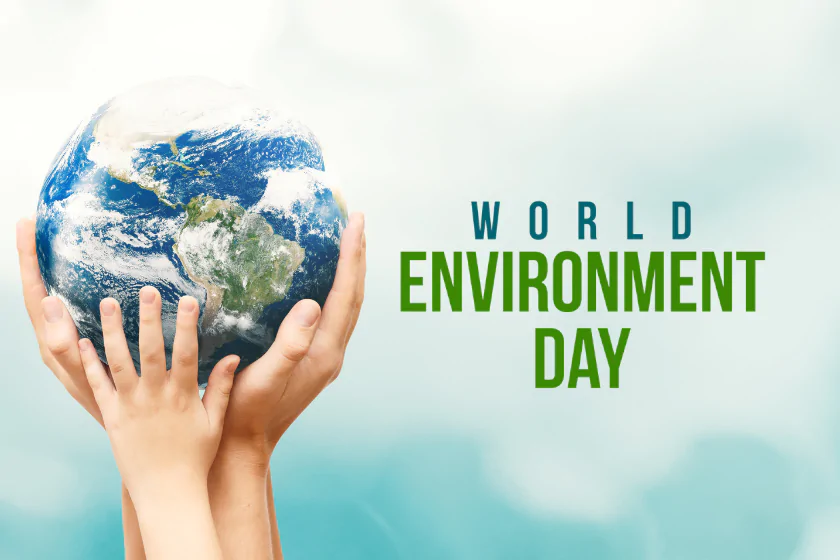
Islamabad (GNP): Dr. Abid Qaiyum Suleri, Executive Director of the Sustainable Development Policy Institute (SDPI), stated that World Environment Day 2026 is not just a symbolic date but also a critical deadline for taking meaningful climate action. The world is currently experiencing an alarming rate of biodiversity loss, melting glaciers, and increasingly severe weather events.
Following an internal faculty discussion on World Environment Day 2026, which falls on June 5, and under the theme “A Global Call for Climate Action,” the SDPI issued an official statement calling for faster implementation of the Paris Agreement and more ambitious Nationally Determined Contributions (NDCs).
Dr. Suleri stressed that this year’s theme must result in clear and measurable commitments.
He pointed out that wealthy nations must fulfill their promise of providing $100 billion annually in climate finance and that loss and damage funding should be made available without unnecessary bureaucratic delays. He added, “For countries like Pakistan, climate adaptation is not an option, it is a necessity for survival.”
The day also served as a powerful reminder that the effects of climate change, from glacial melt in the Hindu Kush region to deadly heatwaves in South Asia, call for immediate and collective action, Dr. Suleri said.
He emphasized that the SDPI strongly supports national ownership and localized solutions.
Reiterating the Institute’s long-standing stance, he said: “Climate action must be centered on people. Our Living Indus Initiative and Recharge Pakistan programmes demonstrate that community-led restoration, ecosystem-based adaptation, and nature-based solutions are effective and scalable. We urge the government to incorporate these into the upcoming NDC revision.”
Dr. Suleri further pointed out that every degree of global warming costs lives and livelihoods, but every investment in adaptation and mitigation saves them.
“SDPI remains committed to policies that are grounded in evidence and connect science, communities, and governance,” he concluded. “On this World Environment Day, let us turn the global call for climate action into a tangible reality at local, national, and international levels.”
Speaking on the occasion, Dr. Shafqat Munir, Deputy Executive Director (Policy) at SDPI and a climate policy analyst, emphasized the importance of accountability and transparency in climate governance.
“Actions must be matched by verifiable targets,” Dr. Munir stated. “SDPI’s research shows that Pakistan’s climate financing gap exceeds $7 billion per year. We need innovative tools like green bonds, nature-based solutions, and debt-for-climate swaps, as well as anticipatory action financing that benefits local communities.”
He also highlighted the disproportionate impact of climate change on women and marginalized communities.
“A just transition means ensuring that climate policies do not worsen existing inequalities,” he said. “Our policy recommendations call for gender-sensitive budgeting in climate adaptation and mandatory social safeguards in all large-scale green projects.”
Dr. Munir called for anticipatory action financing to be included as a regular budget item, so that the country’s humanitarian framework is strengthened through proactive, prearranged financing and preparedness plans before any climate disaster strikes, saving countless lives, livestock, livelihoods, and infrastructure.
Dr. Khalid Waleed, a Research Fellow and Energy Economist at SDPI, noted that Pakistan has made significant progress under SDG 13: Climate Action.
However, the real impact of climate action cannot be measured solely at the national level; it must be inclusive, equitable, and visible at the community level, particularly for those affected by floods, heatwaves, displacement, and loss of livelihoods.
Also Read: Pakistan Must Shift to Export-Led Growth, Iqbal
He emphasized the importance of climate revenue recycling: revenues generated from carbon taxes and climate-related fees should be transparently used to support the most vulnerable communities through targeted social protection programs, climate-resilient livelihoods, adaptation infrastructure, and access to clean energy.
“Climate action only becomes meaningful when those who bear the greatest climate burden receive a fair share of its benefits,” he added.

Zainab Naeem, Head of Ecological Sustainability and Circular Economy at SDPI, highlighted that Pakistan is currently facing a combination of environmental and climate crises during this World Environment Day.
“Ranked 179th out of 180 countries in the Yale Environmental Performance Index, the country continues to struggle with severe challenges such as hazardous air pollution, recurring smog, ecosystem degradation, unmanaged waste, and increasing urban climate vulnerabilities,” she said.
Zainab Naeem also stressed that one of the most pressing yet often overlooked issues is poor waste management.
“As cities expand, open dumping, inefficient resource use, and environmental degradation are putting increasing pressure on public health, ecosystems, and economic productivity,” she said.
Looking ahead, Pakistan needs to speed up the transition to a circular economy by involving the private sector, strengthening environmental governance, and integrating nature-based solutions into development planning.
She added that there is a need for policy consistency to enhance the country’s environmental resilience.

Sohail Majeed is a Special Correspondent at The Diplomatic Insight. He has twelve plus years of experience in journalism & reporting. He covers International Affairs, Diplomacy, UN, Sports, Climate Change, Economy, Technology, and Health.