Mid-Year Review of Annual Plan 2025–26 Held Under the Chairmanship of Federal Minister
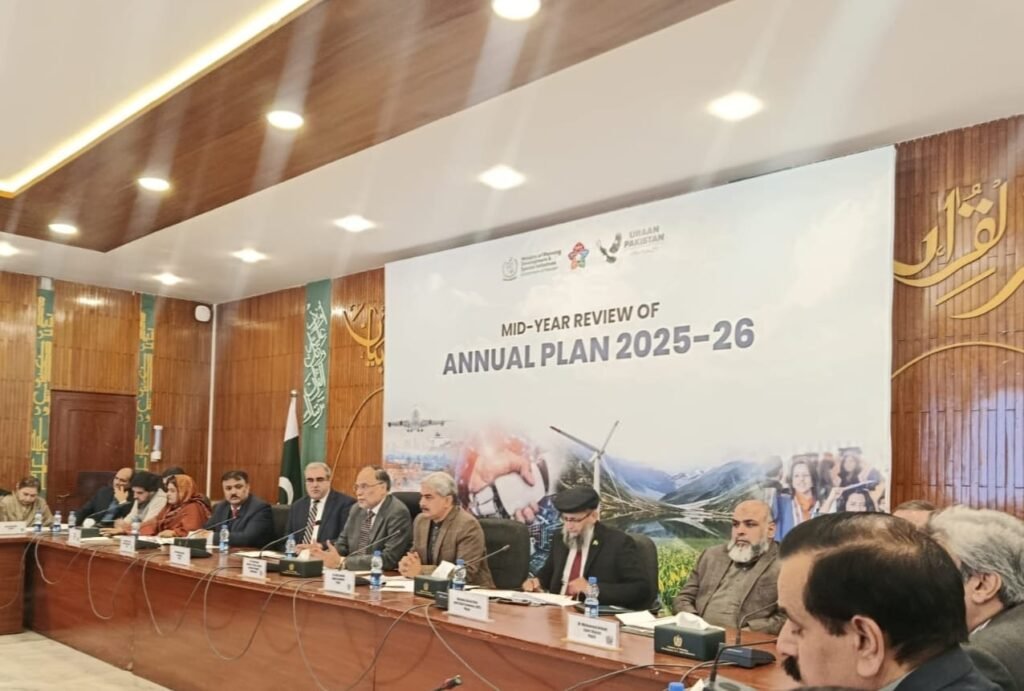
Islamabad : Mid-Year Review Meeting of the Annual Plan 2025–26 was held under the chairmanship of Federal Minister for Planning, Development and Special Initiatives, Ahsan Iqbal. The meeting was attended by Secretaries of all Ministries and Divisions, senior officials, members of the Planning Commission, and relevant stakeholders including Provincial government representatives.
Addressing the meeting, Federal Minister Ahsan Iqbal stated that a new tradition is being laid to strengthen planning, monitoring, and implementation mechanisms. He said that every year, at the time of the budget, an Annual Development Plan is formulated to set national economic targets and assess ministerial performance. Traditionally, this process was conducted on an annual basis; however, to make it more effective and results-oriented, it has now been decided that the Annual Development Plan will be reviewed on a quarterly basis to ensure timely achievement of national objectives.
The Minister emphasized that governance is not merely about performance delivery, but about building institutional capacity to not only achieve defined targets but also to continuously improve future goals. He said the Annual Development Plan serves as a guiding framework for the entire economy and provides a clear pathway toward achieving the country’s five-year development objectives.
Highlighting the government’s long-term vision, Ahsan Iqbal stated that under the “URAAN Pakistan” initiative, the national target has been set to transform Pakistan into a one trillion-dollar economy by 2035. He added that regular review meetings would be held to monitor progress on these goals and ensure effective implementation.
The Federal Minister further noted that following the 18th Constitutional Amendment, most social and economic sectors fall under provincial jurisdiction; therefore, close coordination between the federation and provinces is essential for achieving national economic targets. He identified agriculture, services, Information Technology and particularly the social sector as key drivers of economic performance, stressing that sustainable economic growth is not possible without improving productivity in these sectors.
He informed the participants that a series of review meetings would follow, focusing on detailed analysis of economic indicators. Ministries would not only present progress against assigned targets but would also propose corrective measures to address implementation gaps and bottlenecks. These quarterly reviews, he said, would significantly enhance efficiency, accountability, and delivery.
Ahsan Iqbal also stated that the targets of the current five-year plans have been aligned with the URAAN Pakistan framework. The review process will assess which targets have been achieved within timelines and which require additional effort. Based on these assessments, strategies will be further refined, and a comprehensive performance-based report of ministries will be submitted to the Prime Minister.
During the meeting, Chief Economist Dr. Imtiaz Ahmad briefed participants on key economic and development progress and challenges during the first half-year review of the Annual Plan 2025–26. He highlighted the severe socio-economic impact of recent floods, which affected approximately 6.5 million people and resulted in over one thousand fatalities. The floods damaged nearly 3.3 million acres of cropped land, led to significant livestock losses, and caused extensive destruction to infrastructure including roads, bridges, public buildings, educational institutions, and health facilities. Preliminary estimates place total economic losses at approximately Rs. 822 billion.
He informed the meeting that the Ministry of Planning, Development and Special Initiatives, in collaboration with development partners including the European Union, World Bank, Asian Development Bank, and UNDP, has initiated validation and analytical work on a comprehensive report titled “ Post-2025 Floods: Lessons, Leverage, and the Road to a Resilient and Risk-Informed Pakistan ,” which is expected to be completed by the end of next month.
The Chief Economist also briefed the forum on trends in price stability, reduction in policy rates, decreased energy tariffs for the industrial sector, large-scale manufacturing performance, and improving economic conditions in Gulf countries contributing to increased workers’ remittances. He further outlined key policy priorities including macroeconomic stability and effective utilization of the Public Sector Development Programme (PSDP).
The meeting concluded with a reaffirmation of the government’s commitment to strengthen planning & development discipline, enhancing Provincial & inter-ministerial coordination, and ensuring timely implementation of development priorities for sustainable and inclusive economic growth in the country.

Sohail Majeed is a Special Correspondent at The Diplomatic Insight. He has twelve plus years of experience in journalism & reporting. He covers International Affairs, Diplomacy, UN, Sports, Climate Change, Economy, Technology, and Health.