


Chaudhry’s Fractured Past, Uncertain Future on Pakistan–India Relations Underscored at PIDE Seminar
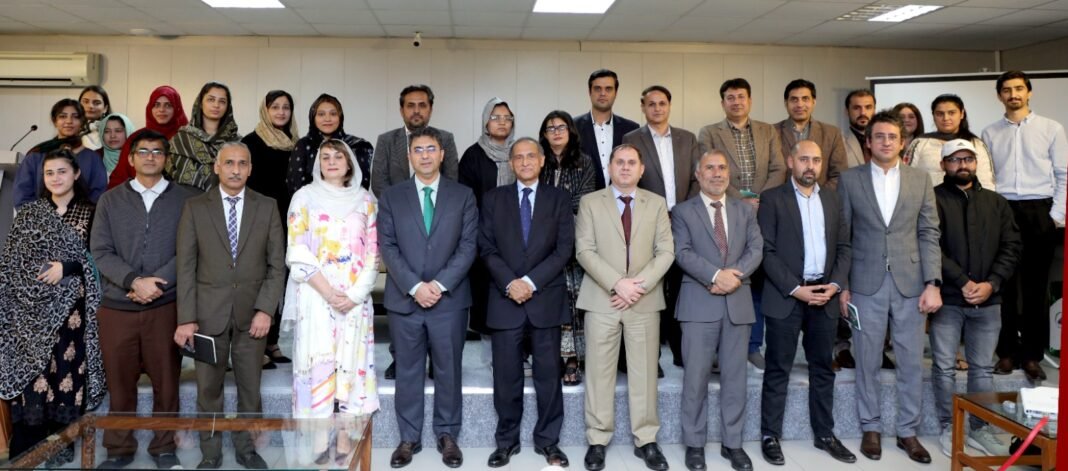
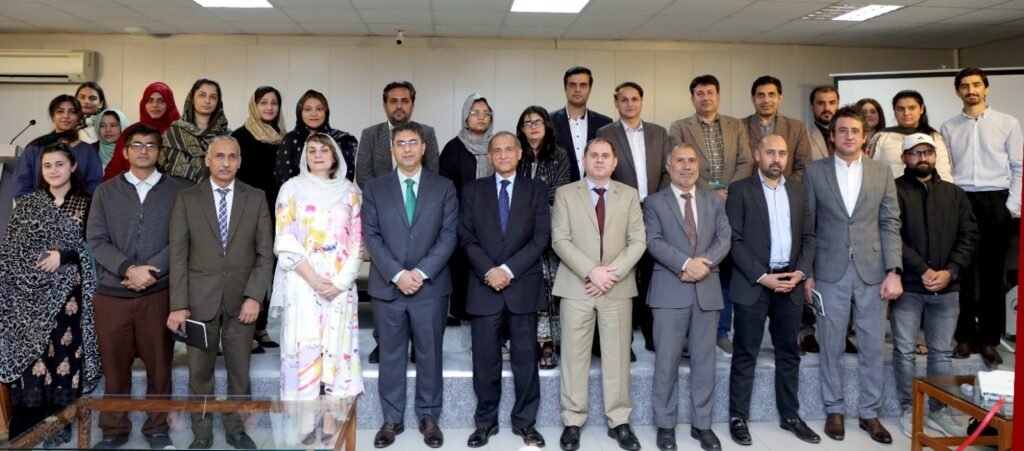
ISLAMABAD – Pakistan Institute of Development Economics (PIDE) hosted a compelling book presentation on “Pakistan–India Relations: Fractured Past, Uncertain Future” by Ambassador Aizaz Ahmad Chaudhry, former Foreign Secretary of Pakistan and former Ambassador to the United States, at A. R. Kemal Hall. PIDE Vice Chancellor Dr. Nadeem Javaid, attracted scholars, students, diplomats, and members of the policy community.
Opening the session, Dr. Javaid introduced Ambassador Chaudhry as a distinguished diplomat whose career spans over three decades of service at the highest levels, including key assignments in The Hague, New York, Washington, and Islamabad. He highlighted Chaudhry’s long association with the Pakistan–India peace process across multiple political eras, from the Vajpayee and Musharraf years to the Manmohan Singh and Narendra Modi periods.
Ambassador Chaudhry explained that his latest book departs from memoir and anecdote, offering instead a rigorous analytical investigation into why Pakistan and India remain trapped in an adversarial relationship despite seventy-eight years of conflict and intermittent dialogue. He noted that his inquiry seeks to understand whether the persistent hostility stems solely from unresolved disputes or whether deeper structural dynamics shape the trajectory of South Asia’s most enduring rivalry.
Drawing from extensive historical evidence and diplomatic experience, he identified four major factors that have prevented peace: entrenched mutual mistrust rooted in colonial-era politics; the unresolved dispute over Jammu and Kashmir, which erupted immediately after independence and remains central to the conflict; the political weaponization of terrorism, whereby incidents are attributed to Pakistan to shape global opinion; and India’s long-standing quest for regional dominance, reinforced by expanding strategic ambitions and narratives such as Akhand Bharat.
He described how wars, crises, and failed peace initiatives—from Lahore and Agra to Mumbai, Pathankot, and Pulwama—have repeatedly reinforced hostility rather than creating openings for reconciliation. Domestic political pressures on both sides, divergent threat perceptions, and shifting global alignments have further entrenched a security-centric relationship where talks are overshadowed by suspicion. Ambassador Chaudhry emphasized that these realities have created a landscape in which even sincere diplomatic efforts struggle to produce lasting change.
The author also addressed the growing digital-era discourse questioning the rationale of Pakistan’s creation. Citing independent studies on the marginalization of Muslims in India, he argued that contemporary developments have validated many of the concerns that shaped the Pakistan movement. He stressed that while Pakistan must continue to strengthen its defense and diplomacy, it also needs to improve its governance and significantly advance its narrative-building capacity.
In the concluding sections of his book, Ambassador Chaudhry outlines possible pathways for breaking the current deadlock. These include reviving sustained dialogue, promoting people-to-people engagement, and leveraging geo-economic cooperation to reduce hostility. He reviewed the wide body of agreements and confidence-building measures negotiated over the decades and noted that, should India reassess its approach, a substantial foundation already exists for building a more predictable future.
During an engaging question-and-answer session, participants raised concerns regarding whether both states genuinely desire peace, how global powers have historically managed South Asian crises, and the politicization of religion in shaping public narratives. Ambassador Chaudhry acknowledged that religion has been used as a political tool on both sides, but noted that the current intensity of polarization in India is unprecedented. He reiterated that while Pakistan has successfully established credible deterrence, it must now focus on strengthening internal governance and advancing fact-based narratives globally.
In his concluding remarks, PIDE Vice Chancellor Dr. Nadeem Javaid noted that while the discussion could have continued far longer, it had already offered a deeply insightful and intellectually rich examination of a critical regional relationship. He expressed profound gratitude to Ambassador Aizaz Ahmad Chaudhry for sharing not only rigorous analysis, but also the depth of experience, perspective, and reflection that comes from a lifetime of diplomatic service.
Dr. Javaid reminded the audience that Pakistan–India relations are not merely a chapter in history books; they are an evolving reality that shapes security, economics, identity, and the aspirations of more than 1.5 billion people. He emphasized that the ambassador’s insights compel policymakers, scholars, and citizens to look beyond daily headlines and examine the structural, political, and human dimensions that define this complex and consequential relationship.
He underscored that progress in South Asia is “neither inevitable nor impossible,” noting that it requires leadership, strategic imagination, and the courage to challenge entrenched narratives as well as emerging uncertainties. Conversations such as this seminar, he said, may not resolve disputes, but they keep the space for possibility alive—an invaluable asset in a region often constrained by history.

Sohail Majeed is a Special Correspondent at The Diplomatic Insight. He has twelve plus years of experience in journalism & reporting. He covers International Affairs, Diplomacy, UN, Sports, Climate Change, Economy, Technology, and Health.


