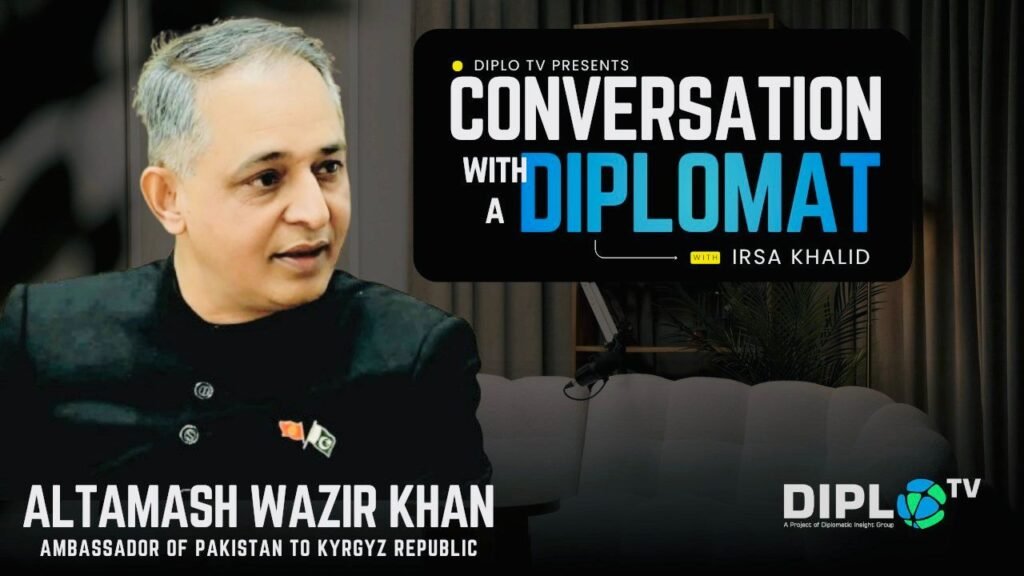
Interview Series: Conversation With a Diplomat H.E. Altamash Wazir Khan
Ambassador of Pakistan to Kyrgyz Republic
Islamabad (GNP) : In an engaging and thought-provoking conversation with Diplo TV, His Excellency Altamash Wazir Khan, Ambassador of Pakistan to the Kyrgyz Republic, shares insights into his unconventional journey from the Merchant Navy to the diplomatic arena. With over two decades of experience in bilateral and multilateral diplomacy, the Ambassador reflects on the deeper purpose of public service, the evolving nature of global engagement, and the values that define effective diplomacy.
Moving beyond conventional narratives, the discussion explores themes of personal transformation, national representation, and the importance of people-to-people connections in shaping a country’s image abroad. From trade opportunities in Central Asia to the responsibilities carried by diplomats and citizens alike, the Ambassador offers a candid and introspective perspective on what it truly means to serve one’s country in today’s interconnected world.
TDI: Before we discuss diplomacy, please tell us about your personal journey toward becoming an ambassador and what values shaped your path into public service.
Amb Altamash Wazir Khan: I was born in Lahore, and I received my early education at Army Burn Hall School in Abbottabad, where I spent many years. After completing my intermediate education, I joined the Pakistan Marine Academy in Karachi and entered the Merchant Navy.
I worked as a navigator and sailed the high seas for eight years, traveling across the world—visiting nearly 52 countries across Africa, South America, North America, and Europe.
In 2003, I decided to leave the Merchant Navy and transition to civil services.
TDI: Why did you switch from the Merchant Navy to civil services?
Amb Altamash Wazir Khan: That is a very important question because it has guided me throughout my career.
When I left the Merchant Navy, my salary was significantly higher than what I earn now. If someone is pursuing money, the Merchant Navy is a very rewarding profession. However, something always troubled me internally.
After each voyage, I would return with enough money to buy material things—a car, gadgets, or luxury items. But I began to question what value these things really had. The excitement they bring is temporary.
I realized that while my living was improving, my life was not changing. There is a difference between living and life. Living is about material possessions, while life is about how you think, how you treat others, and how you are treated in return.
This realization led me toward introspection. Alongside that, my parents were not very happy with my profession due to the long periods away from home and limited communication.
Ultimately, the most compelling factor was my internal dissatisfaction and the desire to find a deeper purpose.
TDI: Did you always intend to join the Foreign Service?
Amb Altamash Wazir Khan: In Pakistan, the system works through the CSS examination. You perform well, but the final allocation depends on merit, quotas, and the assessment of the interview panel.
I believe my interviewers found me suitable for the Foreign Service, and that is how I was allocated to it.
TDI: Diplomacy demands resilience. What phase in your career strengthened your resolve?
Amb Altamash Wazir Khan: One question that we must continuously ask ourselves is: why do I exist?
I was influenced by Viktor Frankl’s book Man’s Search for Meaning, which emphasizes finding purpose in life. Purpose is not fixed; it evolves over time.
If you keep questioning yourself—why you are here and what you are meant to do—you continue to grow.
TDI: What personal principle has guided you throughout your career?
Amb Altamash Wazir Khan: Giving back to society, community, and country is fundamental.
At the Civil Services Academy, the motto “Khalq-e-Khuda ki Khidmat” (service to humanity) is prominently displayed. That is the essence of civil service.
Service is not limited to government officials. It includes teachers, sanitation workers, and everyone contributing to society. Every role matters.
TDI: In your current posting, what are your top priorities for advancing Pakistan’s interests?
Amb Altamash Wazir Khan: My focus is on realistic and achievable goals.
One key area is human resource cooperation. Pakistani workers have started coming to Kyrgyzstan, mostly in construction and textiles. However, I want to expand opportunities for skilled professionals such as doctors and educators.
Another important area is trade. There is immense untapped potential. For example, both countries produce different varieties of honey, which creates an opportunity for mutual exchange.
More importantly, Kyrgyzstan should not be seen merely as a destination but as a transit hub. As part of the Eurasian Economic Union, it provides access to a market of nearly 190 million people.
Additionally, cultural exchange—especially through Pakistani dramas and media—can play a significant role in strengthening ties.
TDI: How have you worked to strengthen Pakistan’s image through people-to-people ties?
Amb Altamash Wazir Khan: Every Pakistani abroad is an ambassador of the country.
Diplomats operate within official circles, but the most lasting impression is created by ordinary citizens—through their behavior, honesty, and hospitality.
If individuals act responsibly, they contribute more effectively to building the country’s image than formal diplomatic efforts alone.
TDI: What opportunities excite you most in strengthening bilateral relations in the future?
Amb Altamash Wazir Khan: There are many opportunities, particularly in trade and human resource development. These may be considered low-hanging fruits, but they still require effort and risk-taking.
I encourage business communities on both sides to explore these possibilities. Kyrgyzstan should be seen as a gateway to a much larger regional market rather than just a single destination.
TDI: What advice would you give to young people aspiring to join the Foreign Service?
Amb Altamash Wazir Khan: It is not just a job—it is a lifestyle that requires sacrifices.
Do not join for privileges. Join only if you have the motivation to serve your country.
You must be prepared for personal sacrifices, including time away from family. If your intention is service, then this is the right path.
TDI: What qualities define a true diplomat?
Amb Altamash Wazir Khan: A good diplomat must be accessible, honest, and truthful.
You must be tolerant of different cultures and perspectives, a good listener rather than just a speaker, and flexible in negotiations.
Diplomacy is about give and take—you cannot expect to achieve your goals without offering something in return.
A pleasant personality and the ability to build trust are also essential.
TDI: Finally, what message would you like to give to our viewers?
Amb Altamash Wazir Khan: For students, the goal should not be marks—it should be knowledge.
Always ask yourself: why am I doing this, what am I doing, and how am I doing it?
Clarity of purpose is essential. Without it, even hard work and intelligence will not lead you anywhere.
As illustrated in Alice in Wonderland, if you do not know where you want to go, any path will do—but it will not take you where you truly want to be.
So define your purpose clearly and ensure that your actions benefit not just yourself, but society and humanity as a whole.
Courtesy: The Diplomatic Insight / Global News Pakistan