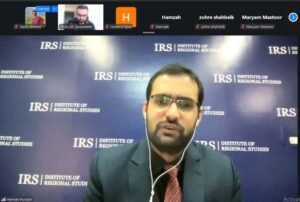
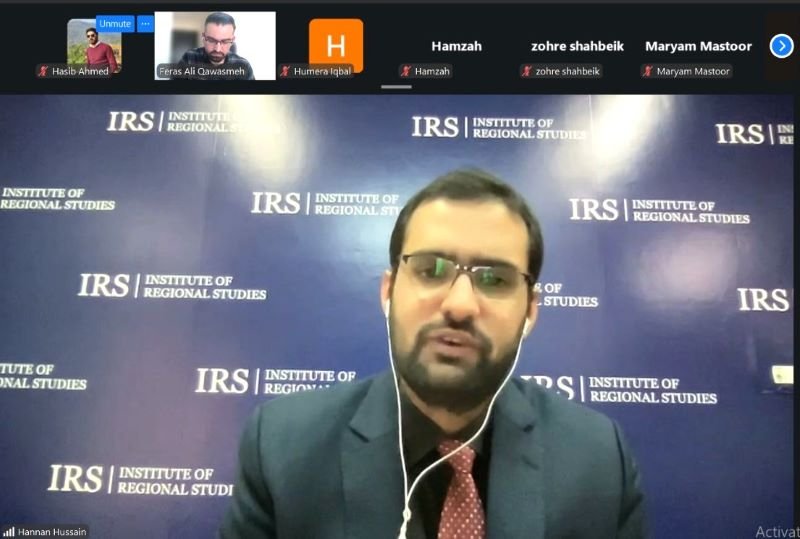
Islamabad (GNP) :- Institute of Regional Studies, Islamabad (IRS) convened an expert webinar featuring Dr. Feras Qawasmeh, Assistant Professor of Public Policy at the Joaan Bin Jassim Academy for Defence Studies in Qatar, on the theme “A United Front Against Illegal Settlement Expansion: The Role of The Organisation of Islamic Cooperation.”
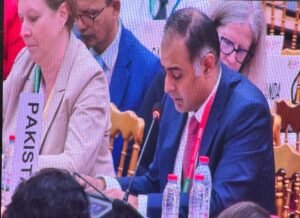
The discussion focused on the changing patterns of Israel’s expanding illegal settlements in the occupied West Bank, and the value of the collective consensus among Pakistan and its OIC partners at the extraordinary open-ended ministerial session recently. Dr. Qawasmeh underlined the need for greater regional diplomacy to leverage grass-root campaigns – including those that involve Palestinian-led movements focused against settlement expansion. The discussion underlined how Pakistan has continued to back the two-state solution, the sanctity of Palestinian liberties, and a clear stance against any illegal aggression or violence that threatens Palestinian statehood. Recognizing the value of the OIC to meaningful progress, Dr. Qawasmeh built on the significance of Muslim-majority states presenting a consensus against settlement expansion. His talk put a premium on countries to navigate complex challenges that prevent sufficient international scrutiny towards the expanding settlement challenge, considering how rising arson attacks and impediments to life carry on.
His talk delivered a critical value addition on the role of key movements, such as the Boycott, Divestment and Sanctions (BDS), in lending international scrutiny and awareness to the settlement issue. These considerations were part of policy recommendations, including a set pipeline of Palestinian rights advocates and organized groupings that can derive traction with Pakistan and key Gulf partners within the OIC, to collectively advance their own consensus against any forced annexation with grass-roots advocacy. Hannan Hussain, head of the West Asia Program at the Institute, added that the talk provided an in-depth assessment of the conditions on-ground in occupied West Bank, where rising tensions between recipient populations and those spearheading violence, deserves ample attention. Core reference points included the lasting effects of the Oslo Accords which have led to a geographical shift in terms of the security controls and political liberties enjoyed by Palestinians at present, and how these elements of control continue to shift to their detriment amid settlement expansion.
These dynamics – largely understudied in official discourse on the occupied West Bank – closely align with Pakistan’s principled position on ending settler violence and growth in illegal settlements as international attention focuses on the tensions within the Middle East. Major proof points for Pakistan’s position include its latest alarm at the UN Security Council, where support for Palestinian liberties – and an end to Israel’s alarming growth in settlements – was amply reinforced.
The talk concluded with an interactive Q&A session, with in-depth assessments on the constraints and opportunities facing key regional players on improving Palestinian freedoms, and marking a break from a potential entrenchment of the occupation – all in line with international legal obligations and the trajectory of the OIC.