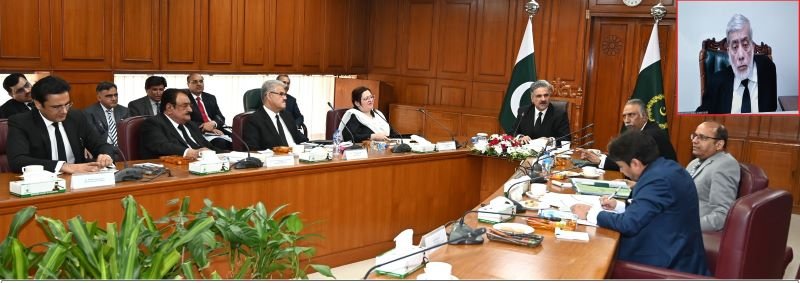
Islamabad (GNP) – Hon’ble the Chief Justice of Pakistan chaired the 59th meeting of the National Judicial (Policy Making) Committee (NJPMC), which was convened at the Supreme Court of Pakistan. The meeting was attended by the Chief Justice, Federal Shariat Court, Chief Justices of all the High Courts, the Attorney General for Pakistan and the Secretary, Law and Justice Commission of Pakistan.
The Committee deliberated on key policy issues, while reviewing implementation status of the decisions taken in its 57th meeting. The Committee unanimously reiterated its resolve to strengthen institutional capacity, accelerate access to justice, and ensure efficient and effective justice delivery.
The following decisions were taken unanimously;
AGENDA ITEM-1: FOLLOW-UP OF DECISIONS OF THE 57TH MEETING OF NJPMC HELD ON FEBRUARY 11, 2026.
- Institutional Response on Cases of Enforced Disappearances.
DECISION:
- The Attorney General for Pakistan appraised the NJPMC that the Federal Government has approved nomination of a former Judge of the Supreme Court of Pakistan to head the Commission, as part of the proposed redressal mechanism and assured that notification in this regard will be issued in due course.
- The Committee, while appreciating the steps taken by the Government, desired that the Attorney General for Pakistan shall keep it regularly apprised of the implementation of the framework through periodic updates.
- Constitution of Designated Benches for Foreign Arbitral Awards
DECISION:
- The NJPMC expressed satisfaction over the constitution of designated benches at the High Courts to adjudicate matters arising under the Recognition and Enforcement (Arbitration Agreements and Foreign Arbitral Awards) Act, 2011. It was also decided that these Benches shall also adjudicate on matters arising out of the National Tariff Commission Act, 2015 and the Anti-Dumping Duties, Act, 2015.
- The NJPMC observed that the establishment of these dedicated benches would foster judicial specialization, ensure greater consistency in the adjudication of arbitration, tariffs and duties related matters, and contribute positively to enhancing the ease of doing business environment.
- Timelines for Disposal of Different Categories of Cases.
DECISION:
- The NJPMC expressed satisfaction over progress made by the High Courts in disposal of prioritized categories of cases, including chronic cases within specified timelines. The Committee also appreciated the progress made by the High Courts in the expeditious disposal of targeted old Succession cases.
- The Committee particularly commended the District Judiciary of Punjab and Balochistan for achieving 92% and 88% disposal of prioritized categories of cases, respectively.
Reported Pendency and Disposal of Notified Timeline Cases
| High Court | Reported Pendency | Disposal (01/09/2025 to 15/03/2026) |
| Lahore High Court | 909972 | 837077 |
| High Court of Sindh | 124491 | 65945 |
| Peshawar High Court | 140942 | 90680 |
| High Court of Balochistan | 15020 | 13269 |
| Islamabad High Court | 36506 | 23404 |
| Total | 1226931 | 1030375 |
- The Committee also reviewed the data on the oldest Succession Cases (Up to Year 2019) and lauded the High Court of Sindh, Peshawar High Court and the High Court of Balochistan for clearing the entire pendency of these cases. The Islamabad High Court has already cleared these cases while the Lahore High Court is left with only 28 cases.
Status of Disposal of oldest Succession Cases (Up to Year 2019) within 30 Days
| High Court | Reported Pendency | Disposal | Pendency |
| Lahore High Court | 38 | 10 | 28 |
| High Court of Sindh | 36 | 36 | 0 |
| Peshawar High Court | 0 | 0 | 0 |
| High Court of Balochistan | 1 | 1 | 0 |
| Islamabad High Court | 0 | 0 | 0 |
| Total | 75 | 47 | 28 |
- Performance of Model Trial Courts.
DECISION:
The NJPMC, after reviewing the performance of Model Civil and Criminal Trial Courts, noted with appreciation the progress made by the District Judiciary in disposal of civil and criminal cases. In order to consolidate these gains, the NJPMC asked the High Courts to further strengthened performance monitoring through data-driven evaluation ensuring quality of adjudication alongside expeditious disposal.
Cases Decided by the Model Criminal and Civil Courts (01-09-2025 to 15-03-2026)
| High Court | Civil Cases Disposal | Criminal Cases Disposal |
| Lahore High Court | 5808 | 6718 |
| High Court of Sindh | 1012 | 3023 |
| Peshawar High Court | 282 | 2657 |
| High Court of Balochistan | 1133 | 2146 |
| Islamabad High Court | 169 | 828 |
| Total | 8404 | 14826 |
- Discouraging False and Frivolous Litigation.
DECISION:
- The Chief Justice, High Court of Balochistan, being chair of the committee constituted for the purpose, appraised the NJPMC that the task of suggesting legislative and policy framework for discouraging false and frivolous litigation, in line with ‘Cost of Litigation Act, 2017’ (ICT), has been embarked upon and initial consultations have been made.
- In order to make the process more inclusive, it was suggested that the draft recommendations by the committee would be shared with relevant stakeholders, including Ministry of Law and Justice, Provincial Law Departments and Bar Councils for their feedback. It was also suggested that the institutionalization of adjournment costs be also looked into.
- The NJPMC appreciated the progress made by the committee and reiterated its resolve that the abuse of judicial processes must be discouraged through strict compliance of available statutory and procedural provisions, in the meanwhile.
- Attorney General for Pakistan, in his capacity as Chairman of the Pakistan Bar council, assured that the Bar Council will be taken on board on the mechanism for addressing the issue of frequent strikes by the Bar and the NJPMC will be apprised about the progress in the next meeting.
- Prison Reform Action Plan
DECISION:
- The NJPMC reviewed the progress made on the implementation of the Prison Reform Action Plan, aimed at aligning Pakistan’s prison system with the United Nations Standard Minimum Rules for the Treatment of Prisoners (the Nelson Mandela Rules). It was noted that deliberations are actively underway within the Provincial Justice Committees to ensure the adoption of effective, rights-based, and sustainable reform measures.
- The NJPMC emphasized the need for a coordinated and harmonized approach to the implementation of the Prison Reform Action Plan, with particular focus on safeguarding prisoners’ rights, improving conditions of detention, and strengthening institutional accountability.
- The NJPMC urged the Provincial Justice Committees to take proactive measures to secure ownership by the Provincial Governments. The NJPMC directed the LJCP Secretariat to organize a National Conference on the ‘Prison Reforms Action Plan’ in June, 2026 to facilitate stakeholders’ engagement and policy dialogue as part of an inclusive reform process.
- It was also directed that the concept note of the proposed National Conference, containing objectives, format and the delegates may be prepared and shared with the High Courts for their input before finalization.
AGENDA ITEM-2: CONSIDERATION OF DRAFT GENDER FAIR LANGUAGE FRAMEWORK-2026.
DECISION:
- The NJPMC appreciated the LJCP Secretariat for spearheading the development of the Gender Fair Language Framework and observed that this initiative will promote the use of neutral, respectful, and stereotype-free language in judicial and legal discourse. Following detailed deliberations, the NJPMC approved the Framework as a non-binding set of guidelines for gradual implementation, allowing flexibility for local contextualization.
- The NJPMC further directed the LJCP Secretariat to:
- Share the Framework with the High Courts for onward circulation among Judges and Judicial Officers, to encourage its appropriate use in judicial proceedings and writings and to promote consistency and best practices;
- Share the Framework with Bar Councils for dissemination among members of the Bar, to encourage its appropriate use in legal drafting and advocacy;
- Share the Framework with Judicial Academies and the Directorate of Legal Education for incorporation into training programmes for Judicial Officers, court staff, and other stakeholders, including members of the Bar;
- Translate the Framework into simple Urdu to enhance accessibility and undertake a public awareness campaign for its wider dissemination.
AGENDA ITEM-3: CONSIDERATION OF DRAFT CONCEPT NOTE OF THE GENDER-RESPONSIVE JUSTICE INITIATIVE (GRJI) 2026-27.
DECISION:
- The NJPMC reviewed the draft Concept Note for the proposed Women Facilitation Centers (WFCs) under the Gender-Responsive Justice Initiative (GRJI) 2026–27 and endorsed the provision of facilities such as free legal aid and advisory services for women, as well as mediation, visitation and family support services. The initiative was recognized as a significant step towards the legal empowerment of women.
- Recognizing the importance of the architectural design of the proposed WFCs in ensuring dignity, safety, and accessibility, the NJPMC directed that prototype designs be developed through a national design competition, enabling the generation of innovative and inclusive solutions from a diverse pool of professionals and emerging talent across the country.
AGENDA ITEM-4: CONSIDERATION OF DRAFT NATIONAL JUDICIAL ANALYTICS DASHBOARD (NJAD) GOVERNANCE AND OPERATIONAL FRAMEWORK.
DECISION:
- The NJPMC acknowledged the need for a structured governance framework for NJAD, to ensure data integrity and sustainability for data-driven judicial governance. The Committee approved the Framework with the following directions:
- Courts shall ensure timely provision, validation, and integration of judicial data.
- Endorsed the strategic and technical role of LJCP and NITB, respectively.
- Strict compliance of data quality assurance mechanisms, including audits.
- Coordination among stakeholders to ensure efficiency and efficacy of NJAD.
- Adoption of all necessary measures for cybersecurity and system integrity.
- The NJPMC also desired that the High Courts may look into implementation of E-Office as a productive internal governance initiative. The LJCP Secretariat may assist the High Courts to coordinate with the National Information Technology Board (NITB) in this regard.
AGENDA ITEM-5: CHILD VISITATION FACILITY.
DECISION:
In order to provide for greater flexibility to families in scheduling visits, enhancing the quality of parent-child interactions, reducing congestion in existing visitation facilities, and promoting a more child-centered and supportive environment within the judicial system, the NJPMC approved the availability of child visitation facilities at District Courts on closed holidays, subject to local requirements and administrative arrangements to be determined by the respective High Courts.
TABLE AGENDA: DISTRICT JUDICIARY REFORMS
DECISION:
- With a view to promoting inclusivity and evidence-based decision-making in the reform process, the NJPMC desired the High Courts to design a structured, anonymized survey targeting members of the District Judiciary, after finalization of the reforms with the Provincial Governments.
- The survey shall seek feedback on the reform interventions already approved, particularly with respect to the terms and conditions of service, in order to assess the level of satisfaction and identify any concerns or reservations.
- The NJPMC further desired that the survey be disseminated by the High Courts with system-generated, anonymized, and analytically compiled results to be presented before the NJPMC in its next meeting to inform future policy deliberations and course corrections, where necessary.
The meeting concluded with an expression of appreciation for the sustained efforts of all High Courts, the Attorney General’s Office, and the Secretariat of the Law and Justice Commission of Pakistan for their valuable contributions toward strengthening the administration of justice, fostering institutional coherence, and enhancing public confidence in the judicial system.