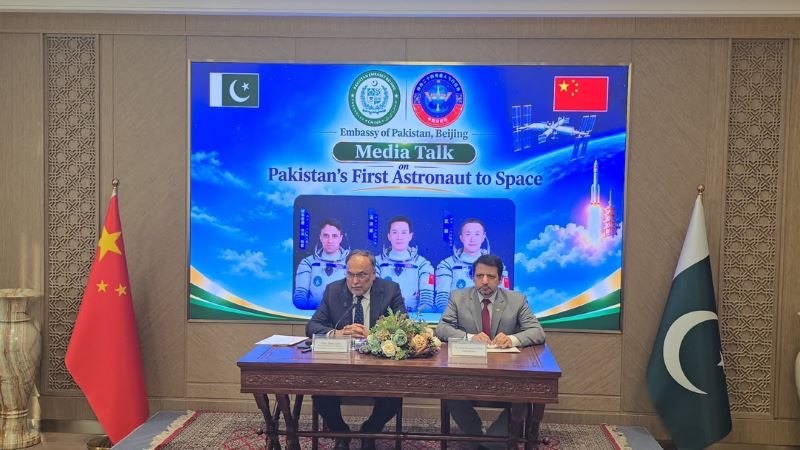
Beijing (GNP): Federal Minister for Planning, Development and Special Initiatives Professor Ahsan Iqbal described Pakistani astronaut Zeeshan Ali’s participation in a Chinese crewed space mission as a historic milestone, saying it marks the start of a new phase of cooperation in space exploration, scientific research and advanced technology.
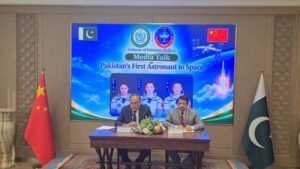
Speaking at a press conference at the Pakistan Embassy in Beijing after the Shenzhou-24 launch, he said Pakistan is now China’s first international partner in a crewed space mission and that Zeeshan Ali is the first foreign visitor to the Chinese space station. He thanked President Xi Jinping, the Chinese government, the China Manned Space Programme and the Chinese people for the opportunity.
The minister said the familiar description of the friendship as “higher than the Himalayas” has taken on a new meaning now that cooperation reaches into space. He recalled that the partnership began with infrastructure, energy projects and highways under the China-Pakistan Economic Corridor (CPEC) and later grew to include digital connectivity through fibre-optic networks. “This is not the finish line. It is the beginning of a new partnership,” he said, adding that space technology has become indispensable for sustainable development and economic competitiveness.
Professor Iqbal said Pakistan is among the world’s ten most climate-vulnerable countries and suffered devastating climate-related disasters in 2022 and 2025. Satellite technology, he said, could improve disaster preparedness, early warning, emergency response and relief, and help with food security, water management, urban planning, logistics and connectivity.
He stressed the need to modernise agriculture through climate-resilient seeds, efficient irrigation and better water management. Citing India’s unilateral suspension of the Indus Waters Treaty, he called water security an increasingly critical national concern. (This characterisation is the minister’s.)
He said the experiments Zeeshan Ali is conducting in orbit would yield knowledge in agriculture and materials science that could help Pakistani researchers develop weather-resistant seed varieties and advanced industrial materials. He also acknowledged astronaut Khurram Dawood, who completed the same training but was not chosen for the flight.
Asked about Pakistan’s plans for the Moon, the minister reaffirmed the government’s commitment to speeding up the space programme. He said Pakistan has launched about five satellites in the past two years and wants to build on that record. He voiced optimism about Pakistan taking part in an upcoming lunar mission by placing a rover on the Moon, as a step towards the long-term goal of a lunar landing by 2035. Pakistan, he added, can draw on China’s expertise rather than develop every capability alone.
Discussions with Chinese counterparts also covered wider cooperation in research, education and advanced technologies. Under the proposed Knowledge Corridor initiative, Pakistan aims to have at least 10,000 PhD scholars trained at leading Chinese universities over the next decade in fields such as artificial intelligence, space sciences, biotechnology, materials science, big data, automation and robotics. He said this would build a new generation of scientists and technology experts to lead Pakistan’s development.
The minister tied these goals to the government’s Uraan Pakistan programme, which seeks to transform the economy through innovation, human capital development and technology. He said the programme envisages a $1 trillion economy by 2035 and a $3 trillion economy by 2047.
Professor Iqbal said the mission has inspired young Pakistanis to pursue science, technology, engineering and mathematics (STEM), calling Zeeshan Ali’s flight a source of national pride and a symbol of Pakistan’s aspirations. He also said cooperation should go beyond infrastructure to include education, literature, poetry, films and the arts, and pointed to the poetry of Allama Muhammad Iqbal and its message of ambition and progress.
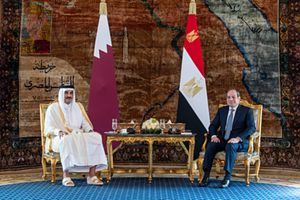
Also read: Qatar’s Amir Meets Sisi in Cairo to Discuss Gaza Ceasefire
He concluded that Pakistan-China cooperation rests on mutual trust, shared aspirations and practical achievements rather than slogans.

Sohail Majeed is a Special Correspondent at The Diplomatic Insight. He has twelve plus years of experience in journalism & reporting. He covers International Affairs, Diplomacy, UN, Sports, Climate Change, Economy, Technology, and Health.