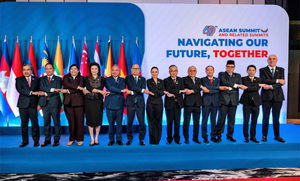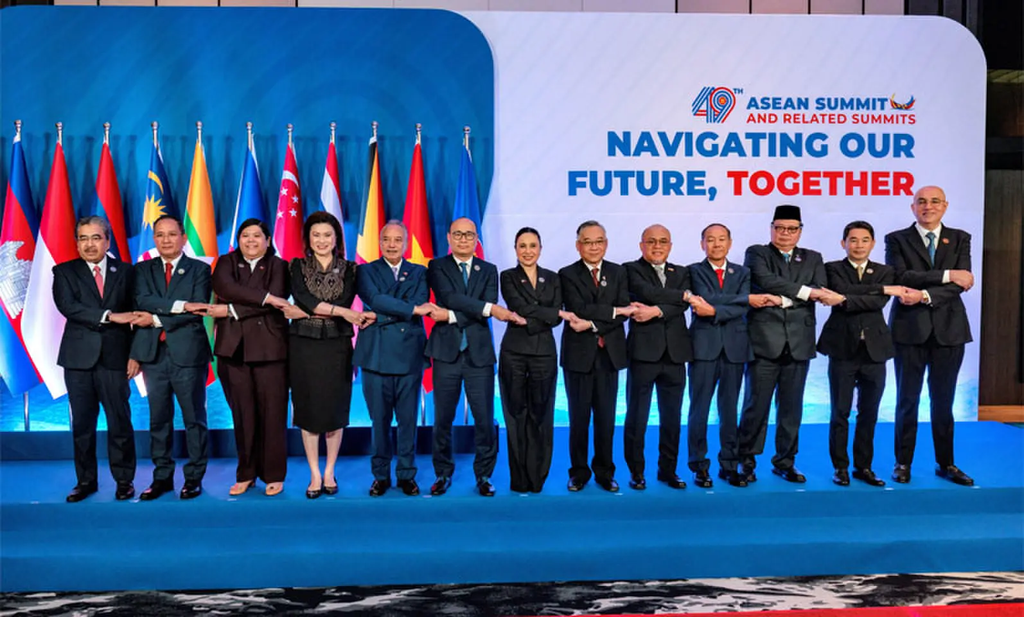
Manila (GNP): A key regional summit has opened in Manila, where Southeast Asian leaders face questions on trade, security and an ongoing energy crisis. They are also hosting a string of global leaders at a time of sharpening US-China rivalry.
The Association of Southeast Asian Nations (ASEAN) meeting began over the weekend. The Philippines is the current chair of the 11-member bloc.
US President Donald Trump is scheduled to arrive on Tuesday, near the end of the summit. His visit is expected to include a sideline meeting with Quad partners India, Japan and Australia, the first such meeting of his second term. The Quad is a grouping broadly aimed at counterbalancing China’s regional influence.
The timing adds weight to the meeting, which comes days before Trump’s planned sit-down with Chinese leader Xi Jinping and Russia’s Vladimir Putin in Shenzhen. Manila’s agenda is also busy with bilateral business. Australian Prime Minister Anthony Albanese will sign a new defense pact with the Philippines, and Canadian Prime Minister Mark Carney announced a trade deal with the host country on Saturday, when early meetings began.
Trump’s arrival is also drawing opposition on the streets. Nearly 20,000 police officers have been deployed around Metro Manila, as progressive groups predict thousands will join an anti-Trump march at the summit site on Tuesday.
Much of the anger targets the US Pax Silica program, a supply-chain initiative designed to counter China’s dominance in semiconductors and rare earths. Its flagship Philippine project is a 1,620-hectare artificial intelligence manufacturing hub north of Manila. Critics say the project threatens to displace Indigenous families.
Inside the summit hall, the harder test is the South China Sea. ASEAN and China failed to conclude talks on a long-delayed code of conduct under the Philippines’ chairmanship, even though they reached provisional agreement on about 80 percent of the draft. Philippine Foreign Minister Ma. Theresa Lazaro said so on Sunday.
Also Read: Trump, Xi and Putin Head to Shenzhen for Historic Nuclear Talks
The talks have dragged on for more than two decades, and Manila had committed to speed them up and conclude the code this year. Lazaro said several key issues remain unresolved, including whether the code would be legally binding. She added that ASEAN countries and China hold different views.
The split runs deeper than the text. China’s Southeast Asian neighbors want the code grounded in international law, which they have repeatedly accused Beijing of disregarding as it asserts sovereignty over nearly all of the South China Sea. Beijing maintains that its actions there have been lawful and professional.
A Southeast Asian diplomat involved in summit preparations said he did not expect a code to be signed at the summit. That leaves the issue for Singapore, which takes over as rotating chair in 2027. It will also inherit the bloc’s long-running difficulty with war-torn Myanmar, which also looks set to pass to Singapore.
Lazaro said, “There is no conclusion yet.”