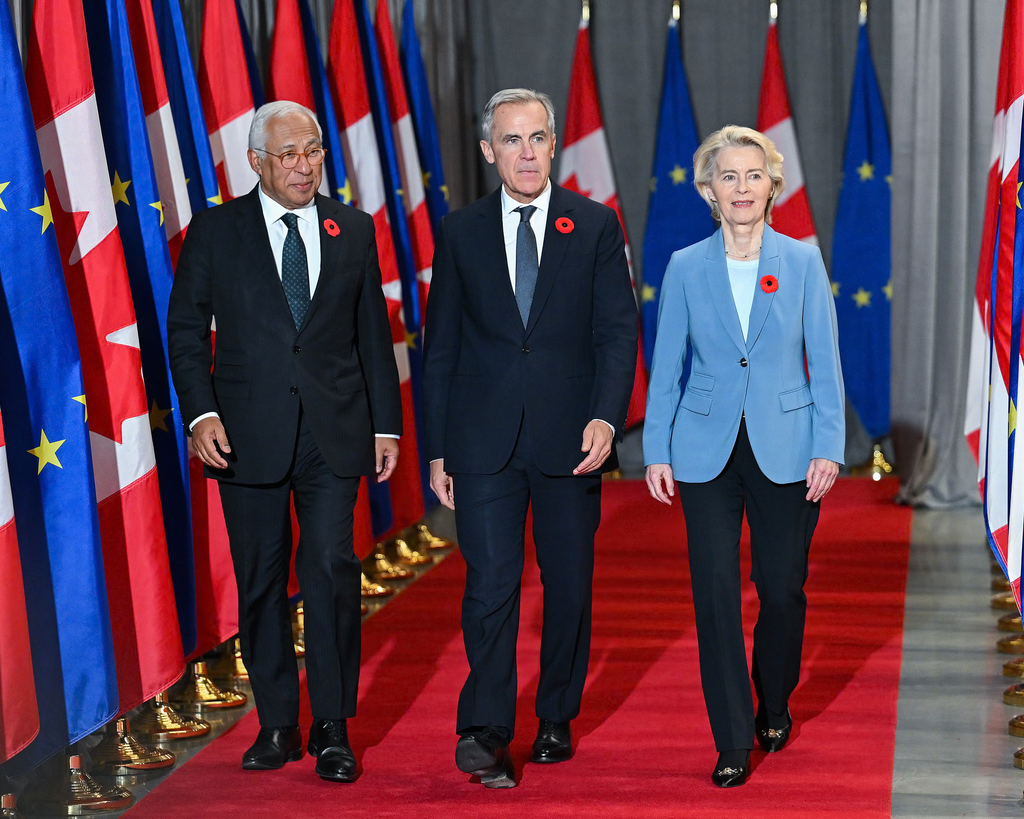
Montreal (GNP): Canada and the European Union have announced a new partnership called the Alliance for the Future, which they say is open to other like-minded countries. Prime Minister Mark Carney and European Commission President Ursula von der Leyen unveiled it at the end of a two-day summit in Montreal.
The two leaders presented the alliance as a shelter and a safeguard in an unpredictable world. Carney said societies had been shaken by new storms, pointing to the climate emergency, the erosion of democratic norms and the use of trade as a weapon. That language reflects the pressure Canada has felt from a trade war with the United States, which has pushed Ottawa to look for new partners.
Concern about dependence on American companies, especially in defence, has added to that search. Carney has repeatedly warned that Canada’s defence technology should not be left to the decisions of political actors or companies with opposing interests. His government is now looking to Europe for alternatives.
Artificial intelligence is one of the first areas where this shift is taking shape. Carney pointed to the planned merger of Canadian firm Cohere and Germany’s Aleph Alpha as a step towards reducing reliance on American AI giants. The new company would have headquarters in both Berlin and Toronto, and the Canadian government has announced a stake in Cohere worth up to C$1.6bn.
A separate agreement will bring Canada into Europe’s supercomputing network. It will give Canadian researchers and companies access to European machines for training AI models.
Support for Ukraine also featured on the summit agenda. Canada agreed to contribute to a €90bn support loan for Ukraine. Leaders added that future talks would aim at a more integrated market worth tens of billions of dollars, fewer trade and travel restrictions, and new educational opportunities on both sides.
The leaders also tied the alliance to everyday concerns such as the cost of living. Von der Leyen said that when trade becomes a tool of economic pressure, families pay the price, from supermarket shelves to the cost of a new car. She noted that once-trusted suppliers of energy, critical minerals and semiconductors are increasingly being used as instruments of pressure.
Also Read: Germany Braces for Gen Z Rallies in 34 Cities on Halloween
The most debated element is the proposal to make Canada an associate member of the EU. Von der Leyen called the designation uncharted territory, and both leaders said a clearer definition of the role would come at a summit in 2027. Some EU members are uneasy about it, and Germany and other states reportedly worked behind the scenes to remove the phrase from a draft of the summit statement. They are said to fear that a designation with no legal meaning could confuse other countries seeking membership.
The summit also exposed a political divide at home. Quebec Premier Paul St-Pierre Plamondon, whose separatist Parti Québécois leads a minority government, skipped the event. He did so after Ottawa refused to let him speak publicly, and he criticised the federal government for offering Quebec little real influence.
Carney said, “Our societies have been shaken by new storms.”
Von der Leyen said, “This is a partnership not against anyone else, but for our common strength.”
European Council President Antonio Costa said, “Canada is by far the most European of the non-European countries.”

Managing Editor at Global News Pakistan (GNP), with a Bachelor's degree in International Relations from Riphah International University, graduated with a Gold Medal. Reach out at sabahtareengnp@gmail.com