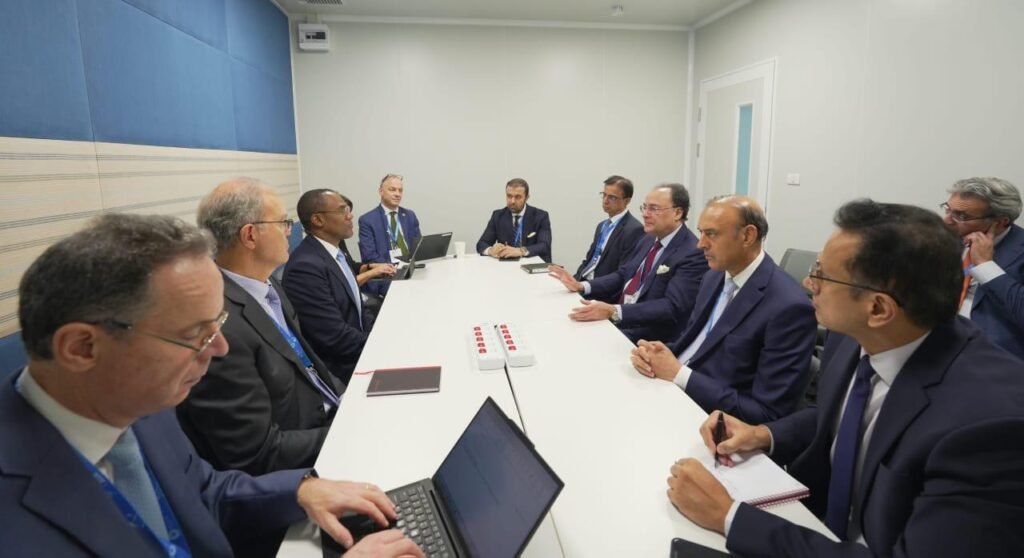
Bangkok (GNP): Finance and Revenue Minister Senator Muhammad Aurangzeb held a string of meetings with international investors, credit rating agencies, multilateral lenders and U.S. officials on the margins of the IMF-World Bank Annual Meetings. The talks covered Pakistan’s macroeconomic gains, diversification of financing, structural reforms, energy security, investment prospects, infrastructure and targeted relief for vulnerable groups as global energy prices rise.
Speaking to international investors at the Citi Macro Forum, Aurangzeb pointed to continuing stabilisation, three straight years of primary surpluses, a fiscal deficit at a 22-year low and stronger foreign exchange buffers. He said he expects growth to reach or exceed 4% this fiscal year.
He described the capital market strategy, which includes more Panda bond issuances, Sukuk and a rupee-denominated, dollar-settled international bond, aimed at broadening funding sources, cutting borrowing costs and lengthening maturities. He also covered progress under the IMF programme, tax-base expansion, tougher enforcement and coordination with the provinces to maintain fiscal discipline.
On the Middle East conflict, he explained the steps being taken to keep energy supplies flowing and to give targeted relief to vulnerable groups within existing budget allocations. Climate resilience, disaster preparedness and effective use of development financing were also discussed. He restated Pakistan’s commitment to sustained reform and to moving from aid toward trade and investment in its partnerships.
At Standard Chartered’s Sovereign Investor Roundtable, he repeated the case for Pakistan’s progress, citing the primary surpluses, the 22-year-low deficit and sovereign rating upgrades. He said Sukuk, Panda bonds and the proposed rupee-denominated, dollar-settled bond lower borrowing costs, extend maturities and reduce rollover risk.
He stressed continued structural reform, fiscal discipline, stronger tax enforcement and growth driven by investment and exports after the IMF programme ends. Reserves, inflation, the external outlook, energy security, targeted relief and climate finance were also on the agenda, and he pledged to sustain reforms and further strengthen the country’s sovereign credit standing.
In his meeting with S&P Global Ratings, Aurangzeb discussed the sovereign credit outlook. He cited the successful September bond issue, strong investor participation and progress under the IMF programme, along with better tax collection, higher reserves and lower swap and forward liabilities.
He said Pakistan aims to reach the double-B rating category through sustained improvement. Agricultural income taxation, energy and food security, targeted relief and climate resilience were discussed. He also noted that S&P regards policy continuity, reform implementation, a lighter interest burden and stronger external buffers as key rating factors.
Meeting Ambassador Yon of the U.S. State Department, he reviewed progress toward a trade framework agreement and energy diversification through more imports from the United States. He described measures to maintain fuel supplies and support vulnerable consumers. The two sides discussed AML/CFT arrangements, FATF follow-up, and investment financing through the U.S. International Development Finance Corporation (DFC) and EXIM Bank.
Aurangzeb raised Reko Diq, critical minerals cooperation, project security and ways to mobilise private investment. They also covered Boeing aircraft acquisition and financing, aviation clearances, digital asset regulation, and possible uses of tokenisation for remittances and Eurobonds.
At the MENAP meeting with the IMF Managing Director, he highlighted the 22-year-low deficit, three years of primary surpluses and growth of 3.7%. Foreign exchange reserves, he said, are at a record high and cover three months of imports, helping Pakistan absorb climate and regional shocks. He offered sovereign rating upgrades, the September Eurobond issue and the 7 October IMF staff-level agreement as evidence of progress.
He reaffirmed commitment to reform and to targeted, budget-neutral, time-bound subsidies protecting low-income groups and social cohesion. He called for more diverse energy sources and trade routes, deeper regional integration, and investment in logistics and food systems, and renewed Pakistan’s commitment to multilateralism and regional cooperation.
With MIGA Managing Director Tsutomu Yamamoto, he discussed financing and guarantee support, arguing that terms should reflect Pakistan’s improved ratings and renewed access to capital markets. He welcomed MIGA’s revised pricing and said he wants to move ahead with Board consideration and documentation. The hydropower-related case before the UK Supreme Court was also reviewed, with next steps depending on the Court’s judgment.
Meeting AIIB President Zou Jiayi, Aurangzeb named power transmission and railway modernisation as priorities. AIIB aims to approve a transmission project before the end of the year. They discussed the Karachi-Rohri section of the ML-1 railway, including possible co-financing with the Asian Development Bank (ADB) or parallel financing for other sections. He called for a multi-year lending programme, timely project delivery and more private-sector participation through public-private partnerships.
The two sides also explored emergency budget support for energy and food security pressures, and possible climate-focused policy financing. Aurangzeb thanked AIIB for backing Panda bond guarantees and for its readiness to support future capital market issues and technical cooperation on Eurobond tokenisation, and outlined Pakistan’s strategy of longer maturities and lower rollover risk.
Meeting IMF Deputy Managing Director Nigel Clarke, he thanked the Fund for its partnership and stressed strong political ownership and sustained implementation of reforms. He cited Pakistan’s return to international capital markets and robust investor demand, and described targeted fuel subsidies to protect vulnerable groups.
He also pointed to stronger reserves, three years of primary surpluses and a falling debt-to-GDP ratio. The talks covered sustainable growth, policy consistency, and protecting health and education spending alongside fiscal discipline. He noted Clarke’s emphasis on adequate reserve buffers and stronger revenues to fund human capital, infrastructure and public services.
Also read: Planning Minister Urges Stronger Value Chains at PSDE Conference
Aurangzeb also spoke with international journalists about the government’s targeted fuel subsidies in response to higher global oil prices, the stabilisation of the economy and investment opportunities in Pakistan.

Sohail Majeed is a Special Correspondent at The Diplomatic Insight. He has twelve plus years of experience in journalism & reporting. He covers International Affairs, Diplomacy, UN, Sports, Climate Change, Economy, Technology, and Health.