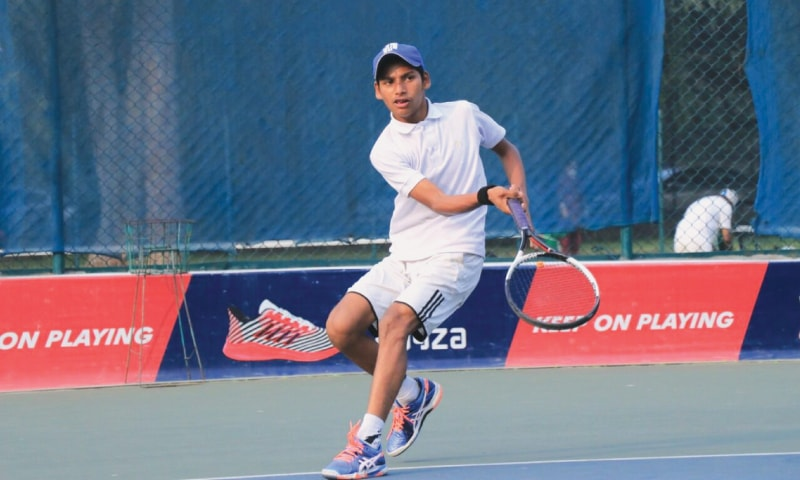
Pakistan’s tennis campaign at the 20th Asian Games Aichi-Nagoya 2026 has ended with a brutally disappointing record. It raises serious questions over the direction of the sport, player development, selection policies and the performance of the Pakistan Tennis Federation (PTF). Pakistan played 10 matches across singles, doubles and mixed doubles during the Asian Games campaign.
The final record tells a stark story: one victory and nine defeats, a 10 percent win rate, only two sets won and 18 sets lost. Even more tellingly, Pakistan failed to win a single set in any of its nine defeats. The country’s only victory came in men’s doubles, where Aqeel Khan and Muhammad Shoaib defeated Mongolia’s Mandakh Davaadash and Sonompuntsag Enkhjargal 6-2, 6-0. The pair then lost in the second round to Chinese Taipei’s Chenjui Ho and Yu-Hsiou Hsu 6-3, 6-2 in only 46 minutes. Every other Pakistani player or pair suffered defeat.
Ushna Suhail lost in the first round to Kazakhstan’s Yuliya Putintseva 6-1, 6-0 in 41 minutes. Mahin Aftab Qureshi was beaten in the first round by Thailand’s Patcharin Cheapchandej 6-1, 6-1 in 53 minutes, while Muzammil Murtaza lost in the first round to Jordan’s Zaid Al-Mashni 6-3, 6-2 in one hour and five minutes. In mixed doubles, Ushna Suhail and Aqeel Khan lost in the first round to Kazakhstan 6-2, 6-1, while Mahin Aftab Qureshi and Aisam-ul-Haq Qureshi went down 6-3, 7-5 in the first round to Kazakhstan.
The men’s doubles combination of Aisam-ul-Haq Qureshi and Muzammil Murtaza subsequently lost in the first round to South Korea 7-5, 6-4 in a match lasting one hour and 50 minutes. Mahin Aftab Qureshi and Ushna Suhail were then beaten in the first round by Mongolia 6-1, 6-0 in 48 minutes. Muhammad Shoaib lost his men’s singles second-round match against Indonesia’s M. Rifqi Fitriadi 6-4, 6-4 in one hour and eight minutes, before teaming up with Aqeel for the second-round defeat to Chinese Taipei 3-6, 2-6.
The statistics are difficult to ignore. Pakistan lost 18 sets in its nine defeats without winning one, while five of those sets were lost 6-1 and another two were lost 6-0. Seven of the 18 sets lost therefore ended with Pakistan winning either one game or none at all. The Asian Games results are particularly concerning when viewed against Pakistan’s recent Davis Cup campaign. Only days before the Asian Games, Pakistan suffered a 3-0 whitewash against Tunisia in the Davis Cup World Group II tie. Muhammad Shoaib lost to Aziz Dougaz 6-2, 6-3 in 55 minutes, Muzammil Murtaza was beaten by Moez Echargui 6-1, 6-1 in 56 minutes, and the doubles pairing of Mohammad Abid Ali Khan Akbar and Murtaza lost 6-3, 6-3. The two reverse singles were not played after Tunisia secured the tie 3-0. Taken together, the Davis Cup and Asian Games results have intensified the debate over whether Pakistan men’s tennis is developing enough young players capable of competing internationally.
At the centre of the debate is the continued presence of veterans Aisam-ul-Haq Qureshi and Aqeel Khan. Both have made enormous contributions to Pakistan, but the question facing Pakistan tennis now is different: how long can the national programme continue relying on the same generation without creating a sufficiently strong replacement?
Aqeel Khan, born in 1980, was 46 during the 2026 Asian Games, while Aisam-ul-Haq Qureshi, also born in 1980, was likewise 46. Aisam had formally announced his retirement from professional tennis in November 2025 at the inaugural ATP Challenger Pakistan, with the PTF describing the occasion as the conclusion of an era. Yet less than a year later, Aisam returned to represent Pakistan at the Asian Games. He told the news media before the Asian Games that he was unfit to play the Davis Cup tie against Tunisia. Yet he surprisingly confirmed soon after that he considered himself fit and would compete in men’s doubles while continuing his responsibilities as PTF president. That decision has inevitably generated questions about the separation between federation leadership and playing responsibilities.
Aisam was elected PTF president in February 2024 for a four-year term by a single controversial vote. The 2026 Asian Games squad announced by the federation included Aisam, Aqeel, Muzammil Murtaza, Muhammad Shoaib, Ushna Suhail and Mahin Aftab Qureshi. The concern is not simply that veterans were selected. The bigger issue is whether every major international opportunity should be used to extend the careers of ageing veteran players or to give younger players meaningful exposure against the best competition available. The situation surrounding the Davis Cup makes that question even more relevant. Aisam did not feature in Pakistan’s 3-0 defeat to Tunisia, stating that he was injured, but he subsequently returned for the Asian Games after saying he was fit to compete. His Asian Games results included a 7-5, 6-4 men’s doubles defeat alongside Muzammil Murtaza against South Korea and a mixed doubles defeat alongside Mahin Aftab Qureshi against Kazakhstan.
Those results do not establish that Aisam was medically unfit, but they do provide legitimate grounds for public discussion about selection, fitness, competitive readiness, age and the role of a federation president who is also an active national-team player. The same debate extends to Aqeel Khan. His longevity and contribution to Pakistan’s Davis Cup history are well documented, but his continued selection at major events inevitably raises the question of whether younger players are receiving enough opportunities to take responsibility at international level.
Pakistan’s women’s tennis results also provide little relief. Ushna Suhail failed to progress in women’s singles, women’s doubles or mixed doubles. According to biographical records, Ushna is a cousin of Aisam-ul-Haq Qureshi, and she was included in Pakistan’s six-player Asian Games tennis contingent. That familial relationship alone does not establish that her selection was improper. However, given her first-round exits in all three events, it is understandable that the selection process and criteria will face scrutiny.
The deeper issue is that Pakistan’s tennis decline cannot simply be blamed on individual players. The responsibility for building a competitive tennis system ultimately extends to the federation. A healthy national programme should continuously produce players capable of replacing its established stars. Young players need regular international tournaments, properly structured training camps, experienced coaching, physical preparation and enough financial support to compete on the ITF circuit. Without that pathway, a country can become dependent on the same small group of players for years without producing a genuine successor generation.
There is also a broader concern about the nature of preparation. Pakistan’s past successful tennis generations were associated with extensive competition, training camps and sustained international exposure. Today, critics increasingly question whether enough of that work is taking place, compared with the emphasis on announcements, photographs and social-media publicity.
The current Asian Games numbers should force an uncomfortable conversation. Ten matches. One win. Nine defeats. Two sets won. Eighteen sets lost. Zero sets won across nine defeats. Five sets lost 6-1. Two sets lost 6-0. That is not merely a bad tournament result. It is a statistical warning sign. And the timing makes it more serious. Pakistan has now experienced a 3-0 Davis Cup defeat against Tunisia, followed immediately by an Asian Games tennis campaign in which it won only one of ten matches.
Also Read: Samad Blitz Takes Pakistan to Asian Games Final Against India
The answer cannot simply be another social-media announcement celebrating participation. Pakistan tennis needs a clear player-development strategy, transparent selection criteria, regular international competition for emerging players and a serious succession plan for the generation that has represented the country for decades. The PTF leadership has repeatedly spoken about developing players and taking Pakistan tennis forward. Aisam himself said, when elected president in 2024, that he wanted to work for the betterment of players, coaches and trainers and take Pakistan tennis to new heights. However, the ground realities are far different from the announcements. And the Asian Games results now provide a measurable test of that ambition. The question is no longer whether Pakistan possesses tennis talent. The more important question is whether its system is giving that talent enough opportunities to develop.
For Pakistan tennis, this should be the point of course correction rather than another round of photo opportunities. The country needs a system that prepares the next generation to take over, not one that repeatedly turns to the previous generation because the next one has not been adequately prepared. The 2026 Asian Games exit should therefore prompt a serious review of selection, preparation, player development, international exposure and governance. Because if the same cycle continues, Pakistan’s biggest problem will not be losing individual matches. It will be losing an entire generation of potential players while waiting for the next veteran to carry the national flag.
The writer is a celebrated tennis champion and Davis Cupper.