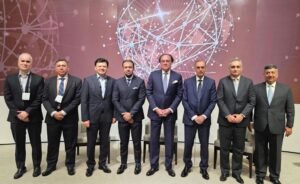
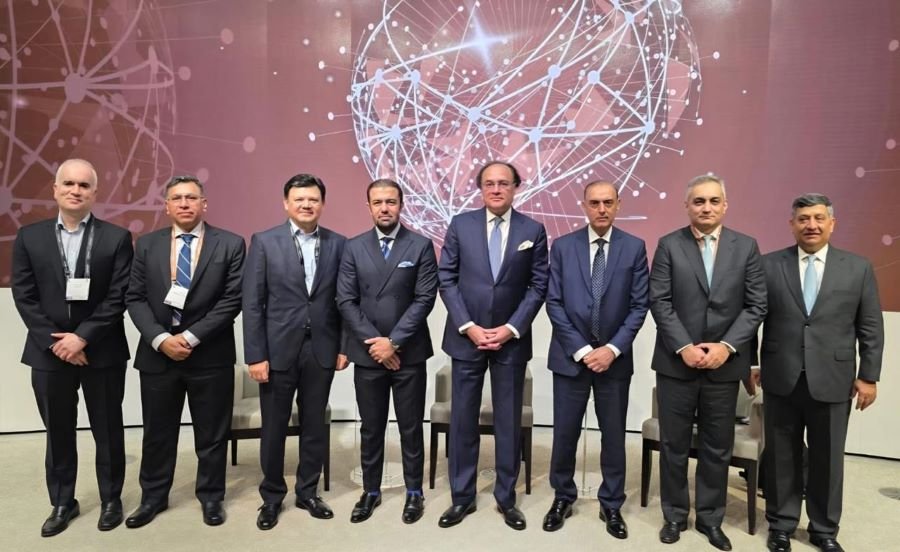
London (GNP): Federal Minister for Finance and Revenue, Senator Muhammad Aurangzeb, addressed the “Fireside Chat: Pakistan: External Shocks Remain Manageable” at the J.P. Morgan Emerging and Frontier Markets Opportunities Conference in London, outlining Pakistan’s progress in restoring macroeconomic stability and the Government’s priorities for moving towards investment, capital formation, exports and private sector led growth.
The conference saw strong interest in Pakistan from leading global institutional investors and top money managers, with 55 global investment funds engaging with the Pakistani delegation through a number of one-on-one meetings and a full investor session. The strong investor interest was accommodated within a day, with discussions focused on Pakistan’s future economic direction, investment opportunities and the sustainability of its ongoing economic transformation. Mr. Amin Khowaja, Chief Executive Officer and Country Head of J.P. Morgan Pakistan, was also present during the meetings.
Setting out the Government’s economic direction, the Finance Minister outlined six key priorities: bringing permanence to macroeconomic stability and strengthening fiscal and external shock-absorbing capacity; moving from stabilisation to sustainable and responsible growth driven by productivity, investment and exports; staying the course on structural reforms; moving from aid to trade and investment; expanding access to finance to enable people and communities; and positioning Pakistan for the new economy, including digitalisation, blockchain and Web 3.0.
Senator Muhammad Aurangzeb said that over the last three years, Pakistan’s overriding task had been to restore macroeconomic stability and rebuild credibility. He noted that significant progress had been made in fiscal consolidation, external sector stability, inflation, debt management and international market access. GDP growth had recovered to 3.7 percent in FY26, while the fiscal deficit had declined to 2.6 percent of GDP, a multi-year low, with the country recording a primary surplus for the third consecutive year.
On the occasion, the Governor State Bank of Pakistan, Mr. Jameel Ahmad, highlighted the strengthening of Pakistan’s external position, noting the improvement in foreign exchange reserves, the quality of reserve accumulation, rising remittance flows and strengthening external-sector fundamentals. He also highlighted the growing contribution of Roshan Digital Account flows, external sector reforms and the strengthening of financial sector fundamentals. He noted the progress made in containing inflation over the years, adding that these developments had contributed to greater macroeconomic stability and strengthened the foundations for sustainable growth and investment.
The Finance Minister said the objective was now to ensure that stability became durable and provided the foundation for a different growth model, one increasingly driven by investment, productivity, exports and private sector activity rather than short term, consumption-led expansion.
Highlighting improvements in Pakistan’s sovereign debt position, the Finance Minister said the Government had pursued active liability management, extended domestic debt maturities and reduced refinancing risks. He said these measures, together with fiscal consolidation, were strengthening the overall sovereign balance sheet and supporting greater confidence in Pakistan’s economic outlook.
Senator Muhammad Aurangzeb said Pakistan had also re-established access to international capital markets through diversified instruments and investor pools. He referred to the inaugural award-winning Panda Bond issuance and Pakistan’s subsequent record US$3 billion dual-tranche Eurobond transaction, noting strong investor demand for both. He emphasised that the objective was not simply to raise financing, but to maintain regular market access, diversify the investor base, extend maturities and progressively improve financing terms.
The Finance Minister highlighted the significant potential for deeper capital formation in Pakistan, saying the Government was working to strengthen equity and corporate debt markets, broaden investor participation, increase IPO activity and improve market infrastructure. He said greater foreign capital participation, along with the development of Islamic finance and Sukuk markets, could further expand the channels available for long term investment.
He also outlined reforms aimed at creating greater space for private capital and reducing the State’s role in commercial activity. Senator Muhammad Aurangzeb said privatisation was being pursued as part of a broader restructuring of the role of the State, with progress across PIA, DISCOs, financial institutions, other SOEs and airport operations. He said the Government was also developing a National Private Equity Framework to mobilise institutional capital into businesses and projects and strengthen the ecosystem for private equity and venture capital.
The Finance Minister said access to finance was also being expanded across SMEs, agriculture and housing so that macroeconomic stability could translate into greater credit, investment and productive activity. He stressed that public balance sheets alone could not finance Pakistan’s next phase of growth and that private capital would increasingly have to play a larger role.
Senator Muhammad Aurangzeb highlighted Pakistan’s large domestic market, young workforce and strategic geographic location, while stressing that the country’s investment proposition was based on the combination of reform and scale. He said reforms in tax administration, tariff rationalisation, energy, SOEs and the financial sector were aimed at improving productivity and shifting the economy towards exports, technology, manufacturing, minerals, agriculture and value-added services.
On external economic engagement, the Finance Minister said Pakistan was moving decisively from traditional dependence on aid towards stronger trade and investment flows. While acknowledging the importance of bilateral partnerships, he emphasised the need to deepen both goods and services trade and attract greater long term investment through mutually beneficial economic relationships.
Also read: Federal, KP Agree to Strengthen Cooperation for Public Welfare
Highlighting the opportunities offered by the New Economy, Senator Muhammad Aurangzeb said Pakistan needed to position itself to benefit from emerging technologies, particularly blockchain and Web 3.0. He said the country’s young workforce and expanding digital ecosystem provided an opportunity to participate more effectively in new areas of the global economy and create new avenues for investment…

Sohail Majeed is a Special Correspondent at The Diplomatic Insight. He has twelve plus years of experience in journalism & reporting. He covers International Affairs, Diplomacy, UN, Sports, Climate Change, Economy, Technology, and Health.