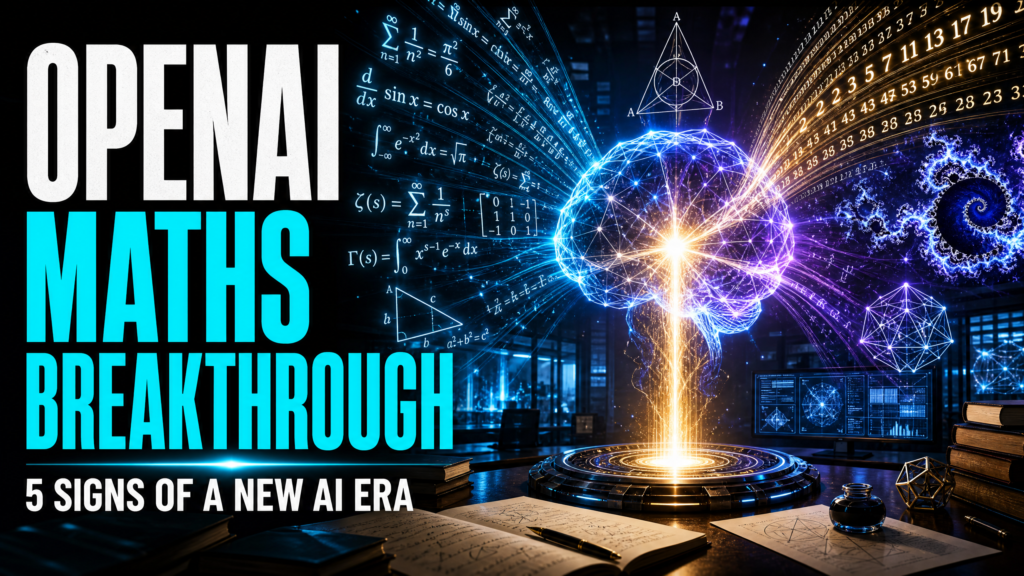
Washington (GNP): OpenAI Maths Breakthrough has created excitement across the scientific and artificial intelligence communities after OpenAI said an advanced AI system had solved a mathematical problem that had challenged researchers for nearly 90 years. The OpenAI Maths Breakthrough involved thousands of AI agents working together and reportedly produced a solution in just 88 hours.
The OpenAI Maths Breakthrough relates to the Navier-Stokes existence and smoothness problem which is one of the seven Millennium Prize Problems known in mathematics. The Navier-Stokes existence and smoothness problem focuses on fluid mechanics and tries to answer the fundamental question whether the equations describing fluid flow can remain mathematically well defined. The OpenAI Maths Breakthrough has drawn attention because of the extraordinary speed at which the AI system reportedly approached this longstanding mathematical challenge.
According to OpenAI’s statement, the company’s inner workings employed around 10,000 AI agents to address the issue at once. In the firm’s words, its AI system turned out to be more powerful than any of the most recent models mentioned in the public domain and was capable of uniting dozens of AI systems autonomously while working on the problem. The fast timing of the OpenAI Maths Breakthrough has caused a stir because such complicated mathematical problems usually take years of human efforts to solve.
The claimed fact may mark the beginning of a brand new stage of artificial intelligence application in scientific research. In fact, the advanced AI systems are already being employed not just to answer questions but also to breed ideas for exploration, work on mathematical hypotheses and help overcome challenging puzzles.The OpenAI Maths Breakthrough could demonstrate how AI systems may increasingly support researchers in solving complex scientific and mathematical questions.
Also Read: https://globalnewspakistan.com/realme-c100-series-launched-with-8000mah-battery/
The Navier-Stokes problem is an important one, as it is among the Millennium Prize Problems posed by the Clay Mathematics Institute. This means that a correct solution to an issue pertaining to one of these problems can lead to a prize of $1 million. Despite this, OpenAI has stated that it does not wish to claim the prize for achieving this result.The significance of the OpenAI Maths Breakthrough extends beyond the potential prize because the problem has remained an important challenge for mathematicians for decades.
Nevertheless, while the OpenAI Maths Breakthrough has attracted attention, questions still pertain to the mathematical proof and the manner in which it was achieved. In this regard, mathematicians such as NYU professor Tristan Buckmaster have expressed concerns regarding similarities that exist between the work of OpenAI and that done with Anthropic researcher Levent Alpöge. However, OpenAI has rejected claims of the use of these specific researches.Independent examination will be important in determining whether the OpenAI Maths Breakthrough represents a complete and valid mathematical solution.
OpenAI has also stated that while it cannot completely discount the chance that information received from its users about how to improve its model may have arrived via indirect means, the reported mathematical solution was developed independently. Thus, the incident is likely to attract a lot of attention from experts in the field.
Another significant point about the OpenAI Maths Breakthrough involves the amount of computing power required to make this project possible. According to some sources, thousands of AI agents were involved simultaneously in this project indicating a development in which specialized AI agents work together on sophisticated problems.The OpenAI Maths Breakthrough therefore highlights the growing importance of coordinated AI agents in advanced research. The idea suggests that the future scientific AI devices will be based on complex interaction of independent agents rather than more powerful separate models.
Nonetheless, the question arises regarding the relationship between mathematicians and artificial intelligence in the future. Artificial intelligence has the ability to analyze a large amount of information very fast, but it should be noted that humans are still needed in order to make sure that the solutions found are mathematically valid. The OpenAI Maths Breakthrough points out the new capabilities of artificial intelligence along with its need for verification.
In case the provided solutions pass thorough mathematic assessment, the OpenAI Maths Breakthrough may be considered the beginning of a new era in the development of AI-driven research. It can prove that artificial intelligence is acting beyond the function of a normal productivity tool and can provide answers to the hardest scientific issues.
OpenAI’s recent achievement in mathematics has fueled discussions about future developments in AI. The powerful AI could provide solutions to issues currently hard to solve through traditional scientific methods in fields of mathematics, physics, medicine, or engineering. Hence, the success could serve as an example of the changing role of AI in scientific discovery.
At the moment, the importance of OpenAI’s accomplishment is based on the need for independent verification of the achievement. If mathematicians confirm the information presented by OpenAI, this will mark a new stage in the development of AI-supported mathematics and scientific endeavors.