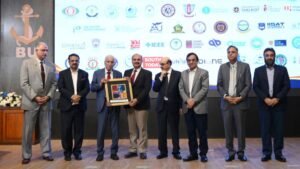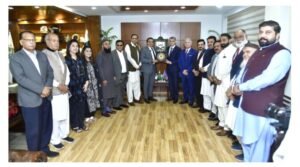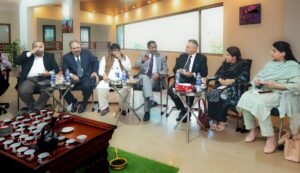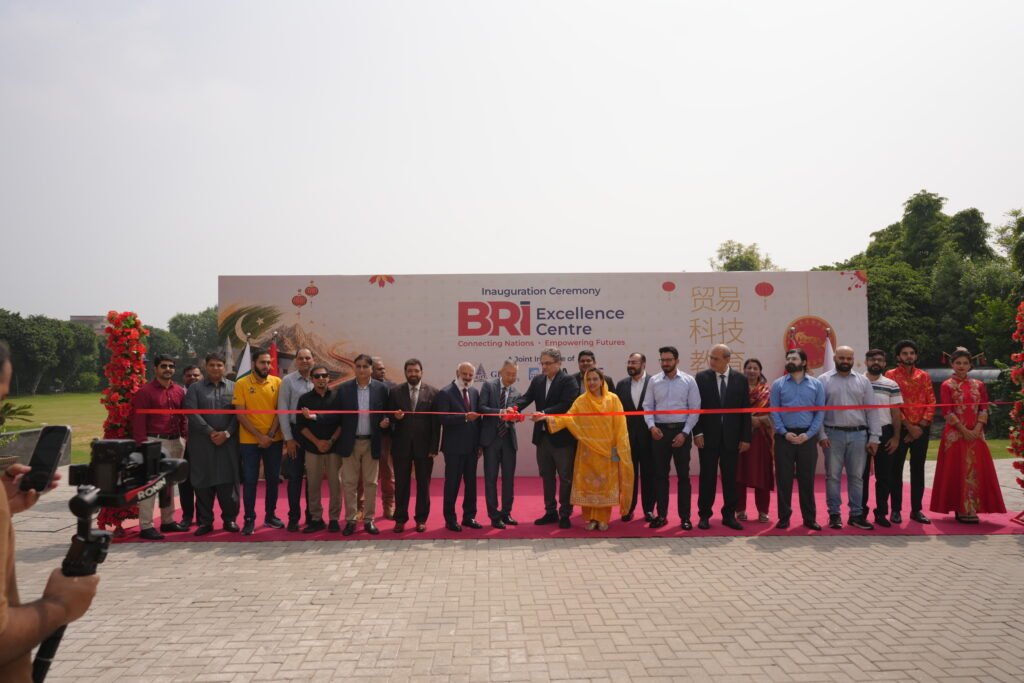
Gujranwala (GNP): Diplomatic Insight Group (DIG), together with GIFT University Gujranwala and the Gujranwala Business Alliance (GBA), inaugurated the BRI Excellence Centre (BEC) at the university campus on Thursday, bringing a structured Belt and Road Initiative (BRI) platform to one of Pakistan’s most export-driven industrial cities.
Sun Yan, Consul General of China in Lahore, attended as chief guest, and was joined by Dr Farhat Asif, Chairperson of Diplomatic Insight Group, Muhammad Anwar Dar, Chairman of GIFT University, and Ahmad Ikram Lone, Founder and Chairman of the Gujranwala Business Alliance.
The Centre is designed to move BRI cooperation from national-level policy into local, commercial and technical outcomes, a shift that carries particular weight this year.
The inauguration falls within the 75th year of diplomatic relations between Pakistan and China, and follows the January 2026 agreement to launch an upgraded China-Pakistan Economic Corridor (CPEC) 2.0, which prioritizes industry, agriculture and mining, sectors that anchor Gujranwala’s economy. Set against that backdrop, the BEC gives the anniversary a working institution rather than a ceremonial marker alone.
Speaking at the ceremony, the Consul General described the timing of the Centre as fitting given the 75-year milestone in bilateral ties, adding that it would strengthen academic and industry exchange between the two countries. Sun Yan said, “This Centre will bring both countries closer together in academic as well as industry exchanges.”
That academic-industry mandate is reflected in how the Centre is structured. The BEC operates six working domains under one roof: a BRI Trade and Investment Centre, a Chinese Language and Cultural Centre, an Artificial Intelligence (AI) and Digital Innovation Centre, an Electric Vehicle (EV) and Green Technology Centre, a BRI Research and Policy Institute, and an Entrepreneurship and Startup Centre. Taken together, the six domains are meant to give Gujranwala’s businesses, students, researchers and startups a single point of access to Chinese markets, language training, policy research and investment linkages.
Dr Farhat Asif framed the Centre’s purpose in those same terms, describing it as a platform for Pakistani businesses to explore Chinese partnerships, for students to learn Mandarin, for researchers to work on CPEC and trade policy, for startups to connect with technology and investment, and for Chinese institutions to find credible partners in Pakistan’s industrial heartland. Dr Farhat Asif said, “We want this Centre to become a platform where Pakistani businesses can explore Chinese markets and partnerships.”
Muhammad Anwar Dar welcomed DIG’s role in helping realize the university’s broader goal of preparing students to build their own businesses rather than pursue education alone, noting that the Centre would help students internationalize their entrepreneurial ambitions and open new avenues for growth.
The choice of Gujranwala as host city reflects the city’s existing manufacturing weight. Gujranwala accounts for roughly 40 percent of Pakistan’s national surgical instrument exports and 30 percent of its cutlery exports, and its 2.3 million residents sit inside the Lahore-Gujranwala-Sialkot industrial triangle, directly along the CPEC route. Despite that position, the city had lacked a structured Chinese institutional presence until this inauguration.
Also Read: Uzbekistan Positions Islamic Heritage as Bridge for Global Cooperation
Ahmad Ikram Lone described the launch as the start of a new phase of cooperation between Pakistan and China rather than a single event, calling the Centre a first-of-its-kind initiative for the region built around trade, technology, education and culture. Ahmad Ikram Lone said, “Today we are opening a new chapter of cooperation and shared opportunity between Pakistan and China.”
The Centre’s inaugural-year calendar is intended to put that cooperation into motion quickly. Planned activities include an Annual Pakistan-China Youth Dialogue Forum, a business-to-business matchmaking summit linking GBA member firms with Chinese enterprises across textiles, surgical instruments, ceramics and manufacturing, an AI and robotics showcase, an EV and green technology demonstration day, a startup pitch day, a student exchange cohort, and a flagship research report marking 75 years of Pakistan-China cooperation across Punjab’s industrial corridor.
The launch builds on DIG’s longer-running engagement with the Belt and Road Initiative, which dates back to 2009. Through its Institute of Peace and Diplomatic Studies, DIG established Pakistan’s first Centre for BRI and China Studies in Islamabad in 2018, a precedent the Gujranwala centre now extends into the country’s industrial belt.

Managing Editor at Global News Pakistan (GNP), with a Bachelor's degree in International Relations from Riphah International University, graduated with a Gold Medal. Reach out at sabahtareengnp@gmail.com