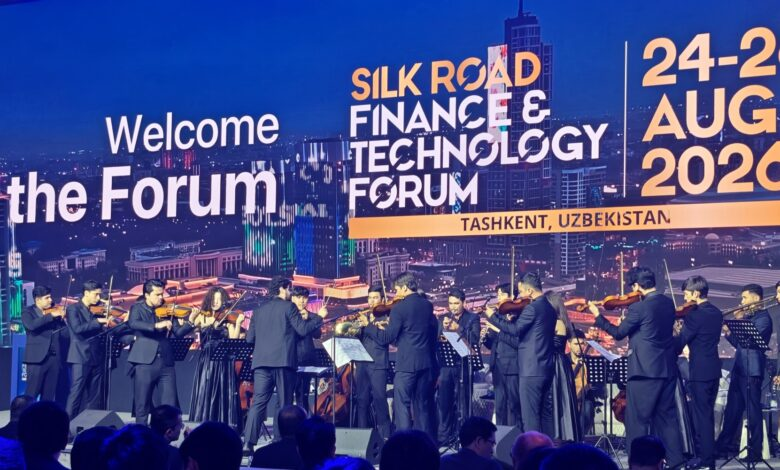
For centuries, the Silk Road moved goods between East and West. This week in Tashkent, Uzbekistan tried something more ambitious: reviving that route for the digital economy, this time carrying capital, technology and data instead of silk and spices. The inaugural Silk Road Finance and Technology Forum 2026 brought together more than 6,000 participants from 74 countries, nearly 200 speakers, and over 25 investors representing four billion dollars in assets under management, making the case that Central Asia’s largest economy is ready to be a financial gateway rather than just a transit point.
A Name Rooted in Reunification
The forum’s organizers, the Central Bank of the Republic of Uzbekistan and Singapore-based Global Finance and Technology Network, co-hosted the event with Ant International at the Central Asian Expo on Monday and Tuesday. Its conceptual framing borrows from the term Al-Jabr, meaning the reunification of parts into a whole, the same Arabic root that gave the world the word algebra. It’s a fitting metaphor for what the forum is attempting: pulling together fragmented regional financial systems into something more connected. The program runs across five pillars, open banking, digital assets and stablecoins, cross-border payments, Islamic finance, and innovation and investment, before shifting to the Islamic Civilization Centre on Wednesday for a dedicated segment called The Azimuth, focused on Islamic finance and entrepreneurship.
The Economic Case Behind the Ambition
Uzbekistan didn’t arrive at this forum empty-handed. The country’s GDP grew 8.5 percent in the first half of 2026, foreign investment hit 8.3 billion dollars in the first quarter alone, and Moody’s upgraded its sovereign credit rating to Ba2 in June. Behind those numbers sits a deliberate policy push: Presidential Decree PQ-359 and the National FinTech Strategy are steering the country toward one billion dollars in fintech investment by 2030, while digital payment adoption has jumped from 39 percent in 2021 to 71 percent in 2025. Opening the forum, Deputy Prime Minister and Minister of Economy and Finance Jamshid Kuchkarov pointed to a decade of reform that has tripled the size of the economy, and laid out what comes next: an investment-grade credit rating, completed WTO accession, and a continued rollback of the state’s role in the economy.
Betting on Islamic Finance as a Connector
Perhaps the most consequential piece of the puzzle is Uzbekistan’s new Islamic banking law, in effect since June 2026. It’s the country’s first legal framework for Shariah-compliant banking, and it opens a door into a global Islamic finance market worth nearly six trillion dollars. That’s not a small side bet, it signals Tashkent wants to be more than a Central Asian hub. The goal is to become a connective corridor linking post-Soviet economies with Islamic finance markets across the Gulf, Türkiye, South Asia and Southeast Asia.
Also Read: Tashkent Opens International Media Forum On Islamic Civilization
Riding a Global Fintech Wave
Uzbekistan’s timing lines up with a broader boom. Global fintech revenues reached 504 billion dollars in 2025, growing 22 percent, more than four times faster than traditional financial institutions, according to the 2026 Global Fintech Report by BCG and FT Partners. The same report found 74 percent of the largest public fintech companies were already profitable. Sopnendu Mohanty, Group CEO of the Global Finance and Technology Network, summed up where Uzbekistan stands in that landscape: strong political will, bold regulatory reform, and rising digital adoption, with the next step being to convert those foundations into real investment and financial corridors linking Central Asia to global markets.
A Modern Silk Road, Built on Data Instead of Silk
The framing running through the entire forum is a reimagining of the historic trade route, from moving goods to moving money, capital and data between Central Asia and markets in the Middle East, China, South Asia and Southeast Asia. Closing out the event, Central Bank Governor Ishmetov left investors with a direct pitch about where that ambition currently stands. Governor Ishmetov said, “Uzbekistan is open to investment, technology, expertise, and long-term partnership.”

Managing Editor at Global News Pakistan (GNP), with a Bachelor's degree in International Relations from Riphah International University, graduated with a Gold Medal. Reach out at sabahtareengnp@gmail.com