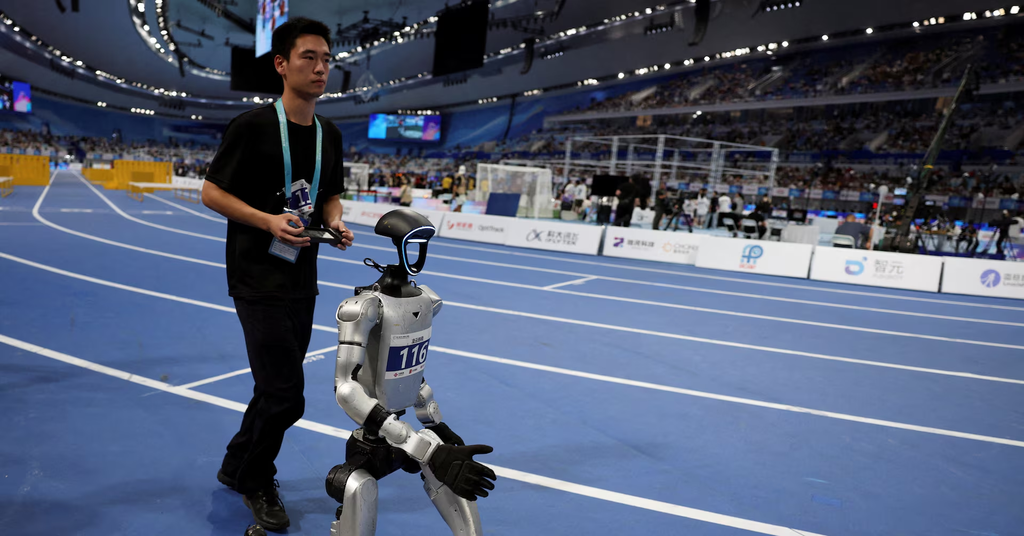
Hong Kong (GNP): Shares in Unitree, China’s best-known humanoid robot maker, have fallen roughly 45 percent since peaking on their Shanghai debut last Wednesday, triggering fresh concerns over bubble risk in the country’s booming robotics sector.
The stock had surged more than fivefold on listing day, briefly pushing the company’s valuation to 66 billion dollars before a three-day slide wiped out around 30 billion dollars in value. Shares steadied on Tuesday after the sharp reversal, but the swing has already prompted broader questions about whether investor enthusiasm for artificial intelligence and robotics has outrun the underlying business fundamentals.
The selloff has drawn attention to structural issues in China’s listing mechanism, which several analysts say distorts pricing at debut. Unitree’s shares finished up 460 percent on their first trading day, well above the average 226 percent first-day gain recorded by newly listed Chinese stocks over the past three years.
Analysts pointed to the company’s fast-tracked listing on Shanghai’s tech-focused STAR Market, reserved for firms in China’s national strategic industries, as a signal of perceived government backing that helped fuel demand.
The rally came even as Unitree’s own financial results showed strain, with adjusted net profit falling 53 percent to 40 million yuan in the first quarter of 2026, despite the company’s robots drawing wide attention for feats such as running, dancing and martial arts demonstrations.
Market participants say the mismatch between Unitree’s debut pricing and its underlying commercial performance reflects broader weaknesses in how Chinese IPOs are priced and traded. With short-selling restricted and regulators closely vetting both listing approval and IPO pricing, bankers have limited room to adjust to surging demand, a dynamic some argue allows early shareholders to cash out at inflated prices while later retail buyers absorb the losses.
Also Read: Tesla Recalls Nearly Three Million Vehicles in China Over Hidden Door Handles
Comparable dynamics were seen last month when shares of memory chipmaker CXMT surged 466 percent on their own Shanghai debut, part of a broader pattern in a market where only 21 companies went public in Shanghai during the first seven months of the year, compared with 104 in Hong Kong.
Not all market watchers view the volatility as purely negative, with some fund managers urging a longer-term perspective given the sector’s heavy research spending and still-developing commercial applications, drawing comparisons to the early growth phase of China’s electric vehicle industry.
Others argue the pattern points to a deeper flaw in how new listings are priced and traded in China, one that has repeatedly left smaller investors exposed once early gains reverse.
Unitree’s debut had been expected to set the tone for a wave of domestic robotics rivals preparing their own listings, meaning the outcome of its post-listing volatility is likely to shape investor appetite and regulatory scrutiny for the companies that follow.
Abraham Zhang said, “The capital drama seen in the Unitree listing is not the first in China, and will not be the last.”