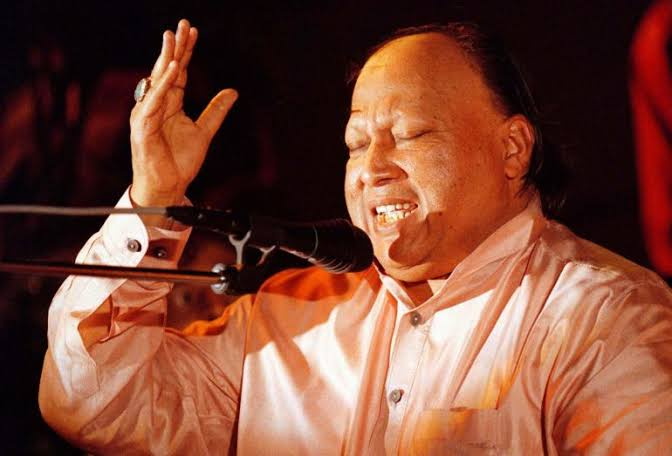
Islamabad (GNP): Fans and artists across the world paid tribute on Sunday to Pakistan’s legendary qawwal Ustad Nusrat Fateh Ali Khan, marking 29 years since his passing with tributes spanning South Asian shrines, concert halls in New York, film studios in Mumbai, and universities in Washington.
Nusrat Fateh Ali Khan was widely regarded as Pakistan’s greatest musical export, a qawwali maestro whose influence extended well beyond cultural, linguistic and religious boundaries. His international breakthrough came through his contribution to the 1995 Hollywood film Dead Man Walking, which introduced his voice to American audiences largely unfamiliar with South Asian devotional music.
He later composed music for Martin Scorsese’s The Last Temptation of Christ, collaborated with musician Peter Gabriel, and performed at prominent venues including the Brooklyn Academy of Music in New York. His academic standing was further recognised when the University of Washington invited him to teach music, an honour rarely extended to a Pakistani artist and one that reflected the depth of his musical scholarship.
While Western audiences came to know him as a pioneer of world music, the subcontinent embraced him as one of its own. Bollywood celebrities, music directors and playback singers shared tributes on social media on Sunday, reflecting on compositions that remain central to some of Indian cinema’s most memorable moments.
His work featured in films including Aur Pyaar Ho Gaya, Kachche Dhaage, Kartoos and Bandit Queen, while Dulhe Ka Sehra from the film Dhadkan continues to be regarded as one of the most popular wedding songs in Indian cinema. Music directors across the region have long acknowledged his influence in fusing Eastern classical traditions with modern Western sound, a style that continues to shape contemporary artists across genres.
Born on October 13, 1948, in Faisalabad, Nusrat came from a distinguished family of qawwals that had migrated from Jalandhar in eastern Punjab to Faisalabad at the time of Pakistan’s creation. His father, Fateh Ali Khan, and his uncle, Mubarak Ali Khan, were both celebrated qawwals in their own right. At the age of 16, Nusrat committed himself to the Sufi tradition of qawwali, and his combination of vocal range, command of classical ragas and improvisational skill set him apart from his contemporaries.
Over the course of his career, Nusrat released 125 audio albums as a qawwal, a volume of work that earned him recognition in the Guinness World Records. His repertoire spanned qawwali, ghazal, and classical and semi-classical forms, performed with equal command in Urdu, Punjabi and Persian.
Among his most celebrated works are Dum Mast Qalandar Mast Mast, Ali Maula Ali, Yeh Jo Halka Halka Suroor Hai, Allah Hoo Allah Hoo and Mera Piya Ghar Aaya, alongside his patriotic composition Mera Paigham Pakistan, which remains a lasting symbol of national pride. Tracks such as San Charkhe Di Mithhi Mithhi Kook and Saanson Ki Mala further broadened the genre’s audience, drawing in listeners who had previously shown little interest in qawwali.
Also Read: Actress Hayden Panettiere, Star of Heroes and Nashville, Dies at 36
Tributes on Sunday came from fans across Pakistan, India, Bangladesh, the United States, the United Kingdom, Canada, Australia and the Middle East, many of whom shared memories of his performances and the impact his music had on their lives. Musicians spanning classical, pop, rock and electronic genres acknowledged his influence, while international music publications and radio stations dedicated coverage and programming to his legacy.
During his lifetime, Nusrat received numerous national and international honours, including Pakistan’s Pride of Performance award, one of the country’s highest civilian recognitions. His work brought recognition to Pakistan in places where the country was otherwise little known, positioning him as both a musical icon and a cultural ambassador.
He died in London on August 16, 1997, but his influence has continued through the qawwals who follow his style, the fans who continue to listen to his recordings, and the film soundtracks that still draw on his compositions.
Nearly three decades after his death, Nusrat Fateh Ali Khan’s voice remains a benchmark for aspiring qawwals and classical vocalists alike. Music scholars and enthusiasts continue to study his tonal technique and improvisational style, underscoring a legacy that has endured well beyond his lifetime and continues to resonate with new generations of listeners around the world.