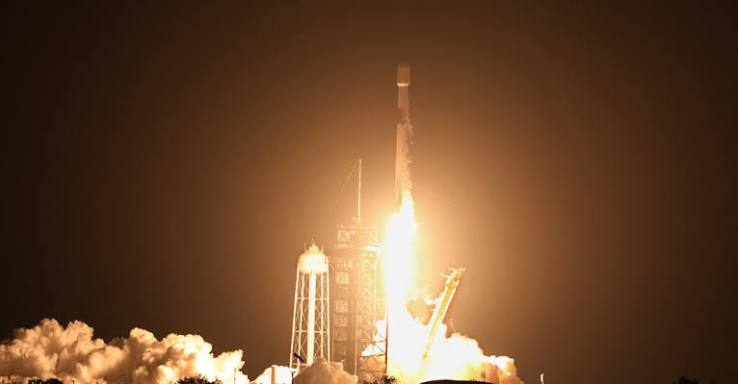
WASHINGTON (GNP): A four-tonne section of a discarded SpaceX Falcon 9 rocket, which had been drifting through space since early last year, is believed to have collided unintentionally with the lunar surface, an impact expected to carve out a new crater but pose no threat to Earth. The object, roughly the size of a building, is the remnant of the rocket that launched Firefly Aerospace’s lunar lander toward the moon in January 2025.
The rocket body was projected to strike the moon at approximately 6:35am BST at a speed of 5,400 miles per hour, an impact forecast to send a plume of lunar dust miles into the sky. Although the plume would be lit by sunlight, officials said it would be difficult to observe from Earth with the naked eye, and professional and amateur astronomers monitoring the event with telescopes were unable to immediately confirm the collision on Wednesday, a gap attributed to the impact site’s proximity to the moon’s visible edge.
NASA has estimated the impact would leave behind a crater roughly 60 feet wide and 12 feet deep, throwing rock and dust outward as debris. The agency said it intends to search for opportunities to photograph the site both before and after the impact, with any resulting data expected to improve scientific understanding of artificial impacts and their implications for future lunar exploration. NASA spokesperson Jimi Russell said the event poses no danger to Earth and that agency scientists plan to use it to refine techniques for tracking objects in space.
The circumstances that left the rocket stage adrift trace back to the nature of its original mission. Rocket stages typically fall back through Earth’s atmosphere and burn up, or land in the ocean, once they have delivered their payload to a precise orbital position. However, because the January 2025 lunar lander mission demanded more thrust than missions confined closer to Earth, the rocket’s second stage remained in space after depleting its fuel, drifting uncontrolled among the thousands of other pieces of debris that active satellites must navigate around.
It was only this year that astronomers identified the stage’s trajectory as one that would ultimately end in a lunar collision. Julianna Scheiman, SpaceX’s director of NASA science and Dragon programs, told reporters that a combination of solar activity and gravitational forces had placed the object on its path toward the moon. Bill Gray, developer of astronomy software who published an analysis of the stage’s trajectory in April, said the event may hold modest scientific value while also underscoring carelessness in how leftover space hardware is managed, though he stressed it presents no danger to anyone.
Also Read: China Guizhou Music Festival Highlights Cultural Tourism Innovation
Such impacts remain uncommon. A Chinese rocket stage struck the moon in March 2022 following a lunar test mission, while NASA itself deliberately crashed a rocket stage into the lunar surface in 2009 to study the resulting debris plume for research purposes. Unintended lunar impacts have also occurred during failed landing attempts in recent years, including Russia’s nuclear-powered Luna-25 mission in 2023 and India’s Chandrayaan-2 lander in 2019. Israel’s Beresheet lander crashed in 2019 as well, and among its payload were tardigrades, microscopic organisms known for surviving extreme radiation and harsh conditions, which may remain on the lunar surface.
Scheiman said NASA and SpaceX are in discussions over methods to prevent similar unintended lunar impacts in the future. The development comes as SpaceX reported a narrower-than-expected loss and a jump in revenue in its first quarterly earnings report since going public, though its shares fell as investors remained cautious about the company’s ability to meet its ambitious targets.