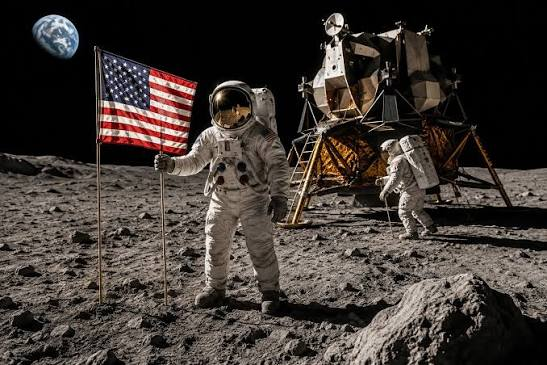
WASHINGTON (GNP): Apollo 11 continues to inspire millions worldwide as scientists, historians, educators, and space enthusiasts commemorate the anniversary of humanity’s first successful Moon landing. The mission remains one of the greatest achievements in modern history, symbolizing scientific innovation, international inspiration, and humanity’s determination to explore beyond Earth.
Apollo 11 was launched by the United States’ National Aeronautics and Space Administration (NASA) on July 16, 1969, carrying astronauts Neil Armstrong, Buzz Aldrin, and Michael Collins aboard the Saturn V rocket. Four days later, on July 20, Armstrong and Aldrin landed the Lunar Module Eagle on the Moon while Collins remained in lunar orbit aboard the Command Module Columbia.
Neil Armstrong became the first human to step onto the lunar surface, delivering the historic words, “That’s one small step for man, one giant leap for mankind.” His statement has become one of the most recognized quotes in history, symbolizing the beginning of a new era in human exploration and scientific discovery.
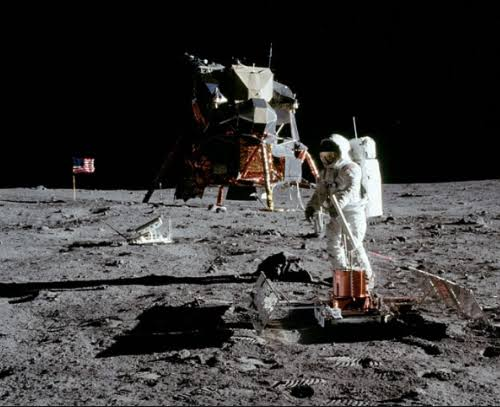
The Apollo 11 crew spent more than two hours conducting experiments, collecting lunar rocks and soil samples, deploying scientific instruments, and capturing photographs of the Moon’s surface. The valuable scientific data returned from the mission significantly expanded global understanding of the Moon’s geological history and contributed to decades of space research.
The mission demonstrated extraordinary engineering capabilities and showcased the technological advancements achieved during the space race. Thousands of scientists, engineers, technicians, and support personnel contributed to Apollo 11, making it one of the most complex scientific projects ever undertaken.
More than five decades later, Apollo 11 continues to influence modern space exploration. NASA’s Artemis program, along with lunar initiatives by other space agencies and commercial companies, builds upon the technological foundation established by the historic mission. The experience gained during Apollo missions continues to guide preparations for long-term lunar exploration and eventual human missions to Mars.
The anniversary has also prompted educational institutions, museums, and space organizations worldwide to organize exhibitions, public lectures, documentaries, and outreach activities celebrating the achievements of Apollo 11. These events encourage younger generations to pursue careers in science, technology, engineering, and mathematics (STEM).
Also Read: Pakistan, Kuwait Explore Expanded Defense Pact Amid Regional Tensions
Apollo 11 remains more than a historic milestone; it represents humanity’s ability to achieve extraordinary goals through international scientific cooperation, innovation, and long-term investment in research. The mission transformed global perceptions of what was technologically possible and accelerated advancements in computing, telecommunications, aerospace engineering, and materials science.
Today, as governments and private companies prepare for sustained lunar exploration, the lessons of Apollo 11 continue to shape future space policies and exploration strategies. The mission also serves as a reminder that ambitious scientific endeavors can unite people across national boundaries in pursuit of shared knowledge and peaceful exploration.